
Processo de remoção do revestimento
O processo de remoção do revestimento refere-se à remoção controlada de Revestimento conformacional de uma PCB para permitir inspeção, reparo, modificação ou retrabalho. É uma operação essencial em Montagem de PCB e Montagem SMT, A empresa deve ter um controle de qualidade, especialmente quando os defeitos precisam ser corrigidos ou os componentes precisam ser substituídos.
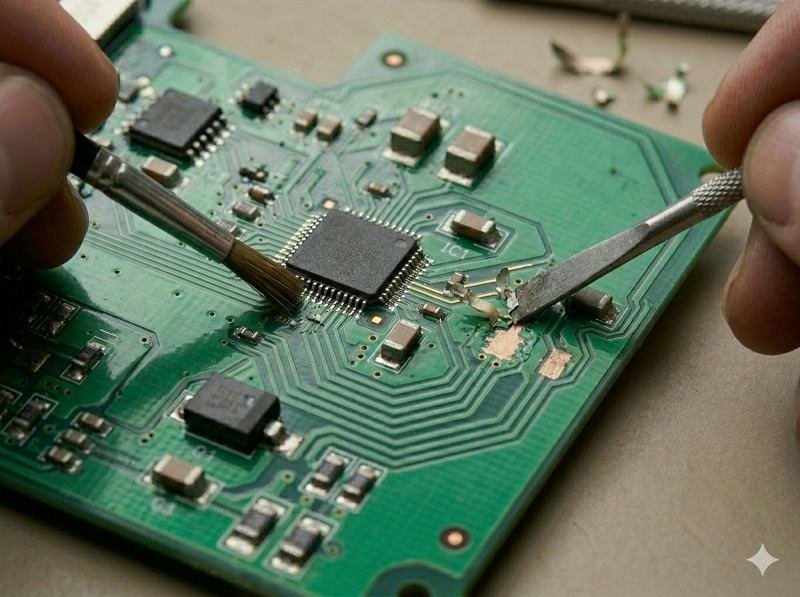
Por que a remoção do revestimento é necessária
Em Montagem de PCB pronta para uso, A remoção do revestimento é normalmente necessária para:
- Reparo ou substituição de componentes defeituosos
- Correção de defeitos de revestimento (bolhas, rachaduras, delaminação)
- Remoção de contaminação presa sob o revestimento
- Implementação de mudanças no projeto ou na engenharia
- Realização de inspeções ou testes detalhados
Sem a remoção adequada, o acesso aos circuitos da placa de circuito impresso seria difícil e arriscado.
Tipos de revestimentos isolantes e dificuldade de remoção
Revestimentos diferentes exigem métodos de remoção diferentes:
- Revestimentos acrílicos → mais fácil de remover
- Revestimentos de silicone → flexível, dificuldade moderada
- Revestimentos de uretano → mais resistente a produtos químicos
- Revestimentos epóxi → muito duro, difícil de remover
- Revestimentos de parileno → requerem técnicas especializadas
Entender o tipo de revestimento é essencial para Montagem de PCB antes de iniciar a remoção.
Métodos comuns de remoção de revestimento
Remoção de solventes
- Usa solventes químicos para dissolver o revestimento
- Mais eficaz para revestimentos acrílicos
- Simples e amplamente utilizado em Montagem SMT retrabalho
Remoção mecânica
- Envolve raspagem, escovação ou microabrasão
- Adequado para remoção localizada
- Requer precisão para evitar danos à placa de circuito impresso
Decapagem química
- Usa produtos químicos mais fortes para revestimentos resistentes (uretano, epóxi)
- Eficaz, mas deve ser cuidadosamente controlado
- Requer medidas de segurança adequadas
Remoção térmica
- Aplica calor para amolecer o revestimento
- Facilita a remoção mecânica
- Deve-se evitar o superaquecimento de componentes sensíveis
Remoção a plasma ou a laser (avançada)
- Usado para placas complexas ou de alta precisão
- Ideal para remoção seletiva em ambientes de alto padrão Montagem de PCB pronta para uso
Etapas do processo de remoção do revestimento
- Identificar o tipo de revestimento
- Selecione o método de remoção apropriado
- Proteja os componentes ao redor (mascarando, se necessário)
- Remover o revestimento da área-alvo
- Limpe os resíduos completamente
- Inspecione a placa de circuito impresso quanto a danos ou revestimento remanescente
Cada etapa deve ser cuidadosamente controlada para manter a integridade da placa.
Desafios na remoção de revestimentos
- Risco de danificar componentes ou traços de PCB
- Resíduos deixados para trás que afetam o novo revestimento
- Demorado para revestimentos duros
- Preocupações com a segurança no uso de produtos químicos
Esses desafios destacam a importância do controle adequado do processo em Montagem de PCB.
Práticas recomendadas
- Use revestimentos que permitam retrabalho mais fácil quando possível
- Limitar a remoção apenas às áreas necessárias
- Use ferramentas adequadas e técnicos treinados
- Seguir as diretrizes de segurança e ambientais
- Assegurar a limpeza completa antes de aplicar o novo revestimento
Conclusão
O processo de remoção do revestimento é uma parte essencial do retrabalho em Montagem de PCB, Montagem SMT, e Montagem de PCB pronta para uso. Selecionando o método correto e seguindo procedimentos controlados, os fabricantes podem remover com segurança Revestimento conformacional, realizar reparos e restaurar a funcionalidade da PCB sem comprometer a confiabilidade.
Obter uma cotação de revestimento isolante
Trabalhando com eletrônicos automotivos, industriais ou externos? Podemos ajudar com o revestimento isolante.
Envie-nos seus requisitos e receba uma resposta rápida de nossa equipe de engenharia.
Resposta 24 horas ✔ Suporte de engenharia ✔ Produção pequena e em massa
Shenzhen Tengxinjie Electronics Co., Ltd.

 Português do Brasil
  English
  Deutsch
  Français
  Español
  日本語
日本語  Nederlands
  Italiano
  Русский
  한국어
한국어  العربية
  Svenska
  Polski
  Türkçe
  繁體中文
繁體中文