
Verschil tussen HumiSeal 1B31 en 1A33
HumiSeal 1B31 en 1A33 zijn twee veelgebruikte Conforme coating materialen in PCB-assemblage, Prototype PCB-assemblage, en SMT-assemblage, maar ze verschillen aanzienlijk in Type chemische stof, prestaties en toepassingsscenario's.
Inzicht in deze verschillen helpt fabrikanten de juiste coating te kiezen op basis van milieu, kosten en betrouwbaarheid.
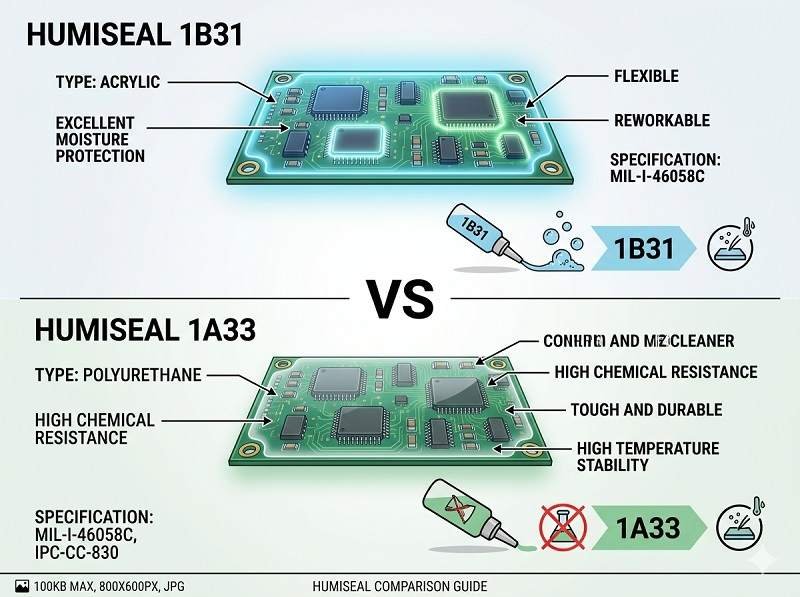
Belangrijkste verschil: materiaalsoort
Het meest fundamentele verschil is de coating chemie:
- HumiSeal 1B31 → Acrylcoating
- HumiSeal 1A33 → Polyurethaan (urethaan) coating
Acryl- en polyurethaancoatings hebben zeer verschillende eigenschappen op het gebied van droging, duurzaamheid en weerstand.
Droog- en verwerkingssnelheid
HumiSeal 1B31 staat bekend om zijn snelle droging en eenvoudige verwerking, waardoor het ideaal is voor hogesnelheidsproductielijnen in SMT-assemblage. Het kan in ongeveer 10 minuten kleefvrij worden en bereikt snel bruikbare eigenschappen.
HumiSeal 1A33 daarentegen vereist meestal langere uithardingstijd om volledige prestaties te bereiken, vooral bij kamertemperatuur
Dit betekent:
- 1B31 → beter voor snelle doorlooptijd en hoge verwerkingscapaciteit
- 1A33 → beter voor prestatie boven snelheid
Chemische weerstand en weerstand tegen het milieu
HumiSeal 1A33 biedt veel sterkere chemische weerstand en duurzaamheid in vergelijking met 1B31. Polyurethaan coatings zijn specifiek bekend om hun weerstand tegen oplosmiddelen, slijtage en ruwe omgevingen.
HumiSeal 1B31 biedt een goede vochtbescherming, maar is minder goed bestand tegen agressieve chemicaliën.
Dus:
- 1B31 → algemene bescherming (vochtigheid, stof)
- 1A33 → ruwe omgevingen (chemicaliën, industriële blootstelling)
Herwerken en repareren
Dit is een van de grootste praktische verschillen in PCB-assemblage:
- 1B31 (acryl) → zeer gemakkelijk te verwijderen en opnieuw te bewerken met oplosmiddelen
- 1A33 (urethaan) → moeilijk te verwijderen door hoge chemische weerstand
Voor Prototype PCB-assemblage, 1B31 heeft meestal de voorkeur omdat technici vaak printplaten moeten aanpassen of repareren.
Flexibiliteit en mechanische prestaties
Beide coatings bieden flexibiliteit, maar hun gedrag verschilt:
- 1B31 → flexibel en geschikt voor algemene toepassingen
- 1A33 → duurzamer en beter bestand tegen mechanische belasting, slijtage en langdurige slijtage
Typische toepassingen
HumiSeal 1B31 wordt vaak gebruikt in:
- Consumentenelektronica
- LED-stuurprogramma's en voedingen
- Algemeen SMT-assemblage productie
- Prototype PCB-assemblage (vanwege eenvoudig herwerken)
HumiSeal 1A33 wordt vaak gebruikt in:
- Industriële elektronica
- Automobielsystemen
- Ruimtevaart- en defensietoepassingen
- Ruwe omgevingen die chemische weerstand vereisen
Kosten en productie
- 1B31 → lagere kosten + snellere verwerking
- 1A33 → hogere kosten + betere bescherming op lange termijn
Voor grootschalige PCB-assemblage, hangt de keuze vaak af van de vraag of snelheid of duurzaamheid is de prioriteit.
Samenvattende vergelijking
| Functie | HumiSeal 1B31 | HumiSeal 1A33 |
|---|---|---|
| Scheikunde | Acryl | Polyurethaan |
| Droogsnelheid | Zeer snel | Langzamer |
| Herwerkbaarheid | Gemakkelijk | Moeilijk |
| Chemische weerstand | Matig | Hoog |
| Kosten | Onder | Hoger |
| Geschikt voor | Algemene elektronica | Ruwe omgevingen |
Definitief inzicht
De keuze tussen HumiSeal 1B31 en 1A33 hangt af van je toepassing:
- Kies 1B31 voor snel, kosteneffectief en rework-vriendelijk coating in PCB-assemblage en SMT-assemblage
- Kies 1A33 voor maximale duurzaamheid en chemische weerstand in veeleisende omgevingen
In de praktijk gebruiken veel fabrikanten 1B31 voor standaardproducten en 1A33 voor zeer betrouwbare of industriële toepassingen, vooral na validatie in Prototype PCB-assemblage.
Vraag een offerte aan voor conforme coating
Snelle doorlooptijd nodig voor conformal coating projecten? Dien vandaag nog uw aanvraag in.
Stuur ons je vereisten en krijg snel antwoord van ons engineeringteam.
✔ 24-uurs respons ✔ Engineering-ondersteuning ✔ Kleine & massaproductie
Shenzhen Tengxinjie Electronics Co, Ltd.
 Nederlands
  English
  Deutsch
  Français
  Português do Brasil
  Español
  日本語
日本語  Italiano
  Русский
  한국어
한국어  العربية
  Svenska
  Polski
  Türkçe
  繁體中文
繁體中文