
Is RoHS compliance
RoHS compliance refers to meeting the requirements of the Restriction of Hazardous Substances directive, a regulation that limits the use of specific hazardous materials in electronic and electrical products. It is a fundamental requirement in modern PCB-assemblage, ensuring that products are environmentally safe and legally compliant—especially for markets like the European Union.
For companies involved in Prototype PCB-assemblage, SMT-assemblage, and full-scale PCB Productie, understanding RoHS compliance is essential for both product design and production.
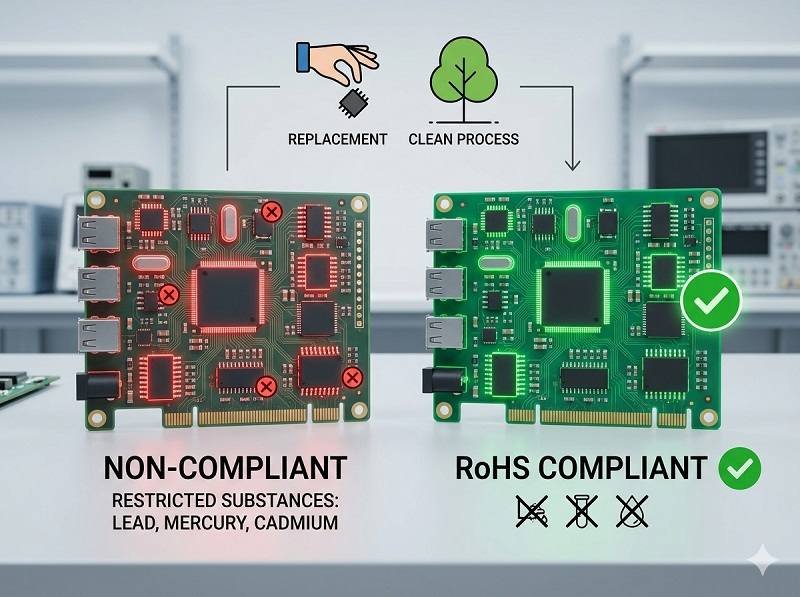
What does RoHS restrict?
RoHS restricts the use of several hazardous substances commonly found in electronics, including:
- Lead (Pb)
- Mercury (Hg)
- Cadmium (Cd)
- Hexavalent chromium (Cr6+)
- Polybrominated biphenyls (PBB)
- Polybrominated diphenyl ethers (PBDE)
Later updates (RoHS 3) also added four phthalates (DEHP, BBP, DBP, DIBP), further tightening environmental requirements.
These substances must be kept below specific threshold levels in all components used in PCB-assemblage.
Why RoHS compliance matters
RoHS compliance is important for several reasons:
- Legal requirement in many global markets
- Environmental protection by reducing toxic waste
- Improved product safety for users
- Market access, especially in Europe
Without RoHS compliance, products may be restricted from sale or face regulatory penalties.
How RoHS affects PCB Assembly
RoHS compliance directly impacts how electronics are designed and manufactured.
Lead-free soldering
Traditional solder contains lead, which is restricted under RoHS. In SMT-assemblage, manufacturers use lead-free solder alloys such as SAC (tin-silver-copper).
This requires:
- Higher reflow temperatures
- Adjusted process parameters
- Compatible components and PCB finishes
Material selection
All materials used in PCB Productie must comply with RoHS limits, including:
- PCB laminates
- Solder masks
- Surface finishes (e.g., ENIG, OSP)
Component compliance
Every component in the BOM must be verified as RoHS compliant, including ICs, passives, and connectors used in Prototype PCB-assemblage en productie.
RoHS in Prototype PCB Assembly vs mass production
RoHS compliance should be considered from the earliest stages:
Prototype PCB-assemblage
- Select RoHS-compliant components from the start
- Avoid mixing leaded and lead-free parts
- Validate design compatibility with lead-free processes
Mass production and SMT Assembly
- Maintain strict process control
- Ensure full traceability of compliant materials
- Use dedicated lead-free production lines if needed
Documentation and certification
To prove RoHS compliance, manufacturers provide documentation such as:
- RoHS certificates of compliance (CoC)
- Material declarations
- Supplier compliance statements
These documents are essential for audits and product certification in PCB Productie.
Challenges in RoHS compliance
While RoHS is widely adopted, some challenges include:
- Sourcing compliant components for legacy designs
- Managing higher process temperatures in SMT-assemblage
- Verifying compliance across complex supply chains
Experienced PCB-assemblage providers help overcome these challenges through strict sourcing and quality control.
RoHS vs non-RoHS products
Some industries (e.g., aerospace, military) may still use non-RoHS components due to performance requirements. However:
- These are exceptions, not the norm
- Most commercial electronics require RoHS compliance
For global markets, RoHS-compliant PCB Productie is the standard.
Benefits of RoHS compliance
Using RoHS-compliant components in PCB-assemblage provides:
- Naleving van regelgeving
- Safer, environmentally friendly products
- Easier market entry
- Long-term sustainability
It also aligns with broader environmental initiatives and corporate responsibility goals.
Conclusie
RoHS compliance is a critical standard in modern electronics, restricting hazardous substances and promoting safer manufacturing practices. From Prototype PCB-assemblage to high-volume SMT-assemblage en PCB Productie, ensuring RoHS compliance is essential for product quality, legal approval, and environmental responsibility.
By working with a knowledgeable PCB-assemblage partner, you can ensure your products meet all RoHS requirements and are ready for global markets.
Snel een nauwkeurige PCB assemblage offerte nodig? Dien uw aanvraag in enkele seconden in.
We bieden professionele assemblagediensten voor printplaten, waaronder SMT, DIP en kant-en-klare oplossingen.
✔ NDA beschikbaar ✔ Snel offerte binnen 24 uur ✔ ISO-gecertificeerde fabriek ✔ One-stop PCB & PCBA Service
 Nederlands
  English
  Deutsch
  Français
  Português do Brasil
  Español
  日本語
日本語  Italiano
  Русский
  한국어
한국어  العربية
  Svenska
  Polski
  Türkçe
  繁體中文
繁體中文