
Optimalisatie droogtijd coating
Optimalisatie droogtijd coating in Conforme coating verwijst naar het proces van het aanpassen van materialen, omgevingscondities en procesparameters om de snelst mogelijke droogtijd zonder afbreuk te doen aan de coatingkwaliteit. In PCB-assemblage, Prototype PCB-assemblage, en SMT-assemblage, Het optimaliseren van de droogtijd is essentieel voor het verbeteren van de productie-efficiëntie met behoud van betrouwbaarheid.
Te langzaam drogen verlaagt de verwerkingscapaciteit, terwijl te snel drogen defecten kan veroorzaken zoals bellen, barsten of slechte hechting. Daarom gaat het bij optimalisatie om het vinden van de juiste balans tussen snelheid en kwaliteit.
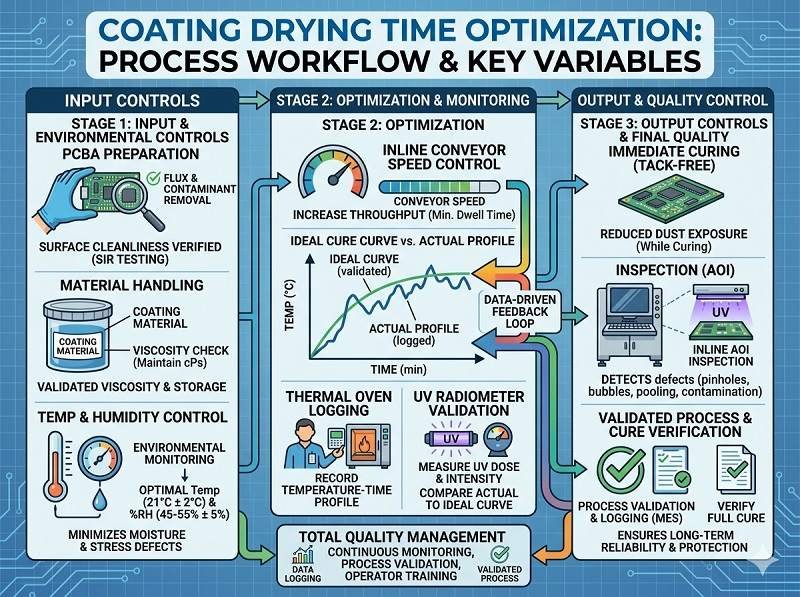
Waarom droogtijdoptimalisatie belangrijk is
- Verhoogt de productiesnelheid in SMT-assemblage
- Vermindert knelpunten in coating- en uithardingsfasen
- Verbetert consistentie en coatingprestaties
- Minimaliseert defecten veroorzaakt door verkeerd drogen
- Verlaagt de productiekosten op grote schaal PCB-assemblage
Belangrijkste factoren die de droogtijd beïnvloeden
Type coatingmateriaal
Verschillende Conforme coating materialen hebben een verschillend drooggedrag. Bijvoorbeeld:
- Acryl: snelle droging aan de lucht
- Silicone: langzamer, vochtafhankelijk
- UV-coatings: extreem snelle uitharding
Het juiste materiaal kiezen is de eerste stap in optimalisatie.
Laagdikte
Dikkere coatings hebben meer tijd nodig om te drogen. Aanbrengen meerdere dunne lagen in plaats van één dikke laag helpt het drogen te versnellen en verbetert de uniformiteit in PCB-assemblage.
Temperatuurregeling
Hogere temperaturen versnellen de verdamping van het oplosmiddel en de uitharding. In SMT-assemblage, Het gebruik van gecontroleerde ovens kan de droogtijd aanzienlijk verkorten met behoud van kwaliteit.
Luchtstroom en ventilatie
Een goede luchtstroom verwijdert verdampte oplosmiddelen en versnelt het drogen. Slechte ventilatie kan het proces vertragen en leiden tot defecten.
Vochtigheidsniveaus
Vochtigheid beïnvloedt vochtuithardende coatings. Gecontroleerde vochtigheid zorgt voor consistente droogprestaties, vooral in Prototype PCB-assemblage.
Aanbrengmethode
Spray-, dip- of selectieve coatingmethoden beïnvloeden hoe gelijkmatig de coating wordt aangebracht, wat een directe invloed heeft op de droogtijd.
Methoden om droogtijd te optimaliseren
Gebruik snel uithardende coatings
Overschakelen op UV- of duale UV-uitharding Conforme coating materialen voor hoge snelheid SMT-assemblage productielijnen.
Thermische of UV-uithardingssystemen implementeren
Luchtdroging vervangen door oven- of UV-uitharding kan de cyclustijd drastisch verkorten bij PCB-assemblage.
Procesparameters optimaliseren
Pas de spuitinstellingen, coatingdikte en uithardingsprofielen aan voor een snellere en consistentere droging.
Controleomgeving
Zorg voor een stabiele temperatuur, vochtigheid en schone luchtstroom in de coatingruimte om vertragingen en defecten te voorkomen.
Parallelle verwerking
Gebruik meerdere droogstations of inline systemen om grotere volumes efficiënt te verwerken.
Valideren in prototypestadium
In Prototype PCB-assemblage, test verschillende droogcondities en materialen om het optimale proces te bepalen voordat de productie wordt opgeschaald.
Veel voorkomende problemen zonder optimalisatie
- Lange productiecycli
- Ongelijkmatige droging of kleverige oppervlakken
- Bellenvorming door ingesloten oplosmiddelen
- Verhoogde defectpercentages en meer werk
Beste praktijken
- Volg de door de fabrikant aanbevolen droogprofielen
- Real-time procesomstandigheden bewaken
- Gebruik geautomatiseerde systemen voor consistentie
- Regelmatig de procesprestaties beoordelen en verbeteren
Concluderend, optimalisatie droogtijd coating is een sleutelfactor in het bereiken van efficiënte en hoogwaardige Conforme coating processen. Door zorgvuldig de materialen, omgeving en toepassingsmethodes in PCB-assemblage, SMT-assemblage, en Prototype PCB-assemblage, Fabrikanten kunnen de productiviteit aanzienlijk verbeteren en tegelijkertijd betrouwbare coatingprestaties garanderen.
Vraag een offerte aan voor conforme coating
Verminder het risico op PCB-storingen met professionele conformal coating. Vraag nu een offerte aan.
Stuur ons je vereisten en krijg snel antwoord van ons engineeringteam.
✔ 24-uurs respons ✔ Engineering-ondersteuning ✔ Kleine & massaproductie
Shenzhen Tengxinjie Electronics Co, Ltd.
 Nederlands
  English
  Deutsch
  Français
  Português do Brasil
  Español
  日本語
日本語  Italiano
  Русский
  한국어
한국어  العربية
  Svenska
  Polski
  Türkçe
  繁體中文
繁體中文