
Automated vs Manual Assembly in PCB Manufacturing
In electronics production, assembly processes can be broadly divided into automated assembly and manual assembly. Both methods are widely used in PCB-assemblage, depending on factors such as production volume, component type, and product complexity.
Understanding the differences between these two approaches helps manufacturers choose the most efficient and cost-effective solution for SMT-assemblage en Turnkey PCB-assemblage projecten.
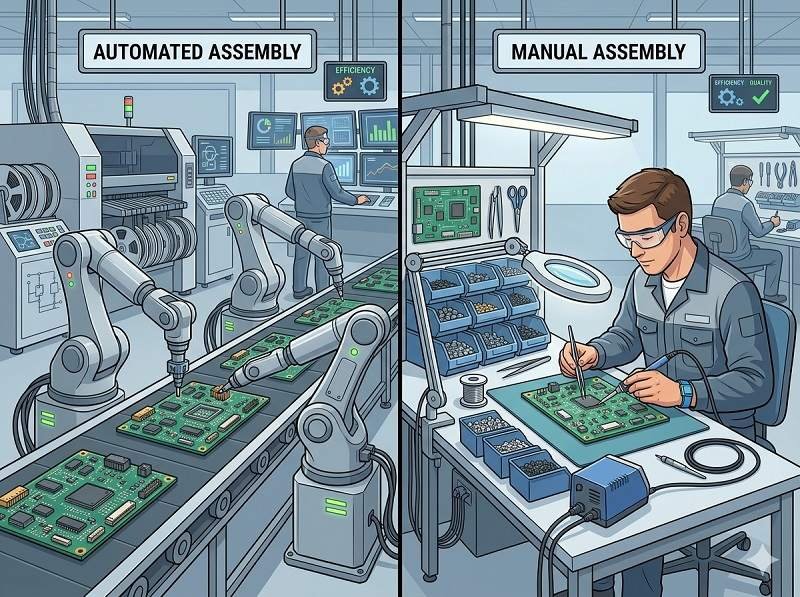
What is Automated Assembly
Automated assembly refers to the use of machines and equipment to place, solder, and inspect electronic components on a PCB.
In SMT-assemblage, automated systems such as pick-and-place machines, solder paste printers, and reflow ovens handle most of the production process.
These systems operate with high speed and precision, making them ideal for large-scale PCB Productie.
Key Features of Automated Assembly
Automated assembly offers several advantages.
High production speed suitable for mass production.
Consistent quality with minimal human error.
Accurate placement of fine-pitch and small components.
Integration with inspection systems such as AOI and X-ray.
This makes it the preferred method for high-volume PCB-assemblage.
What is Manual Assembly
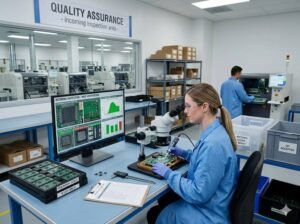
Manual assembly involves human operators placing and soldering components by hand.
It is commonly used for through-hole components, prototypes, or low-volume production.
In some cases, manual work is required even in automated lines, especially for complex or non-standard parts in Turnkey PCB-assemblage.
Key Features of Manual Assembly
Manual assembly provides flexibility and adaptability.
It is ideal for small production runs and prototypes.
It allows handling of unusual or large components.
It requires lower initial investment in equipment.
However, it is slower and more dependent on operator skill compared to automated SMT-assemblage.
Automated vs Manual Assembly Comparison
Productievolume
Automated assembly is best suited for high-volume production.
Manual assembly is more suitable for low-volume or customized orders.
Accuracy and Consistency
Automated systems provide higher precision and repeatability.
Manual assembly may vary depending on operator experience.
Cost Considerations
Automated assembly has higher initial setup costs but lower cost per unit at scale.
Manual assembly has lower setup costs but higher labor costs over time.
Flexibiliteit
Manual assembly is more flexible for design changes and special components.
Automated assembly requires programming and setup adjustments.
Role in SMT Assembly
Automated assembly dominates SMT-assemblage due to the need for speed and precision.
Machines can place thousands of components per hour with high accuracy, especially for fine-pitch and high-density PCBs.
Manual intervention is usually limited to inspection, rework, or special cases.
Role in Turnkey PCB Assembly
In Turnkey PCB-assemblage, both automated and manual methods are often combined.
Automated processes handle standard SMT components.
Manual assembly is used for through-hole insertion, connectors, or final adjustments.
This hybrid approach ensures efficiency while maintaining flexibility.
When to Choose Automated Assembly
Automated assembly is the best choice when:
Production volume is high.
Designs are stable and standardized.
High precision is required.
Cost per unit needs to be minimized.
When to Choose Manual Assembly
Manual assembly is suitable when:
Production volume is low or prototype-based.
Components are complex or irregular.
Frequent design changes are expected.
Budget for automation is limited.
Conclusie
Automated and manual assembly each play important roles in modern electronics production. Automated assembly delivers speed, precision, and scalability, making it ideal for mass PCB Productie en SMT-assemblage. Manual assembly, on the other hand, offers flexibility and is essential for prototypes and specialized components.
In PCB-assemblage en Turnkey PCB-assemblage, combining both methods often provides the best balance between efficiency, cost, and quality.
Stuur uw PCB-bestanden in en ontvang vandaag nog een snelle offerte. Vraag nu aan.
We bieden professionele assemblagediensten voor printplaten, waaronder SMT, DIP en kant-en-klare oplossingen.
✔ NDA beschikbaar ✔ Snel offerte binnen 24 uur ✔ ISO-gecertificeerde fabriek ✔ One-stop PCB & PCBA Service
 Nederlands
  English
  Deutsch
  Français
  Português do Brasil
  Español
  日本語
日本語  Italiano
  Русский
  한국어
한국어  العربية
  Svenska
  Polski
  Türkçe
  繁體中文
繁體中文