
Productie van conforme coatings
Schalen Conforme coating Productie van kleine batches tot massaproductie vereist een gestructureerde aanpak van apparatuur, procescontrole en kwaliteitssystemen. Op PCB-assemblage, Prototype PCB-assemblage, en SMT-assemblage, succesvolle schaalvergroting zorgt voor een consistente coatingkwaliteit terwijl de verwerkingscapaciteit wordt verbeterd en de kosten per eenheid worden verlaagd.
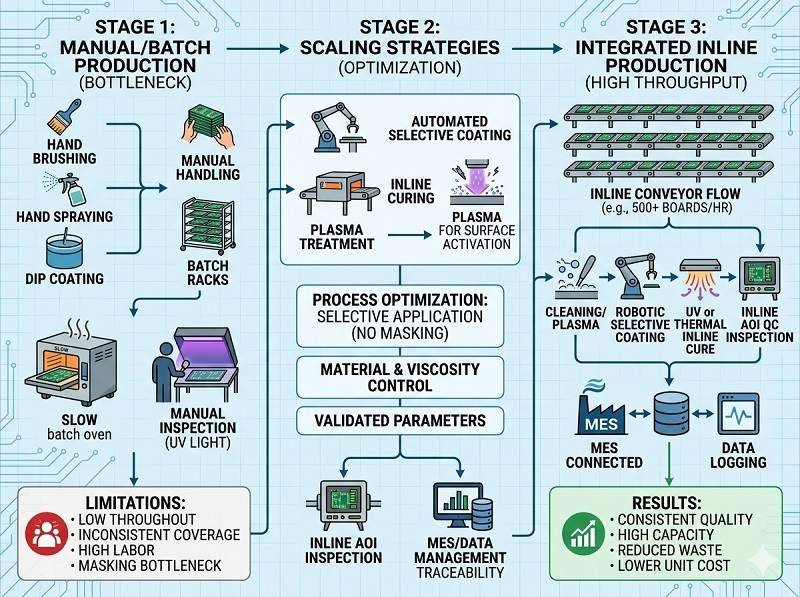
Het coatingproces standaardiseren
Voordat je gaat schalen, valideer en documenteer je alle belangrijke parameters in Prototype PCB-assemblage-zoals coatingtype, viscositeit, dikte, uithardingsprofiel en maskeringstrategie. Een stabiel, herhaalbaar proces is de basis voor massafabricage. PCB-assemblage.
Overgang van handmatige naar geautomatiseerde systemen
Handmatig spuiten of borstelen werkt voor prototypes, maar schaalvergroting vereist automatisering. implementeren selectieve coatingmachines of robotspuitsystemen in SMT-assemblage voor een nauwkeurige, herhaalbare toepassing en minder variabiliteit voor de operator.
Coatingmaterialen optimaliseren
Kies coatings die geschikt zijn voor productie op hoge snelheid, zoals sneluithardende acrylverf of UV-/duaaluithardende systemen. Deze materialen verkorten de cyclustijd aanzienlijk bij grootschalige PCB-assemblage.
Opspannen en hanteren verbeteren
Ontwerp speciale klemmen of pallets om printplaten veilig vast te houden tijdens het coaten en uitharden. Efficiënte behandelingssystemen verminderen het risico op schade en verhogen de doorvoer in SMT-assemblage lijnen.
Verbeter de uithardingscapaciteit
Upgrade van drogen aan de lucht naar thermische ovens of UV-uithardingssystemen om de productie te versnellen. Inline uithardingsoplossingen zijn vooral belangrijk voor continu SMT-assemblage operaties.
Inline productiestroom implementeren
Overschakelen van batchverwerking naar inline coatinglijnen waarbij printplaten in een continue volgorde worden gereinigd, gecoat, uitgehard en geïnspecteerd. Dit verhoogt de efficiëntie aanzienlijk bij grote volumes PCB-assemblage.
Kwaliteitscontrolesystemen versterken
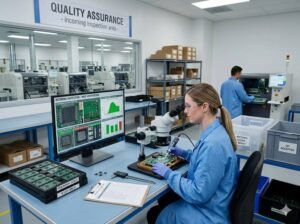
Voor het opschalen van de productie zijn robuuste inspectiemethoden nodig, zoals:
- UV-inspectie voor coatingdekking
- Gereedschap voor diktemeting
- Geautomatiseerde optische inspectie (AOI)
Consistente kwaliteitscontrole zorgt ervoor dat een groter volume niet leidt tot meer defecten.
Controleomgeving en procesomstandigheden
Zorg voor een stabiele temperatuur, vochtigheid en reinheid in de coatingruimte. Omgevingscontrole is essentieel voor het bereiken van consistente resultaten in grootschalige SMT-assemblage.
Personeel opleiden en SOP's definiëren
Operators en technici moeten gestandaardiseerde operationele procedures (SOP's) volgen. Een goede training zorgt voor een consistente uitvoering in ploegen en productielijnen.
Integreren met upstream- en downstreamprocessen
Coördineer coating met reinigen, afplakken en testen in PCB-assemblage. Naadloze integratie vermindert knelpunten en verbetert de algehele productie-efficiëntie.
Geleidelijk opschalen met validatie
Verhoog de productiecapaciteit stap voor stap. Valideer elke fase door middel van proefruns voordat het op volledige schaal wordt ingezet om de risico's te minimaliseren.
Veelvoorkomende uitdagingen bij schaalvergroting
- Inconsistente laagdikte
- Verhoogde defectpercentages (bellen, leegtes)
- Knelpunten bij uitharding of inspectie
- Problemen met kalibratie van apparatuur
Deze in een vroeg stadium aanpakken Prototype PCB-assemblage zorgt voor soepel schalen.
Samenvatting van best practices
- Automatiseren van aanbrengen en uitharden
- Snel uithardende, productievriendelijke materialen gebruiken
- Inline processen implementeren
- Inspectie en kwaliteitscontrole versterken
- Strikte omgevingscontrole handhaven
Concluderend kan worden gesteld dat schaalvergroting Conforme coating productie vereist de overgang van handmatige, flexibele processen naar geautomatiseerde, gestandaardiseerde systemen. Door apparatuur, materialen en workflows te optimaliseren in PCB-assemblage, SMT-assemblage, en Prototype PCB-assemblage, kunnen fabrikanten een hoge efficiëntie, consistente kwaliteit en betrouwbare prestaties op schaal bereiken.
Vraag een offerte aan voor conforme coating
Snelle doorlooptijd nodig voor conformal coating projecten? Dien vandaag nog uw aanvraag in.
Stuur ons je vereisten en krijg snel antwoord van ons engineeringteam.
✔ 24-uurs respons ✔ Engineering-ondersteuning ✔ Kleine & massaproductie
Shenzhen Tengxinjie Electronics Co, Ltd.
 Nederlands
  English
  Deutsch
  Français
  Português do Brasil
  Español
  日本語
日本語  Italiano
  Русский
  한국어
한국어  العربية
  Svenska
  Polski
  Türkçe
  繁體中文
繁體中文