
Defecten in coating opsporen
Defecten opsporen in Conforme coating is essentieel om betrouwbaarheid en prestaties te garanderen in PCB-assemblage en SMT-assemblage. Zelfs kleine problemen met de coating kunnen leiden tot binnendringen van vocht, corrosie of elektrische storingen. Een combinatie van inspectiemethoden wordt meestal gebruikt in Turnkey PCB-assemblage om defecten effectief te identificeren en te controleren.
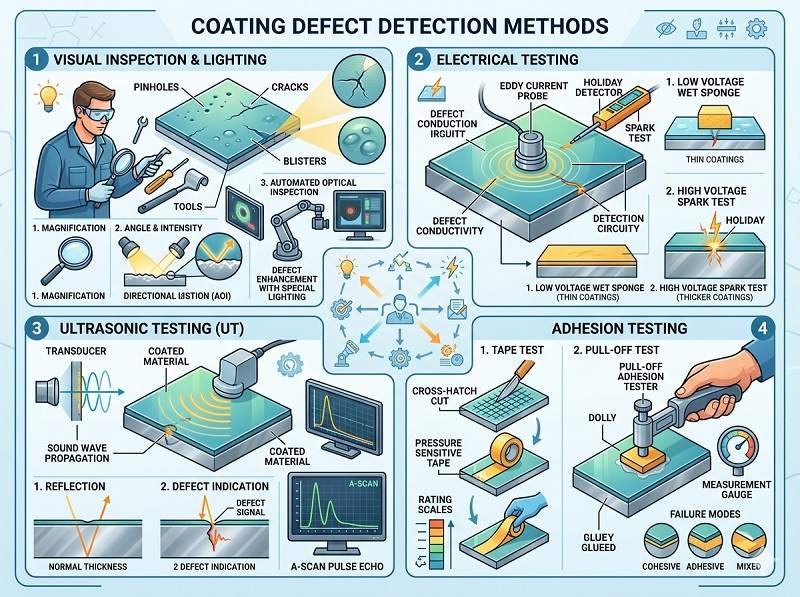
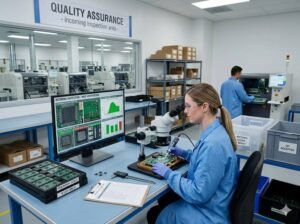
Visuele inspectie (basismethode)
De eenvoudigste manier om coatingdefecten op te sporen is door visuele inspectie:
- Gebruik de juiste verlichting en vergroting
- Controleer op ongelijkmatige coating, luchtbellen of gemiste plekken
- Controleer overcoating op connectoren of testpunten
Hoewel deze methode basaal is, wordt ze nog steeds veel gebruikt als eerste stap in PCB-assemblage kwaliteitscontrole.
Inspectie met UV-licht (meest gebruikte methode)
Veel Conforme coating materialen omvatten UV-tracers:
- Coating gloeit onder UV-licht
- Ontbrekende of dunne gebieden zien er donker uit
- Gemakkelijke detectie van dekkingsproblemen en vervuiling
Dit is een van de meest efficiënte technieken in SMT-assemblage lijnen voor snelle defectidentificatie.
AOI (geautomatiseerde optische inspectie)
AOI-systemen bieden geautomatiseerde en zeer nauwkeurige detectie:
- Detecteert onvoldoende of overmatige coating
- Identificeert luchtbellen, leegtes en inconsistenties
- Vergelijkt resultaten met geprogrammeerde standaarden
AOI wordt vaak gebruikt in grote volumes Turnkey PCB-assemblage voor consistente inspectieresultaten.
Diktemeting
Defecten zijn niet altijd zichtbaar-diktecontrole is ook belangrijk:
- Gebruik natte filmmeters tijdens het aanbrengen
- Gebruik meetinstrumenten voor droge film na uitharding
- Zorg ervoor dat de coating binnen het typische bereik valt (25-250 µm)
Onjuiste dikte kan leiden tot prestatieproblemen, zelfs als de dekking er acceptabel uitziet.
Functioneel en elektrisch testen
Sommige coatingdefecten verschijnen pas tijdens het gebruik:
- Isolatieweerstand testen
- Hoogspanningstesten (op lekkage of doorslag)
- Milieustresstests (vochtigheid, temperatuur)
Deze tests controleren of Conforme coating correct presteert in echte omstandigheden.
Veel voorkomende coatingdefecten om op te letten
- Bubbels en leemtes
- Scheuren of afschilferen
- Delaminatie
- Schaduwvorming (niet-gecoate gebieden)
- Overlagen op kritieke onderdelen
- Verontreiniging onder coating
Vroege detectie helpt herbewerking te verminderen en de opbrengst te verbeteren in PCB-assemblage.
Beste praktijken voor defectdetectie
- Meerdere inspectiemethoden combineren (UV + AOI + visueel)
- Inspectiecriteria en -procedures standaardiseren
- Train operators en onderhoud apparatuur
- Integreer inline inspectie in SMT-assemblage processen
Conclusie
Het opsporen van coatingdefecten vereist een combinatie van visuele, UV-, geautomatiseerde en functionele inspectiemethoden. In PCB-assemblage, SMT-assemblage, en Turnkey PCB-assemblage, zorgt een robuust inspectieproces ervoor dat Conforme coating correct wordt toegepast, waardoor storingen worden voorkomen en de algehele betrouwbaarheid van het product wordt verbeterd.
Vraag een offerte aan voor conforme coating
Klaar om uw conformal coating project te starten? Vul onderstaand formulier in om te beginnen.
Stuur ons je vereisten en krijg snel antwoord van ons engineeringteam.
✔ 24-uurs respons ✔ Engineering-ondersteuning ✔ Kleine & massaproductie
Shenzhen Tengxinjie Electronics Co, Ltd.
 Nederlands
  English
  Deutsch
  Français
  Português do Brasil
  Español
  日本語
日本語  Italiano
  Русский
  한국어
한국어  العربية
  Svenska
  Polski
  Türkçe
  繁體中文
繁體中文