
Source obsolete components
Sourcing obsolete or end-of-life (EOL) components is a common challenge in the electronics industry, especially for products with long life cycles or legacy designs. The short answer is yes—professional manufacturers offering PCB-assemblage services can source obsolete components, but the process requires specialized strategies, strict verification, and risk management.
Whether you are dealing with maintenance of existing products or continuing production without redesign, experienced providers of Prototype PCB-assemblage, SMT-assemblage, en PCB Productie services can help secure hard-to-find parts while maintaining quality and reliability.
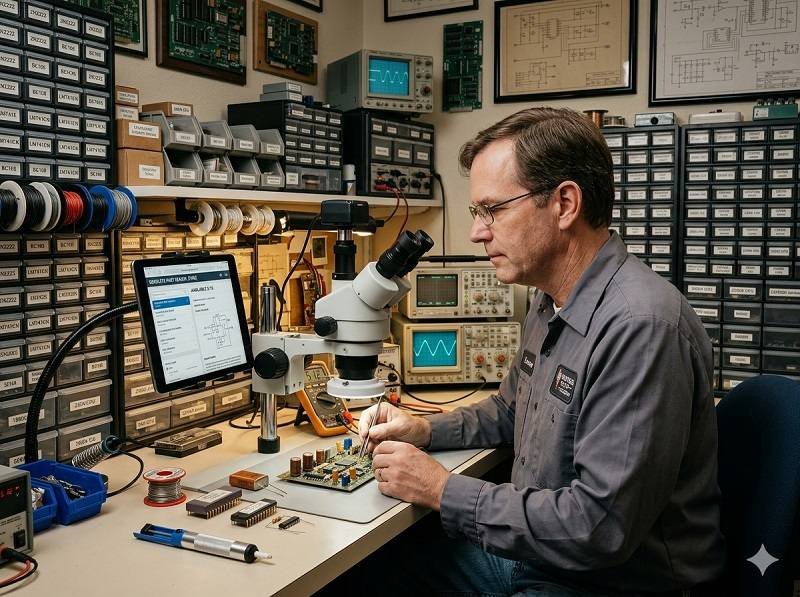
Why components become obsolete
Electronic components typically become obsolete due to:
- Manufacturer discontinuation
- Rapid technological upgrades
- Low market demand
- Supply chain shifts
When a component reaches EOL status, it may no longer be available through authorized distributors, making sourcing more complex for PCB-assemblage projecten.
Strategies for sourcing obsolete components
Professional PCB-assemblage providers use multiple approaches to locate and procure obsolete parts:
Global independent distributors
When authorized channels no longer carry a component, manufacturers turn to vetted independent distributors with global inventories. These suppliers often specialize in obsolete and hard-to-find components.
Excess inventory and stock sourcing
Manufacturers may access surplus inventories from:
- OEM overstock
- Contract manufacturers
- Component brokers
This approach is especially useful in Prototype PCB-assemblage, where smaller quantities are needed quickly.
Last-time buy (LTB) management
For ongoing projects, manufacturers may recommend a last-time buy strategy, securing sufficient stock before a component becomes unavailable. This ensures continuity in SMT-assemblage productie.
Quality risks and how they are managed
Sourcing obsolete components carries inherent risks, particularly the possibility of counterfeit or degraded parts. Reliable PCB Productie partners mitigate these risks through strict quality control processes.
Supplier qualification
Only pre-approved and audited suppliers are used. This reduces the likelihood of counterfeit components entering the supply chain.
Inspection and testing
Obsolete components often undergo enhanced inspection, including:
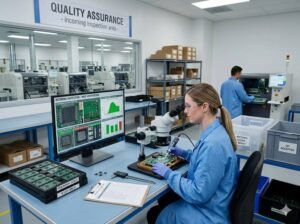
- Visual and microscopic inspection
- X-ray analysis
- Elektrisch testen
- Solderability testing
These steps ensure that components meet the requirements for SMT-assemblage and long-term reliability.
Traceability and documentation
Maintaining full traceability is essential. Manufacturers document:
- Component origin
- Batch and lot numbers
- Testing reports
This is critical for high-reliability PCB-assemblage applications such as industrial or medical electronics.
Alternative solutions to obsolete components
In many cases, sourcing obsolete parts is not the only—or best—solution. Experienced PCB-assemblage providers will also evaluate alternatives:
Cross-referenced components
Engineers identify equivalent components with similar:
- Electrical specifications
- Package types
- Prestatiekenmerken
This allows continued PCB Productie without redesigning the entire board.
Design updates and redesign
For long-term production, redesigning the PCB to accommodate modern components may be more sustainable. This is often recommended when:
- Obsolete parts are extremely rare
- Costs of sourcing are too high
- Reliability cannot be guaranteed
Hybrid approach
Some projects use a mix of obsolete sourcing and partial redesign, especially during transition phases from Prototype PCB-assemblage to mass production.
Inventory planning to avoid obsolescence issues
To reduce dependence on obsolete components, manufacturers implement proactive inventory strategies:
- Lifecycle monitoring of components
- Early risk identification
- Strategic stock planning
- Supplier diversification
These practices help ensure smoother SMT-assemblage operations and minimize disruptions in PCB-assemblage projecten.
When should you source obsolete components?
Sourcing obsolete components is usually appropriate when:
- Redesign is not feasible due to cost or time constraints
- The product is in maintenance or support phase
- Certification requirements prevent design changes
However, for new designs and Prototype PCB-assemblage, it is generally better to avoid obsolete or near-EOL components whenever possible.
Conclusie
Yes, obsolete components can be sourced, but it requires expertise, reliable supplier networks, and rigorous quality control. Professional PCB-assemblage providers combine global sourcing capabilities with advanced inspection processes to ensure that even hard-to-find components meet production standards.
At the same time, they offer practical alternatives such as component substitution and design optimization to support long-term success in PCB Productie en SMT-assemblage. By choosing the right partner, you can effectively manage obsolescence challenges while maintaining product quality and supply chain stability.
Krijg snel antwoord van ons engineeringteam. Vraag nu uw PCB assemblage offerte aan.
We bieden professionele assemblagediensten voor printplaten, waaronder SMT, DIP en kant-en-klare oplossingen.
✔ NDA beschikbaar ✔ Snel offerte binnen 24 uur ✔ ISO-gecertificeerde fabriek ✔ One-stop PCB & PCBA Service
 Nederlands
  English
  Deutsch
  Français
  Português do Brasil
  Español
  日本語
日本語  Italiano
  Русский
  한국어
한국어  العربية
  Svenska
  Polski
  Türkçe
  繁體中文
繁體中文