
Verschil tussen acryl en silicone HumiSeal coatings
Acryl en siliconen HumiSeal coatings zijn twee van de meest gebruikte Conforme coating soorten in PCB-assemblage, Prototype PCB-assemblage, en SMT-assemblage. Hoewel beide bescherming bieden tegen vocht, stof en verontreinigingen, verschillen ze aanzienlijk in prestaties, flexibiliteit, kosten en toepassingsscenario's.
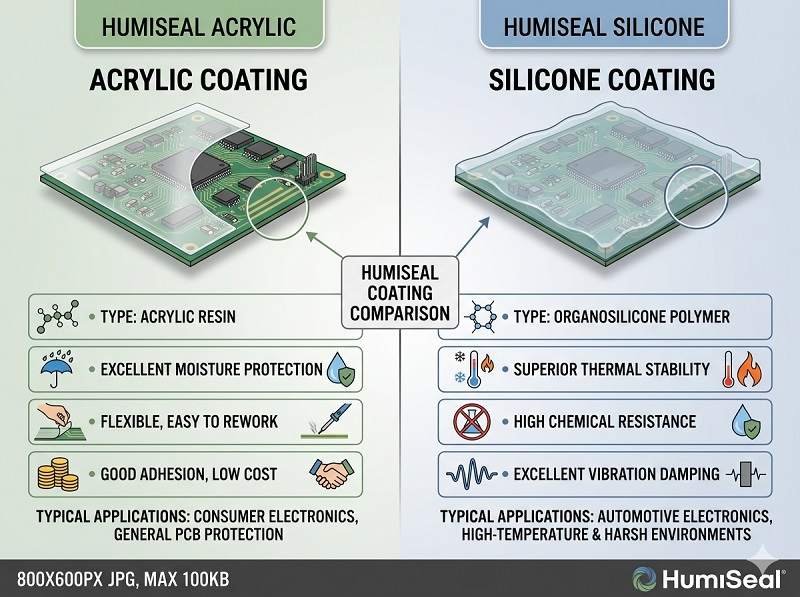
Belangrijkste verschil: materiaaleigenschappen
Het belangrijkste onderscheid ligt in hun chemische aard:
- Acrylcoatings (AR) → harde, transparante, sneldrogende polymeren
- Siliconencoatings (SR) → zachte, rubberachtige, zeer flexibele materialen
Acrylcoatings harden uit in een harde beschermlaag, terwijl siliconencoatings blijven elastisch en flexibel.
Droogsnelheid en procesefficiëntie
Acrylcoatings staan bekend om hun snelle droging en eenvoudige verwerking, waardoor ze ideaal zijn voor hoge snelheden SMT-assemblage productielijnen. Ze kunnen binnen enkele minuten drogen en zijn eenvoudig aan te brengen.
Siliconencoatings vereisen meestal langere uithardingstijd, Vooral als er sprake is van vochtuitharding, wat de productiedoorvoer kan vertragen.
Flexibiliteit en trillingsbestendigheid
Dit is een van de belangrijkste verschillen:
- Acryl → relatief stijf, kan barsten bij trillingen of thermische cycli
- Silicone → zeer flexibel, absorbeert spanning en is bestand tegen barsten
Siliconencoatings zijn beter geschikt voor omgevingen met mechanische spanning, trillingen of thermische uitzetting.
Temperatuurbestendigheid
Acrylcoatings presteren goed in gematigde temperatuurbereiken (meestal tot ~120°C).
Siliconencoatings bieden uitstekende weerstand tegen hoge en lage temperaturen, vaak opererend vanuit -55°C tot 200°C of hoger, waardoor ze ideaal zijn voor extreme omgevingen.
Chemische weerstand en weerstand tegen het milieu
- Acryl → goede vochtbescherming, maar beperkte weerstand tegen agressieve chemicaliën
- Silicone → sterke weerstand tegen chemicaliën, vochtigheid en ruwe omgevingen
Siliconencoatings hebben de voorkeur voor auto-, luchtvaart- en buitenelektronica waar duurzaamheid op lange termijn kritisch is.
Herwerken en repareren
In PCB-assemblage, De mogelijkheid tot herbewerking is erg belangrijk:
- Acryl → eenvoudig te verwijderen en repareren gewone oplosmiddelen gebruiken
- Silicone → moeilijker te verwijderen, vereist speciale processen
Hierdoor zijn acrylcoatings zeer geschikt voor Prototype PCB-assemblage, waar frequente aanpassingen nodig zijn.
Kosten en productie
- Acryl → lagere kosten + snellere verwerking
- Silicone → hogere kosten + betere prestaties
Voor grote volumes SMT-assemblage, Acryl wordt vaak gekozen vanwege de kostenefficiëntie, terwijl siliconen worden gebruikt als de prestatievereisten de hogere kosten rechtvaardigen.
Typische toepassingen
Acryl HumiSeal coatings (bijv. 1B31):
- Consumentenelektronica
- LED-stuurprogramma's en voedingen
- voor algemeen gebruik PCB-assemblage
- Prototype PCB-assemblage (eenvoudig herwerken)
Silicone HumiSeal coatings:
- Automobielelektronica
- Ruimtevaartsystemen
- Buiten en omgevingen met een hoge vochtigheidsgraad
- Toepassingen bij hoge temperaturen
Samenvattende vergelijking
| Functie | Acrylcoating | Siliconencoating |
|---|---|---|
| Droogsnelheid | Zeer snel | Langzamer |
| Flexibiliteit | Laag tot matig | Zeer hoog |
| Temperatuurbestendigheid | Matig | Uitstekend |
| Chemische weerstand | Matig | Hoog |
| Herwerkbaarheid | Gemakkelijk | Moeilijk |
| Kosten | Onder | Hoger |
| Beste gebruik | Standaard elektronica | Ruwe omgevingen |
Definitief inzicht
Er is geen “one-size-fits-all” keuze tussen acryl en silicone HumiSeal coatings.
- Kies acrylcoatings voor kosteneffectief, snel en rework-vriendelijk oplossingen in PCB-assemblage en SMT-assemblage
- Kies siliconencoatings voor extreme omgevingen, hoge betrouwbaarheid en duurzaamheid op lange termijn
In de praktijk valideren veel fabrikanten beide opties tijdens Prototype PCB-assemblage voordat de meest geschikte coating voor massaproductie wordt geselecteerd.
Vraag een offerte aan voor conforme coating
Weet u niet zeker welke conformal coating geschikt is voor uw product? Neem vandaag nog contact op met onze experts.
Stuur ons je vereisten en krijg snel antwoord van ons engineeringteam.
✔ 24-uurs respons ✔ Engineering-ondersteuning ✔ Kleine & massaproductie
Shenzhen Tengxinjie Electronics Co, Ltd.
 Nederlands
  English
  Deutsch
  Français
  Português do Brasil
  Español
  日本語
日本語  Italiano
  Русский
  한국어
한국어  العربية
  Svenska
  Polski
  Türkçe
  繁體中文
繁體中文