
Verwijderen van coating
Het coatingverwijderingsproces verwijst naar het gecontroleerd strippen van Conforme coating van een printplaat om inspectie, reparatie, aanpassing of herbewerking mogelijk te maken. Het is een kritische bewerking in PCB-assemblage en SMT-assemblage, vooral wanneer defecten moeten worden verholpen of onderdelen moeten worden vervangen.
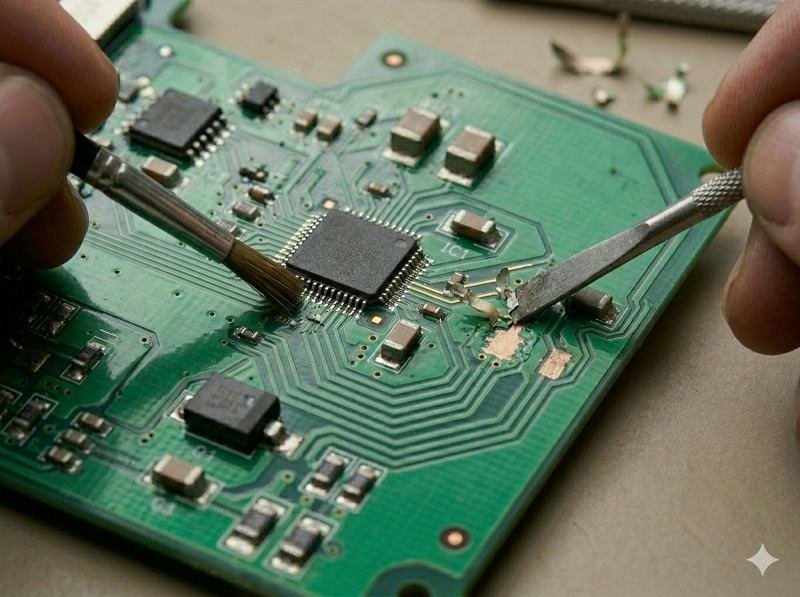
Waarom coating verwijderen noodzakelijk is
In Turnkey PCB-assemblage, Het verwijderen van coatings is meestal nodig voor:
- Defecte onderdelen repareren of vervangen
- Verhelpen van coatingdefecten (bellen, scheuren, delaminatie)
- Vervuiling verwijderen die onder de coating zit
- Ontwerp- of technische wijzigingen doorvoeren
- Gedetailleerde inspecties of tests uitvoeren
Zonder goede verwijdering zou toegang tot het PCB-circuit moeilijk en riskant zijn.
Soorten conforme coatings en verwijderingsmoeilijkheden
Verschillende coatings vereisen verschillende verwijderingsmethoden:
- Acrylcoatings → Gemakkelijkst te verwijderen
- Siliconencoatings → flexibel, gemiddelde moeilijkheidsgraad
- Urethaan coatings → beter bestand tegen chemicaliën
- Epoxy coatings → erg hard, moeilijk te verwijderen
- Parylene coatings → vereisen gespecialiseerde technieken
Inzicht in het coatingtype is essentieel bij PCB-assemblage voordat u begint met verwijderen.
Gebruikelijke coatingverwijderingsmethoden
Verwijdering van oplosmiddelen
- Gebruikt chemische oplosmiddelen om de coating op te lossen
- Het meest effectief voor acrylcoatings
- Eenvoudig en veel gebruikt in SMT-assemblage herwerken
Mechanische verwijdering
- Schrapen, borstelen of microschuren
- Geschikt voor plaatselijke verwijdering
- Vereist precisie om PCB-beschadiging te voorkomen
Chemisch strippen
- Gebruikt sterkere chemicaliën voor taaie coatings (urethaan, epoxy)
- Effectief, maar moet zorgvuldig worden gecontroleerd
- Vereist de juiste veiligheidsmaatregelen
Thermische verwijdering
- Brengt warmte aan om de coating zachter te maken
- Maakt mechanisch verwijderen gemakkelijker
- Moet oververhitting van gevoelige onderdelen voorkomen
Plasma- of laserverwijdering (gevorderd)
- Gebruikt voor zeer nauwkeurige of complexe printplaten
- Ideaal voor selectieve verwijdering in het topsegment Turnkey PCB-assemblage
Stappen in coatingverwijderingsproces
- Type coating identificeren
- Kies de juiste verwijderingsmethode
- Bescherm de omringende onderdelen (indien nodig afplakken)
- Verwijder coating van het doelgebied
- Resten grondig reinigen
- PCB inspecteren op schade of resterende coating
Elke stap moet zorgvuldig worden gecontroleerd om de integriteit van de printplaat te behouden.
Uitdagingen bij het verwijderen van coatings
- Risico op beschadiging van componenten of printsporen
- Resten die achterblijven beïnvloeden het opnieuw coaten
- Tijdrovend voor harde coatings
- Veiligheid bij het gebruik van chemicaliën
Deze uitdagingen benadrukken het belang van goede procesbeheersing in PCB-assemblage.
Beste praktijken
- Gebruik waar mogelijk coatings die nabewerking vergemakkelijken
- Beperk het verwijderen tot alleen de noodzakelijke gebieden
- Gebruik het juiste gereedschap en getrainde technici
- Volg de veiligheids- en milieurichtlijnen
- Zorg voor volledige reiniging voor het opnieuw coaten
Conclusie
Het coatingverwijderingsproces is een essentieel onderdeel van herbewerking in PCB-assemblage, SMT-assemblage, en Turnkey PCB-assemblage. Door de juiste methode te kiezen en gecontroleerde procedures te volgen, kunnen fabrikanten op een veilige manier Conforme coating, reparaties uit te voeren en de functionaliteit van printplaten te herstellen zonder de betrouwbaarheid in gevaar te brengen.
Vraag een offerte aan voor conforme coating
Werk je aan elektronica voor de auto-industrie, de industrie of voor buiten? Wij kunnen helpen met conformal coating.
Stuur ons je vereisten en krijg snel antwoord van ons engineeringteam.
✔ 24-uurs respons ✔ Engineering-ondersteuning ✔ Kleine & massaproductie
Shenzhen Tengxinjie Electronics Co, Ltd.
 Nederlands
  English
  Deutsch
  Français
  Português do Brasil
  Español
  日本語
日本語  Italiano
  Русский
  한국어
한국어  العربية
  Svenska
  Polski
  Türkçe
  繁體中文
繁體中文