
Conformal coating herbewerkingsproces
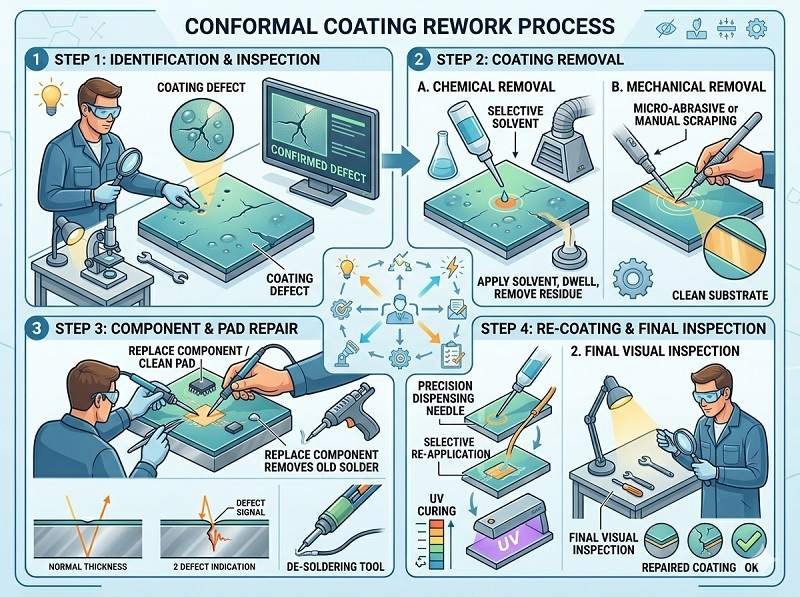
Het conformal coating rework proces verwijst naar het gecontroleerd verwijderen, repareren en opnieuw aanbrengen van Conforme coating op een PCB wanneer defecten, wijzigingen in het ontwerp of vervanging van componenten nodig zijn. Het is een belangrijke stap in PCB-assemblage en SMT-assemblage, Dit zorgt ervoor dat printplaten kunnen worden gecorrigeerd zonder de betrouwbaarheid in gevaar te brengen.
Waarom herwerken nodig is
Herbewerking kan nodig zijn in Turnkey PCB-assemblage om verschillende redenen:
- Deklaagdefecten (bellen, holtes, ongelijke dikte)
- Verontreiniging onder de coating
- Verkeerd afplakken of overcoaten van connectoren
- Reparatie of vervanging van onderdelen
- Technische wijzigingen of ontwerpupdates
Zonder de juiste nabewerking kunnen deze problemen leiden tot functionele storingen of een kortere levensduur.
Stappen in conformal coating rework
Coating identificatie
Identificeer eerst het type Conforme coating gebruikt (acryl, siliconen, urethaan, epoxy of parylene), aangezien elk een andere verwijderingsmethode vereist.
Verwijderen van coating
Gebruikelijke verwijderingstechnieken zijn onder andere:
- Verwijdering van oplosmiddelen → lost acrylcoatings op
- Mechanische verwijdering → schrapen of microschuren
- Thermische methoden → coating zacht maken met hitte
- Chemisch strippen → gebruikt voor sterkere coatings zoals epoxy
De methode moet zorgvuldig gekozen worden om beschadiging van componenten of sporen te voorkomen. PCB-assemblage repareren.
De printplaat reinigen
Na verwijdering:
- Resten reinigen met geschikte oplosmiddelen
- Zorg ervoor dat het oppervlak vrij is van verontreinigingen
- Droog het bord volledig af voor verdere verwerking
Een goede reiniging is essentieel voor het opnieuw coaten in SMT-assemblage.
Reparatie of vervanging
Voer noodzakelijke acties uit zoals:
- Defecte onderdelen vervangen
- Soldeerverbindingen bevestigen
- Circuitgebieden wijzigen
Deze stap volgt de standaard reparatieprocedures in Turnkey PCB-assemblage.
Opnieuw aanbrengen van coating
Zodra de reparaties zijn voltooid:
- Opnieuw toepassen Conforme coating met kwast, spray of selectieve coating
- Zorg voor een goede afdekking van gebieden zonder laklaag
- Handhaaf de juiste dikte en dekking
Uitharding en eindinspectie
Eindelijk:
- De coating uitharden (luchtdroging, hitte of UV afhankelijk van het materiaal)
- Inspecteren met UV- of AOI-methoden
- Controleer dekking, hechting en dikte
Uitdagingen bij herwerken
- Risico op beschadiging van gevoelige onderdelen
- Moeite met het verwijderen van bepaalde coatings (bijv. epoxy of parylene)
- Consistente coatingkwaliteit behouden na herbewerking
- Tijd en arbeidskosten
Vanwege deze uitdagingen moet herbewerking worden geminimaliseerd door een goede procesbeheersing in PCB-assemblage.
Beste praktijken
- Gebruik waar mogelijk herwerkvriendelijke coatings (bijv. acryl).
- Ontwerp voor toegankelijkheid in PCB-lay-out
- Breng de juiste maskering aan tijdens de eerste coatinglaag
- Technici trainen in veilige verwijderingstechnieken
Conclusie
Het conformal coating rework proces is essentieel voor het corrigeren van defecten en het mogelijk maken van reparaties in PCB-assemblage, SMT-assemblage, en Turnkey PCB-assemblage. Door de coating zorgvuldig te verwijderen, te repareren en opnieuw aan te brengen, kunnen fabrikanten de productkwaliteit behouden en tegelijkertijd afval en kosten beperken.
Vraag een offerte aan voor conforme coating
Verminder het risico op PCB-storingen met professionele conformal coating. Vraag nu een offerte aan.
Stuur ons je vereisten en krijg snel antwoord van ons engineeringteam.
✔ 24-uurs respons ✔ Engineering-ondersteuning ✔ Kleine & massaproductie
Shenzhen Tengxinjie Electronics Co, Ltd.
 Nederlands
  English
  Deutsch
  Français
  Português do Brasil
  Español
  日本語
日本語  Italiano
  Русский
  한국어
한국어  العربية
  Svenska
  Polski
  Türkçe
  繁體中文
繁體中文