
Through-Hole PCB Assembly
Through-hole PCB Assembly is a traditional method in electronics manufacturing where component leads are inserted into pre-drilled holes on a printed circuit board (PCB) and then soldered to create strong mechanical and electrical connections. Although modern PCB 어셈블리 increasingly relies on SMT 어셈블리, through-hole technology (THT) remains essential for applications that require durability, reliability, and high mechanical strength.
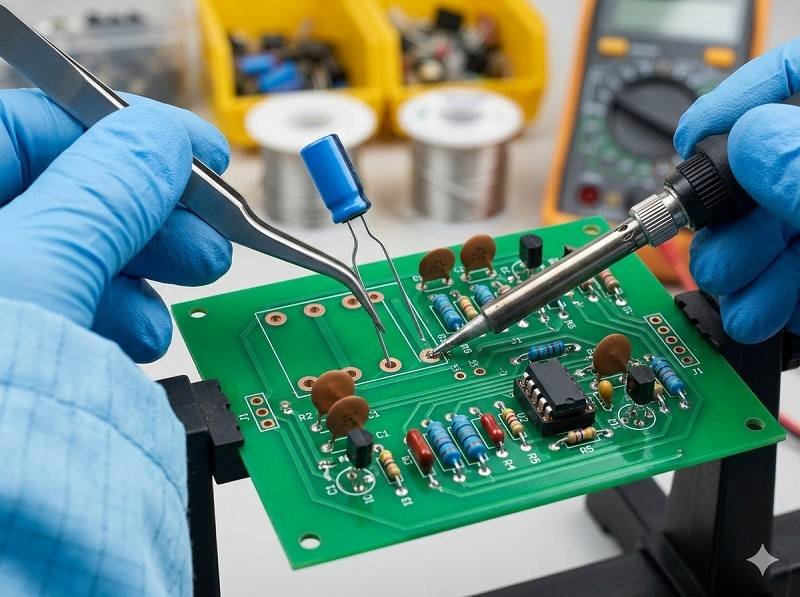
How Through-Hole PCB Assembly Works
Through-hole PCB Assembly involves several structured steps to ensure proper component placement and secure soldering:
Drilling Holes in the PCB
During PCB fabrication, holes are precisely drilled at designated locations where through-hole components will be mounted. These holes are typically plated to allow electrical connectivity between layers.
Component Insertion
Electronic components with long leads—such as connectors, capacitors, transformers, and switches—are inserted into the drilled holes. This can be done manually or using automated insertion machines.
납땜 프로세스
Once components are placed, the leads are soldered to the PCB to establish electrical connections. Common soldering methods include:
- Wave soldering: The PCB passes over a موجة من solder (wave of molten solder) that bonds all exposed leads simultaneously.
- Manual soldering: Used for small batches, prototypes, or complex boards requiring precision.
검사 및 테스트
After soldering, the assembly undergoes inspection (visual or AOI) and functional testing to ensure quality and reliability.
Types of Through-Hole PCB Assembly
Through-hole PCB Assembly can be divided into two main categories:
Manual Through-Hole Assembly
Performed by skilled technicians, this method is ideal for low-volume production, prototypes, and complex designs where flexibility is required.
Automated Through-Hole Assembly
Uses machines to insert components and perform wave soldering. This approach improves efficiency and consistency in medium-to-high volume production.
Advantages of Through-Hole PCB Assembly
Despite the popularity of SMT Assembly, through-hole PCB Assembly offers several unique benefits:
Strong Mechanical Bonding
Components are anchored through the board, making them more resistant to mechanical stress, vibration, and shock.
High Reliability
Ideal for critical applications such as aerospace, automotive, and industrial equipment.
Better for High-Power Components
Through-hole components can handle higher currents and voltages compared to many surface-mount devices.
Ease of Prototyping and Repair
Larger components and leads make manual assembly and rework easier.
Limitations of Through-Hole PCB Assembly
Through-hole PCB Assembly also has some disadvantages compared to SMT Assembly:
- Requires drilling holes, increasing PCB fabrication cost
- Lower component density compared to SMT Assembly
- More manual labor involved, leading to higher production costs
- Slower production speed
Because of these limitations, through-hole technology is often used selectively rather than exclusively.
Through-Hole vs SMT Assembly
Through-hole PCB Assembly and SMT Assembly are often compared:
Through-Hole Assembly:
- Components inserted into holes
- Strong mechanical connections
- Suitable for large or high-power components
- Lower automation level
SMT 어셈블리:
- Components mounted directly on PCB surface
- High-speed automated production
- Ideal for compact, high-density designs
- Lower cost in mass production
In many modern designs, manufacturers combine both methods in a mixed PCB Assembly process to achieve optimal performance.
Applications of Through-Hole PCB Assembly
Through-hole PCB Assembly is still widely used in applications where durability and reliability are critical:
- 자동차 제어 시스템
- Industrial machinery and power equipment
- 항공우주 및 방위 전자 제품
- 의료 기기
- Connectors, transformers, and high-load components
These applications often require stronger physical connections than SMT Assembly alone can provide.
최신 PCB 어셈블리에서의 역할
Although SMT Assembly dominates today’s electronics manufacturing, through-hole PCB Assembly remains an essential part of the overall PCB Assembly process. Many products use a hybrid approach, combining SMT Assembly for compact components and through-hole assembly for robust, high-stress components.
결론
Through-hole PCB Assembly is a reliable and durable method of mounting electronic components by inserting leads into drilled holes and soldering them securely. While it is less efficient than SMT Assembly for high-density designs, it provides superior mechanical strength and is indispensable for many industrial and high-power applications.
In modern PCB Assembly, through-hole technology continues to complement SMT Assembly, ensuring that electronic products meet both performance and reliability requirements.
필요에 맞는 전문 PCB 어셈블리 견적을 받아보세요. 여기에서 시작하세요.
당사는 SMT, DIP 및 전체 턴키 솔루션을 포함한 전문 PCB 조립 서비스를 제공합니다.
NDA 가능 ✔ 24시간 이내 빠른 견적 ✔ ISO 인증 공장 ✔ 원스톱 PCB 및 PCBA 서비스
 한국어
한국어  English
  Deutsch
  Français
  Português do Brasil
  Español
  日本語
日本語  Nederlands
  Italiano
  Русский
  العربية
  Svenska
  Polski
  Türkçe
  繁體中文
繁體中文