
리플로우 납땜
Reflow soldering is a key process in PCB 어셈블리, particularly in SMT 어셈블리, used to permanently attach surface-mount electronic components to a printed circuit board. It involves heating solder paste to a controlled temperature until it melts (reflows) and forms reliable electrical and mechanical connections between components and PCB pads.
This process is widely used in modern electronics manufacturing due to its efficiency, precision, and ability to handle high-density circuit designs.
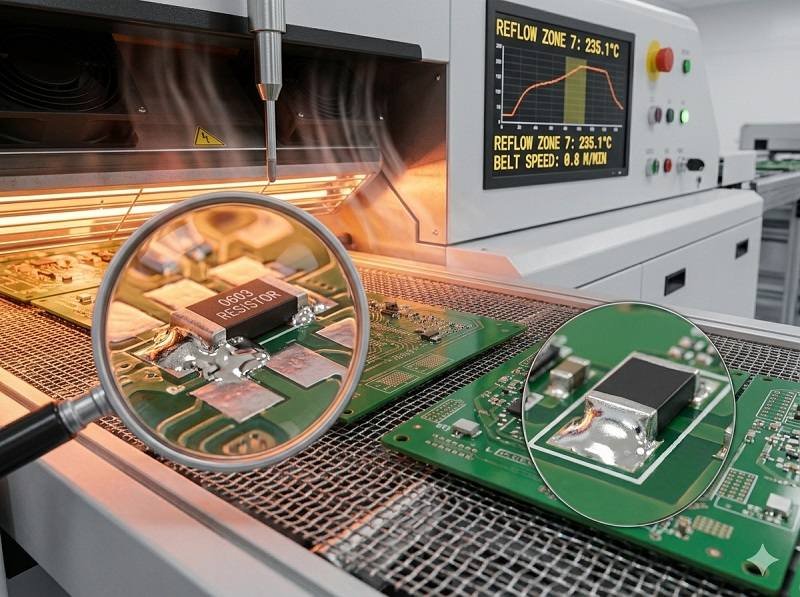
How Reflow Soldering Works
The reflow soldering process begins after solder paste has been applied to the PCB using a stencil. Components are then placed onto the paste in their correct positions.
The assembled board is passed through a reflow oven, where it is subjected to a carefully controlled temperature profile. As the temperature rises, the solder paste melts and flows around the component leads and pads.
After reaching peak temperature, the board is gradually cooled. The molten solder solidifies, forming strong and reliable solder joints that ensure proper electrical connections.
This step is a critical bridge between PCB 제조 and final PCB Assembly.
Reflow Soldering Temperature Profile
A reflow profile is a controlled heating and cooling curve that ensures proper soldering without damaging components. It typically consists of four stages.
Preheat stage gradually raises the temperature to prevent thermal shock and activate the flux.
Soak stage stabilizes the temperature and allows the flux to clean the surfaces.
Reflow stage reaches the melting point of the solder, allowing it to flow and form joints.
Cooling stage solidifies the solder and ensures joint strength.
Optimizing this temperature profile is essential for achieving high-quality results in SMT Assembly.
Types of Reflow Soldering
There are different types of reflow soldering methods used in PCB Assembly.
Convection reflow soldering is the most common, using heated air to evenly distribute temperature across the PCB.
Infrared (IR) reflow soldering uses infrared radiation to heat components, though it is less commonly used due to uneven heating risks.
Vapor phase reflow soldering uses a special liquid to transfer heat efficiently and prevent overheating, making it suitable for sensitive components.
Role of Reflow Soldering in SMT Assembly
Reflow soldering is essential in SMT 어셈블리 because it ensures precise and consistent soldering of surface-mount components.
It supports automated production lines, allowing for high-speed and repeatable PCB Assembly. This is especially important for complex and high-density boards used in modern electronics.
By combining solder paste application, component placement, and reflow soldering, manufacturers can achieve reliable and scalable production.
Reflow Soldering in Turnkey PCB Assembly
In 턴키 PCB 어셈블리, reflow soldering is managed as part of a complete manufacturing solution. The service provider controls solder paste selection, stencil design, component placement, and reflow parameters.
This integrated approach ensures compatibility across PCB Manufacturing and assembly processes, reducing defects and improving overall product quality.
Common Defects in Reflow Soldering
Despite its advantages, reflow soldering can produce defects if not properly controlled.
Common issues include solder bridging, tombstoning, cold joints, and voids. These defects are often caused by incorrect solder paste volume, improper temperature profiles, or poor component placement.
Regular inspection methods such as automated optical inspection (AOI) and X-ray analysis are used to detect and correct these problems.
Best Practices for Reflow Soldering
To achieve optimal results, several best practices should be followed.
Use high-quality solder paste and ensure proper storage conditions.
Design accurate PCB stencils to control paste deposition.
Optimize the reflow temperature profile based on the PCB design and component specifications.
Maintain and calibrate reflow ovens regularly to ensure consistent performance.
Work with experienced PCB Assembly providers to ensure process control and quality assurance.
결론
Reflow soldering is a fundamental process in PCB Assembly and SMT Assembly, enabling reliable and efficient attachment of electronic components. Its precision and scalability make it essential for both prototyping and high-volume PCB Manufacturing.
When integrated into Turnkey PCB Assembly services, reflow soldering helps ensure consistent quality, reduced defects, and efficient production of modern electronic devices.
Need support with BOM and component sourcing? Start by requesting a quote.
당사는 SMT, DIP 및 전체 턴키 솔루션을 포함한 전문 PCB 조립 서비스를 제공합니다.
NDA 가능 ✔ 24시간 이내 빠른 견적 ✔ ISO 인증 공장 ✔ 원스톱 PCB 및 PCBA 서비스
 한국어
한국어  English
  Deutsch
  Français
  Português do Brasil
  Español
  日本語
日本語  Nederlands
  Italiano
  Русский
  العربية
  Svenska
  Polski
  Türkçe
  繁體中文
繁體中文