
IPC-A-610 Standard
The IPC-A-610 standard is the most widely used document for defining the acceptability of electronic assemblies in PCB 어셈블리. It is published by the IPC and provides visual criteria for evaluating the quality of assembled printed circuit boards.
This standard is essential in SMT 어셈블리 그리고 턴키 PCB 어셈블리, as it ensures that products meet consistent quality and workmanship requirements.
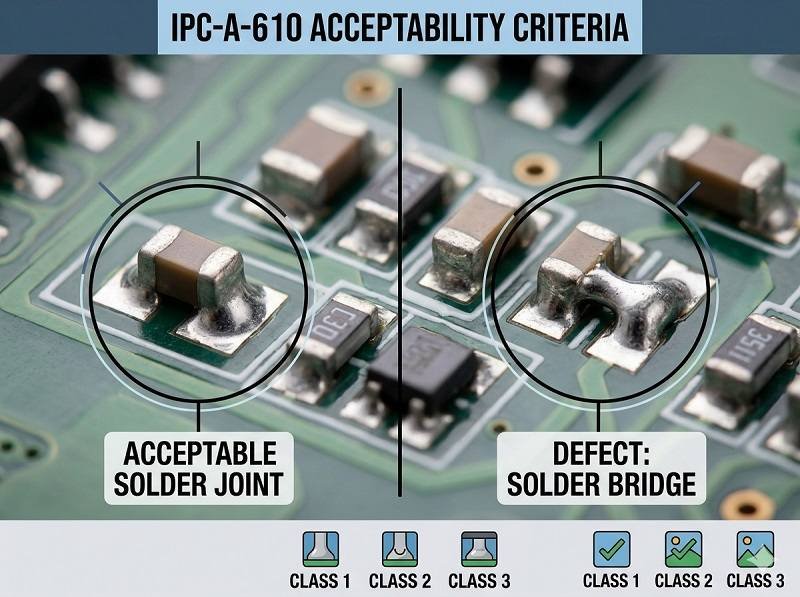
Purpose of IPC-A-610
IPC-A-610 establishes clear guidelines for what is considered acceptable, defective, or non-conforming in electronic assemblies.
It helps inspectors, engineers, and manufacturers assess solder joints, component placement, cleanliness, and overall build quality in PCB 제조 and assembly processes.
By using a standardized reference, companies can maintain consistent quality across different production lines and suppliers.
What IPC-A-610 Covers
The standard includes detailed visual examples and criteria for a wide range of assembly aspects.
Key areas include:
- Solder joint quality (through-hole and surface mount)
- Component placement and alignment
- Polarity and orientation
- PCB cleanliness and contamination
- Mechanical damage and defects
- Wire and terminal connections
These guidelines are critical for ensuring reliable performance in SMT 어셈블리.
IPC-A-610 Classes
IPC-A-610 defines three product classes based on reliability requirements.
클래스 1 applies to general consumer electronics, where basic functionality is sufficient.
클래스 2 covers dedicated service electronics, such as industrial equipment, where reliability is important.
클래스 3 is for high-performance and high-reliability products, including medical, aerospace, and military applications, where failure is not acceptable.
Selecting the correct class is crucial in PCB 어셈블리 프로젝트.
Role in SMT Assembly
In SMT 어셈블리, IPC-A-610 provides detailed criteria for evaluating solder joints on surface-mounted components.
It defines acceptable solder fillet shapes, wetting conditions, and defect limits such as bridging, voids, or insufficient solder.
This ensures consistent quality even in high-density and fine-pitch designs.
Importance in Turnkey PCB Assembly
In 턴키 PCB 어셈블리, IPC-A-610 is applied throughout the entire process.
From PCB 제조 to final inspection, the standard ensures that every stage meets defined quality levels.
It also helps align expectations between customers and manufacturers by providing a common inspection reference.
Benefits of IPC-A-610 Compliance
Following IPC-A-610 offers several advantages.
It improves product reliability and reduces defect rates.
It standardizes inspection processes across different facilities.
It enhances communication between customers and suppliers.
It ensures compliance with industry requirements and customer specifications.
IPC Certification
Many manufacturers train their staff and obtain IPC-A-610 certification.
Certified operators and inspectors are trained to identify defects and ensure compliance with the standard, improving overall quality in PCB Assembly.
결론
IPC-A-610 is the global benchmark for evaluating the quality of electronic assemblies. By defining clear visual acceptance criteria, it plays a critical role in ensuring consistency and reliability in PCB 어셈블리, SMT 어셈블리, 및 턴키 PCB 어셈블리.
For any company involved in electronics manufacturing, understanding and applying IPC-A-610 is essential for delivering high-quality products that meet industry standards.
프로토타입부터 대량 생산까지 모든 것을 지원합니다. 지금 PCB 어셈블리 견적을 요청하세요.
당사는 SMT, DIP 및 전체 턴키 솔루션을 포함한 전문 PCB 조립 서비스를 제공합니다.
NDA 가능 ✔ 24시간 이내 빠른 견적 ✔ ISO 인증 공장 ✔ 원스톱 PCB 및 PCBA 서비스
 한국어
한국어  English
  Deutsch
  Français
  Português do Brasil
  Español
  日本語
日本語  Nederlands
  Italiano
  Русский
  العربية
  Svenska
  Polski
  Türkçe
  繁體中文
繁體中文