
Is Burn-in testing means
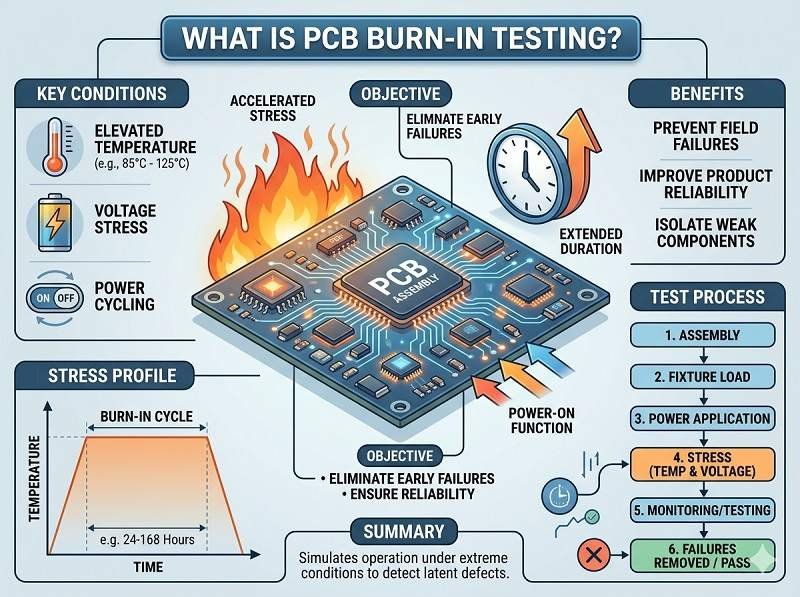
Burn-in testing is a reliability testing method used in PCB 어셈블리 to identify early-life failures by operating electronic products under controlled stress conditions for an extended period. The goal is to expose weak components or hidden defects before the product reaches the end user.
In SMT Assembly, burn-in testing is typically performed after the board has passed initial inspections and functional testing. It ensures that the PCB can operate consistently over time without unexpected failures.
Why burn-in testing is important
Not all defects appear immediately after manufacturing. Some components may fail only after prolonged use, especially under thermal or electrical stress.
Burn-in testing helps manufacturers:
- Detect early component failures
- Improve overall product reliability
- Reduce field returns and warranty costs
- Ensure stable long-term performance
For industries like automotive, medical, and industrial electronics, burn-in testing is often a critical requirement in PCB Assembly.
How burn-in testing works
During burn-in testing, the assembled PCB is powered on and operated continuously under elevated stress conditions. These conditions are designed to accelerate aging and reveal weaknesses.
Typical stress factors include:
- High temperature environments
- Continuous electrical load
- Voltage variations
- Extended operating time (hours or days)
By simulating harsh conditions, SMT 어셈블리 providers can ensure that only stable and reliable boards proceed to shipment.
Burn-in testing process in PCB assembly
In a standard PCB Assembly workflow, burn-in testing is performed after functional testing.
The typical sequence is:
- SMT Assembly → AOI/ICT → Functional Testing → Burn-in Testing
Boards are placed in specialized burn-in chambers or racks where they operate continuously. Any failure during this stage is recorded and analyzed.
Types of burn-in testing
Different products require different burn-in strategies depending on their application and reliability requirements.
Common types include:
- Static burn-in
The board is powered on without active signals, focusing on basic stability. - Dynamic burn-in
The PCB operates with full functionality, simulating real working conditions. - High-temperature burn-in
The board is tested under elevated temperatures to accelerate failure detection. - Load burn-in
Applies real or simulated loads to evaluate performance under stress.
These methods ensure comprehensive validation of PCB Assembly quality.
Benefits of burn-in testing
Burn-in testing provides several key advantages in SMT Assembly and PCB Assembly:
- Identifies weak or defective components early
- Improves product lifespan and reliability
- Reduces unexpected failures in the field
- Enhances customer confidence
It is particularly valuable for mission-critical applications where failure is not acceptable.
Limitations of burn-in testing
While burn-in testing is highly effective, it also has some limitations.
- It increases production time and cost
- Not all failure modes can be detected
- Requires specialized equipment and setup
Therefore, it is usually applied to high-reliability or high-value PCB Assembly projects rather than all products.
Burn-in testing vs other testing methods
Burn-in testing is different from other testing methods used in PCB Assembly.
- AOI focuses on visual defects
- ICT checks electrical connections
- Functional testing verifies performance
- Burn-in testing evaluates long-term reliability
Each method plays a unique role in ensuring product quality.
When burn-in testing is required
Burn-in testing is recommended for products that must operate reliably under demanding conditions.
Typical applications include:
- 자동차 전자 제품
- 의료 기기
- 산업용 제어 시스템
- Aerospace equipment
In these fields, SMT Assembly quality must meet strict reliability standards.
결론
Burn-in testing is a critical reliability verification process in PCB Assembly and SMT Assembly. By exposing products to extended stress conditions, it helps identify early failures and ensures long-term stability.
Although it adds time and cost, burn-in testing significantly improves product quality and reliability, making it an essential step for high-performance and mission-critical electronic products.
지금 바로 PCB 파일을 제출하고 빠른 견적을 받아보세요. 지금 요청하세요.
당사는 SMT, DIP 및 전체 턴키 솔루션을 포함한 전문 PCB 조립 서비스를 제공합니다.
NDA 가능 ✔ 24시간 이내 빠른 견적 ✔ ISO 인증 공장 ✔ 원스톱 PCB 및 PCBA 서비스
 한국어
한국어  English
  Deutsch
  Français
  Português do Brasil
  Español
  日本語
日本語  Nederlands
  Italiano
  Русский
  العربية
  Svenska
  Polski
  Türkçe
  繁體中文
繁體中文