
Is Batch Production in PCB Assembly
Batch production is a manufacturing method where a specific number of identical products are produced together in groups, known as batches. In the context of PCB 어셈블리, this means assembling a set quantity of printed circuit boards at one time before switching to another design or order.
This approach is commonly used in SMT 어셈블리 그리고 PCB 제조 when production volumes are moderate and multiple product types need to be handled efficiently.
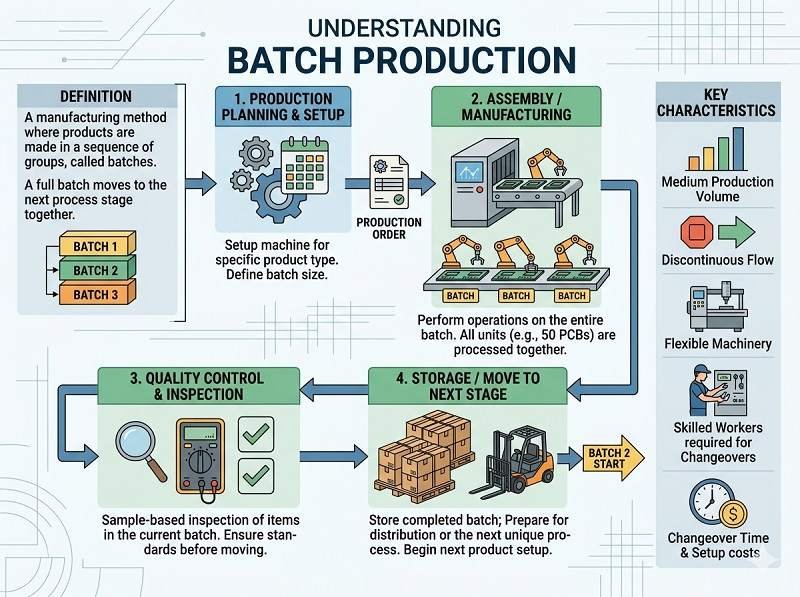
How Batch Production Works
In batch production, the manufacturing process is organized into cycles.
A batch of PCBs is prepared, assembled, inspected, and completed as a group. Once the batch is finished, the production line is reconfigured for the next batch.
For example, a factory may produce 500 units of one PCB design, then switch to another design for the next batch.
This method is widely applied in 턴키 PCB 어셈블리, where different customer orders are processed in sequence.
Key Characteristics of Batch Production
Batch production has several defining features.
Production is divided into groups rather than continuous flow.
Equipment setup changes between batches.
It balances efficiency and flexibility.
It is suitable for medium-volume production.
These characteristics make it ideal for many PCB 어셈블리 scenarios.
Advantages of Batch Production
Batch production offers multiple benefits.
It allows manufacturers to handle different product types efficiently.
It reduces setup costs compared to producing very small quantities individually.
It provides better quality control since each batch can be inspected before moving forward.
It is more flexible than mass production, especially in SMT 어셈블리 환경으로 이동합니다.
Disadvantages of Batch Production
Despite its advantages, batch production also has limitations.
Frequent setup changes can increase downtime.
Inventory may build up between production stages.
Lead times can be longer compared to continuous production.
Planning and scheduling are more complex in PCB 제조.
Batch Production vs Other Production Methods
Batch vs Mass Production
Mass production focuses on continuous, high-volume output of a single product.
Batch production, on the other hand, produces multiple products in separate groups.
Batch production offers more flexibility, while mass production offers higher efficiency.
Batch vs Low-Volume Production
Low-volume production focuses on small quantities, often prototypes.
Batch production typically involves larger quantities and more structured processes.
Role in SMT Assembly
In SMT 어셈블리, batch production is very common.
Each batch requires setup of solder paste stencils, pick-and-place programming, and reflow profiles.
Once configured, the system runs efficiently for the entire batch.
After completion, the line is adjusted for the next product.
Role in Turnkey PCB Assembly
In 턴키 PCB 어셈블리, batch production helps manage multiple customer orders.
Manufacturers can group similar projects to optimize material usage and machine setup.
This improves efficiency while maintaining flexibility for different designs.
When to Use Batch Production
Batch production is ideal when:
Production volumes are moderate.
Multiple product designs need to be manufactured.
Flexibility is required.
Cost efficiency is important but full automation is not necessary.
결론
Batch production is a practical and widely used manufacturing method in electronics production. It provides a balance between efficiency and flexibility, making it suitable for many PCB 어셈블리 그리고 SMT 어셈블리 프로젝트.
In PCB 제조 그리고 턴키 PCB 어셈블리, batch production enables manufacturers to handle diverse orders while maintaining quality and cost control.
신뢰할 수 있는 PCB 조립 파트너가 필요하신가요? 견적을 요청하고 상담해 보세요.
당사는 SMT, DIP 및 전체 턴키 솔루션을 포함한 전문 PCB 조립 서비스를 제공합니다.
NDA 가능 ✔ 24시간 이내 빠른 견적 ✔ ISO 인증 공장 ✔ 원스톱 PCB 및 PCBA 서비스
 한국어
한국어  English
  Deutsch
  Français
  Português do Brasil
  Español
  日本語
日本語  Nederlands
  Italiano
  Русский
  العربية
  Svenska
  Polski
  Türkçe
  繁體中文
繁體中文