
A Pick and Place File
A pick and place file is a crucial data file used in PCB 어셈블리 to guide automated machines in placing electronic components onto a printed circuit board. It provides precise information about where each component should be positioned, making it essential for modern SMT 어셈블리 프로세스.
This file is also commonly referred to as a centroid file, and the two terms are often used interchangeably in the electronics manufacturing industry.
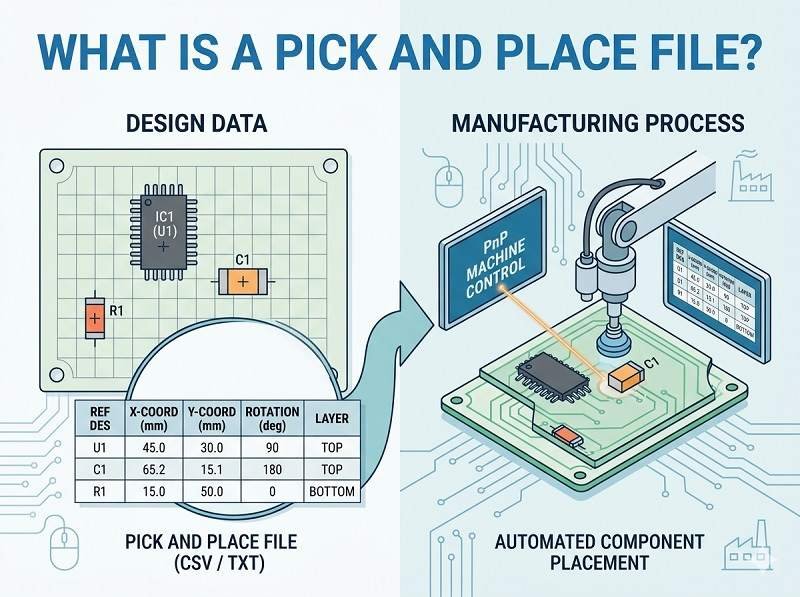
What Information Does a Pick and Place File Contain
A standard pick and place file includes all the data required for accurate component placement.
Typical fields include:
- Reference Designator (e.g., R1, C1, U1)
- X and Y Coordinates (exact component location)
- Rotation (orientation angle of the component)
- Layer (Top or Bottom side of the PCB)
- Package or Footprint type
This structured information allows machines to place components quickly and accurately during SMT 어셈블리.
How It Is Used in SMT Assembly
In SMT 어셈블리, pick and place machines use this file to automate the placement process.
The machine reads the coordinates and orientation data, picks components from feeders, and places them onto the PCB with high precision. This automation significantly improves speed, consistency, and accuracy compared to manual assembly.
For high-density designs and fine-pitch components, the pick and place file is indispensable.
Pick and Place File vs BOM
The pick and place file works together with the BOM in PCB 어셈블리.
The BOM defines what components are needed, while the pick and place file defines where and how those components should be placed on the board.
Both files must match perfectly to ensure correct assembly, especially in 턴키 PCB 어셈블리, where the manufacturer manages the entire process.
File Formats
Pick and place files are usually provided in simple, machine-readable formats.
Common formats include CSV (.csv), TXT (.txt), or Excel (.xls/.xlsx). These formats are compatible with most PCB Manufacturing and assembly equipment.
Clear formatting ensures that the data can be imported directly into placement machines without errors.
Importance in Turnkey PCB Assembly
In 턴키 PCB 어셈블리, the pick and place file is essential for efficient production.
Since the manufacturer handles both sourcing and assembly, accurate placement data ensures that components procured based on the BOM are correctly installed during SMT Assembly.
It reduces setup time and minimizes the risk of placement errors.
Common Errors to Avoid
Mistakes in the pick and place file can cause serious issues.
Incorrect coordinates can lead to misplaced components.
Wrong rotation values may result in improper orientation, especially for polarized parts.
Inconsistent reference designators between files can create confusion.
Missing layer information may cause components to be placed on the wrong side.
Avoiding these errors is critical for successful PCB Assembly.
Best Practices
To ensure a reliable pick and place file, follow these best practices.
Verify all component footprints and orientations in the PCB design.
Ensure consistency with BOM and Gerber files.
Clearly specify Top and Bottom layers.
Use standard file formats like CSV or TXT.
Double-check rotation values, especially for ICs and connectors.
결론
A pick and place file is a fundamental part of the PCB Assembly process, providing the exact placement data needed for automated SMT 어셈블리. Together with BOM and Gerber files, it ensures accurate, efficient, and high-quality production.
In both prototyping and mass production, especially in 턴키 PCB 어셈블리, a well-prepared pick and place file is key to achieving reliable results in modern PCB 제조.
파일을 업로드하고 자세한 견적을 받아보세요. 시작하려면 아래를 클릭하세요.
당사는 SMT, DIP 및 전체 턴키 솔루션을 포함한 전문 PCB 조립 서비스를 제공합니다.
NDA 가능 ✔ 24시간 이내 빠른 견적 ✔ ISO 인증 공장 ✔ 원스톱 PCB 및 PCBA 서비스


 한국어
한국어  English
  Deutsch
  Français
  Português do Brasil
  Español
  日本語
日本語  Nederlands
  Italiano
  Русский
  العربية
  Svenska
  Polski
  Türkçe
  繁體中文
繁體中文