
Standards Are Used in PCB Assembly
PCB assembly relies on a set of internationally recognized standards to ensure product quality, reliability, and consistency. These standards guide every stage of PCB 어셈블리, including SMT 어셈블리, inspection, testing, and PCB 제조 프로세스.
By following these standards, manufacturers can meet customer expectations, reduce defects, and comply with global regulations.
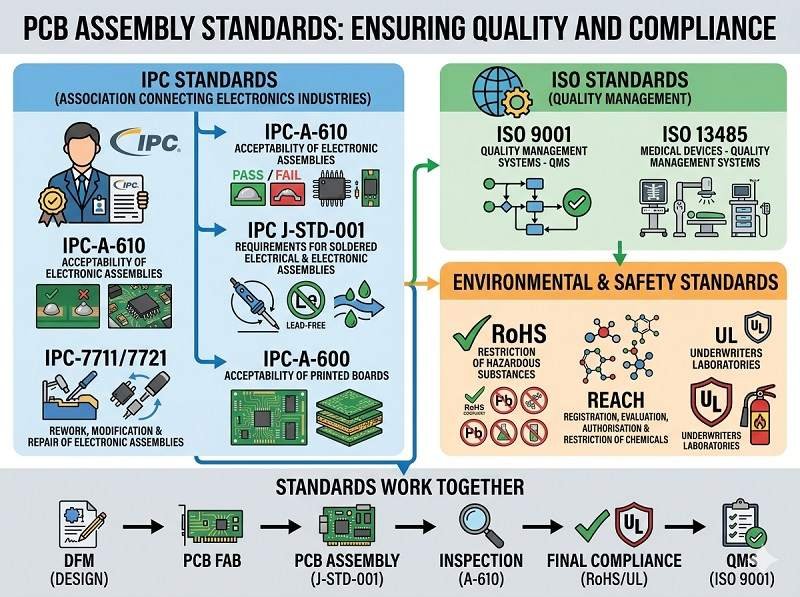
IPC Standards
The most important standards in PCB assembly are developed by the IPC.
Key IPC standards include:
- IPC-A-610 – Acceptability of electronic assemblies (visual inspection criteria)
- IPC-J-STD-001 – Requirements for soldered electrical and electronic assemblies
- IPC-7711/7721 – Rework, modification, and repair of electronic assemblies
- IPC-2221 – General PCB design standard
- IPC-6012 – Qualification and performance specification for rigid PCBs
These standards define quality levels and are widely used in SMT 어셈블리 그리고 턴키 PCB 어셈블리.
ISO Standards
International Organization for Standardization (International Organization for Standardization) standards are also important in PCB Manufacturing and assembly.
Common ISO standards include:
- ISO 9001 – Quality management systems
- ISO 14001 – Environmental management systems
- ISO 13485 – Quality management for medical devices
These standards ensure that manufacturers maintain consistent processes and continuous improvement.
RoHS 준수
Environmental compliance is governed by the RoHS 지침.
RoHS restricts the use of hazardous substances such as lead, mercury, and cadmium in electronic products.
In PCB 어셈블리, this means using lead-free solder and compliant materials throughout SMT 어셈블리 and PCB Manufacturing.
UL 인증
그리고 UL certification focuses on product safety.
UL standards ensure that PCBs meet fire resistance and electrical safety requirements. Many products, especially those sold in North America, require UL certification.
IEC Standards
그리고 International Electrotechnical Commission develops standards for electrical and electronic technologies.
IEC standards cover safety, performance, and testing requirements for electronic products, complementing IPC and ISO standards in PCB Assembly.
JEDEC Standards
그리고 JEDEC standards are widely used in the semiconductor industry.
They define component packaging, reliability testing, and moisture sensitivity levels (MSL), which are critical for proper handling during SMT 어셈블리.
ANSI Standards
그리고 American National Standards Institute oversees standards used in the United States.
ANSI standards often align with IPC, ISO, and IEC, ensuring consistency across industries.
Importance of Standards in Turnkey PCB Assembly
In 턴키 PCB 어셈블리, these standards are applied across all stages—from PCB 제조 and component sourcing to SMT Assembly and final testing.
They ensure that the final product meets quality, safety, and environmental requirements while maintaining consistency across production batches.
Benefits of Following PCB Assembly Standards
Adhering to industry standards provides several advantages.
제품 신뢰성을 향상하고 고장률을 줄입니다.
It ensures compliance with global regulations.
It enhances customer trust and market acceptance.
It standardizes processes across design, manufacturing, and assembly.
결론
Multiple standards are used in PCB assembly, with IPC standards forming the foundation for quality and workmanship. Additional standards from ISO, IEC, UL, and JEDEC ensure compliance, safety, and reliability.
By following these standards in PCB 어셈블리, SMT 어셈블리, 및 턴키 PCB 어셈블리, manufacturers can deliver high-quality products that meet global industry requirements and customer expectations.
PCB 어셈블리 가격 및 리드 타임에 대한 도움이 필요하신가요? 지금 바로 견적을 요청하세요.
당사는 SMT, DIP 및 전체 턴키 솔루션을 포함한 전문 PCB 조립 서비스를 제공합니다.
NDA 가능 ✔ 24시간 이내 빠른 견적 ✔ ISO 인증 공장 ✔ 원스톱 PCB 및 PCBA 서비스
 한국어
한국어  English
  Deutsch
  Français
  Português do Brasil
  Español
  日本語
日本語  Nederlands
  Italiano
  Русский
  العربية
  Svenska
  Polski
  Türkçe
  繁體中文
繁體中文