
Conformal Coating Process
그리고 컨포멀 코팅 프로세스 is a protective step in PCB 어셈블리 where a thin, non-conductive polymer layer is applied to a completed circuit board. This coating “conforms” to the contours of the PCB, covering components, solder joints, and exposed traces to protect them from environmental hazards.
It is commonly used after SMT 어셈블리 and testing to enhance reliability, especially in harsh operating conditions.
Why Conformal Coating is Important
Electronic assemblies are often exposed to:
- 수분 및 습도
- 먼지 및 오염 물질
- 화학 물질 및 용제
- Temperature fluctuations
- 부식 및 산화
👉 Conformal coating acts as a barrier, significantly improving the durability of the PCB 어셈블리.
Conformal Coating Process Steps
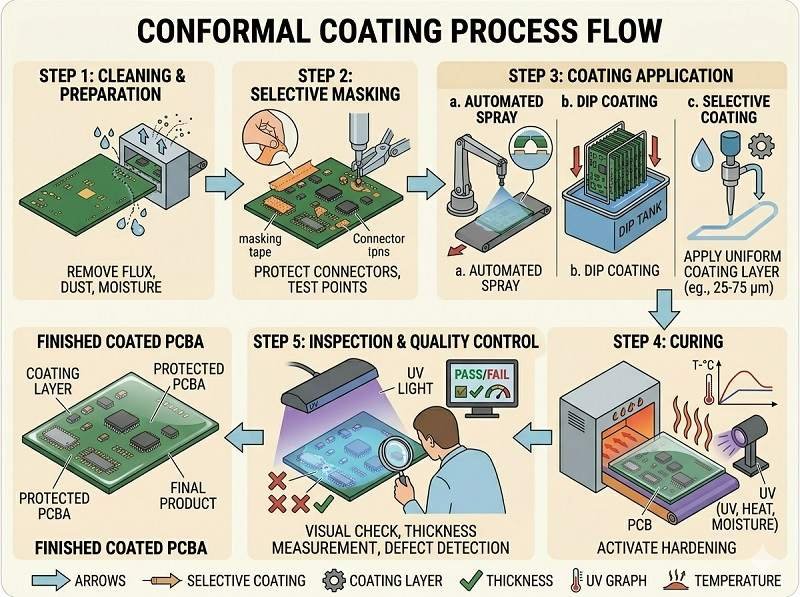
그리고 컨포멀 코팅 process typically includes the following stages:
Surface Cleaning
Before coating, the PCB must be thoroughly cleaned to remove:
- Flux residues
- 먼지 및 입자
- Oils or contaminants
Common cleaning methods include:
- Aqueous cleaning
- 솔벤트 청소
- Plasma cleaning
👉 Proper cleaning ensures strong adhesion of the coating.
마스킹
Certain areas must not be coated, such as:
- Connectors
- 테스트 포인트
- Switches
Masking methods include:
- Tape masking
- Rubber boots
- Custom fixtures
Coating Application
The coating material is applied using one of several methods:
Spray Coating
- Most common method
- Suitable for automated production
- Even coverage
Dip Coating
- PCB가 코팅액에 담근 상태
- Good for full coverage
- Less selective
Brush Coating
- Manual method
- Ideal for prototypes or rework
선택적 코팅
- Automated, precise application
- Coats only required areas
- Widely used in modern SMT 어셈블리 라인
치료
After application, the coating must cure (dry and harden):
- Air curing (room temperature)
- Heat/oven curing
- UV curing (fast and efficient)
👉 Curing time depends on the coating material used.
검사
Final inspection ensures:
- Proper coverage
- Correct thickness
- No bubbles or defects
Inspection methods include:
- Visual inspection (UV light)
- 두께 측정
Types of Conformal Coating Materials
Different materials are used depending on application needs:
- 아크릴(AR) – Easy to apply and repair
- 실리콘(SR) – High temperature resistance
- 폴리우레탄(UR) – Strong chemical resistance
- 에폭시(ER) – Excellent durability but difficult to rework
- 파릴렌(XY) – High-performance vacuum deposition coating
Advantages of Conformal Coating
- Protects against moisture and corrosion
- Extends product lifespan
- Improves reliability in harsh environments
- Reduces failure rates
- Lightweight and thin protection
Limitations of Conformal Coating
- Adds extra process cost
- Requires masking and process control
- Rework and repair can be difficult
- Not a substitute for full encapsulation
Applications of Conformal Coating
Conformal coating is widely used in:
- 자동차 전자 제품
- 항공우주 시스템
- 산업 장비
- 의료 기기
- Outdoor and IoT electronics
Best Practices for Conformal Coating
- Ensure thorough PCB cleaning before coating
- Choose the right coating material for the environment
- Use selective coating for precision
- Control coating thickness (typically 25–75 microns)
- Combine with proper inspection methods
Role in PCB Assembly
In the overall PCB 어셈블리 workflow:
- Applied after SMT Assembly and testing (ICT/FCT)
- Acts as a final protection layer
- Enhances long-term product reliability
결론
The conformal coating process is a vital step in PCB 어셈블리 그리고 SMT 어셈블리, providing essential protection against environmental damage. By selecting the right materials and applying proper process control, manufacturers can significantly improve the performance and lifespan of electronic products.
신뢰할 수 있는 PCB 어셈블리 솔루션을 찾고 계신가요? 지금 견적을 요청하려면 아래를 클릭하세요.
당사는 SMT, DIP 및 전체 턴키 솔루션을 포함한 전문 PCB 조립 서비스를 제공합니다.
NDA 가능 ✔ 24시간 이내 빠른 견적 ✔ ISO 인증 공장 ✔ 원스톱 PCB 및 PCBA 서비스
 한국어
한국어  English
  Deutsch
  Français
  Português do Brasil
  Español
  日本語
日本語  Nederlands
  Italiano
  Русский
  العربية
  Svenska
  Polski
  Türkçe
  繁體中文
繁體中文