
Riapplicare il rivestimento
Sì, Rivestimento conforme può essere riapplicato su un circuito stampato, e questa è una pratica standard in Assemblaggio di PCB e Assemblaggio SMT in caso di riparazioni, rilavorazioni o difetti del rivestimento. Tuttavia, il successo della riapplicazione dipende dalla corretta preparazione della superficie e dalla compatibilità con il rivestimento originale.
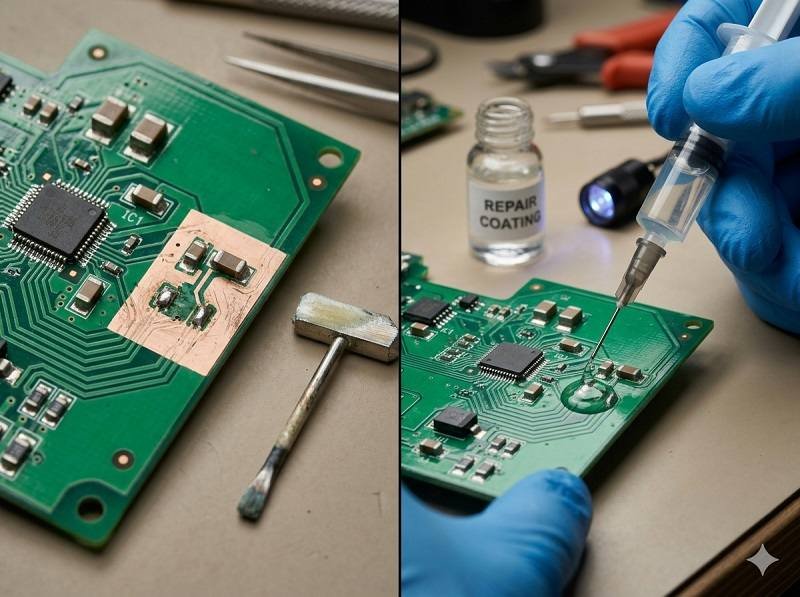
Quando è necessaria una nuova applicazione
La riapplicazione del rivestimento è comune in Assemblaggio di PCB chiavi in mano alle seguenti condizioni:
- Dopo la riparazione o la sostituzione dei componenti
- Quando il rivestimento originale è danneggiato (crepe, scrostature, graffi)
- In presenza di difetti del rivestimento, come bolle o copertura non uniforme
- A seguito di cambiamenti o modifiche ingegneristiche
Requisito fondamentale prima di ripresentare la domanda
Il passo più critico è preparazione della superficie:
- Rimuovere le parti danneggiate o vecchie Rivestimento conforme nell'area interessata
- Pulire la superficie per eliminare residui, polvere e contaminanti.
- Assicurarsi che il PCB sia completamente asciutto
Senza un'adeguata pulizia, il nuovo rivestimento potrebbe non aderire bene, causando futuri guasti.
Considerazioni sulla compatibilità
- Idealmente, riapplicare il stesso tipo di rivestimento (acrilico, silicone, uretano, ecc.).
- Alcuni rivestimenti aderiscono bene a se stessi (ad esempio, gli acrilici).
- Altri possono richiedere la rimozione completa prima della riverniciatura (ad esempio, epossidici o parilenici).
In Assemblaggio SMT, L'utilizzo di materiali compatibili garantisce una forte adesione e una protezione uniforme.
Metodi di riapplicazione
I metodi più comuni includono:
- Rivestimento a pennello → adatto per piccole aree di riparazione
- Rivestimento a spruzzo → fornisce una copertura più uniforme
- Rivestimento selettivo → automatizzato e preciso per gli ambienti di produzione
Il metodo deve corrispondere al processo originale utilizzato in Assemblaggio di PCB il più vicino possibile.
Polimerizzazione dopo la riapplicazione
Dopo l'applicazione del nuovo rivestimento:
- Consentire un'adeguata polimerizzazione (aria secca, calore o raggi UV a seconda del materiale).
- Seguire le specifiche del produttore per il tempo e la temperatura
- Evitare la manipolazione prima della completa polimerizzazione
Una corretta polimerizzazione garantisce durata e prestazioni.
Ispezione dopo la riverniciatura
Una volta indurito, ispezionare il PCB:
- Utilizzare l'ispezione UV per verificare la copertura
- Controllare che non vi siano bolle, spazi vuoti o sovracopertura.
- Confermare il corretto spessore e l'adesione
L'ispezione è essenziale per Assemblaggio di PCB chiavi in mano per mantenere gli standard di qualità.
Limiti e rischi
- Scarsa adesione se la superficie non è adeguatamente pulita
- Incompatibilità tra vecchi e nuovi rivestimenti
- Spessore non uniforme se la ricopertura non è controllata
- Difficoltà con più cicli di rilavorazione
Per ridurre al minimo i rischi, la riapplicazione deve seguire rigorosi controlli di processo.
Conclusione
Sì, Rivestimento conforme possono essere riapplicati efficacemente, a condizione che la superficie sia adeguatamente preparata e che si utilizzino materiali compatibili. In Assemblaggio di PCB, Assemblaggio SMT, e Assemblaggio di PCB chiavi in mano, Un'accurata riverniciatura aiuta a ripristinare la protezione, a prolungare la vita del prodotto e a mantenere un'elevata affidabilità.
Richiedete un preventivo per il rivestimento conforme
Volete ottimizzare i costi di rivestimento senza compromettere la qualità? Contattateci subito.
Inviateci i vostri requisiti e riceverete una risposta rapida dal nostro team di ingegneri.
✔ Risposta in 24 ore ✔ Supporto ingegneristico ✔ Produzione di piccole dimensioni e di massa
Shenzhen Tengxinjie Electronics Co., Ltd.
 Italiano
  English
  Deutsch
  Français
  Português do Brasil
  Español
  日本語
日本語  Nederlands
  Русский
  한국어
한국어  العربية
  Svenska
  Polski
  Türkçe
  繁體中文
繁體中文