
Through-Hole Assembly Process
Les through-hole assembly process is a traditional but still widely used method in Assemblage du circuit imprimé, where electronic components are inserted into drilled holes on a printed circuit board and then soldered to form strong mechanical and electrical connections. While modern manufacturing relies heavily on Assemblage SMT, through-hole technology (THT) remains essential for components that require durability, high power handling, or mechanical stability.
Below is a detailed explanation of the through-hole PCB Assembly process.
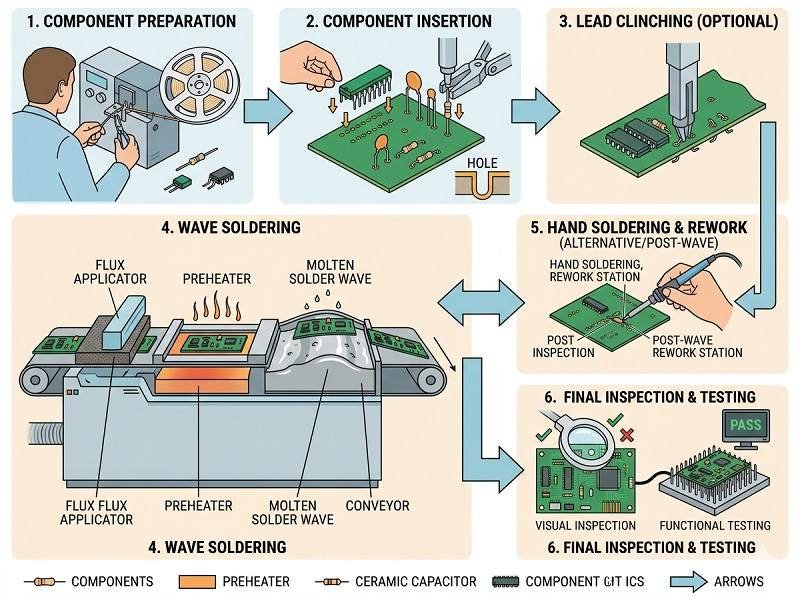
Overview of Through-Hole Assembly
In through-hole PCB Assembly:
- Component leads are inserted into pre-drilled holes
- Leads pass through the board and are soldered on the opposite side
- Connections are stronger compared to SMT-only designs
This method is commonly used in:
- Power electronics
- Équipements industriels
- Connectors and transformers
Through-Hole Assembly Process Flow
A standard through-hole PCB Assembly process includes:
- Component preparation
- Component insertion
- Lead trimming
- Soldering (wave or selective)
- Inspection et contrôle de la qualité
- Cleaning and finishing
Each step ensures reliability and structural strength.
Component Preparation
Before assembly begins:
- Components are checked for quality
- Leads may be pre-formed to fit hole spacing
- Parts are organized for efficient insertion
Proper preparation improves assembly efficiency and reduces errors.
Component Insertion
Components are inserted into the PCB:
- Manual insertion: used for low volume or complex boards
- Automated insertion: used in high-volume production
Operators or machines place components into designated holes based on assembly drawings.
Découpage des plombs
After insertion:
- Excess leads extending from the bottom of the PCB are trimmed
- Ensures proper soldering and prevents short circuits
This step prepares the board for the soldering process.
Soldering Methods
Soudure à la vague
The most common method in through-hole PCB Assembly:
- The PCB passes over a موجة من solder molten
- Solder attaches to exposed metal leads and pads
- Suitable for high-volume production
Soudure sélective
Used for mixed Assemblage du circuit imprimé (SMT + through-hole):
- Solder is applied only to specific areas
- Prevents damage to nearby SMT components
Selective soldering offers higher precision.
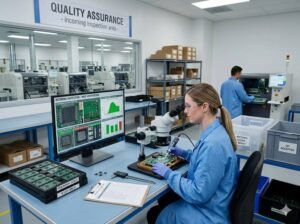
Inspection et contrôle de la qualité
After soldering, inspection ensures quality:
- Visual inspection for solder joints
- AOI (Inspection optique automatisée)
- X-ray inspection (if necessary)
Checks include:
- Proper wetting
- No cold joints
- No solder bridges
Cleaning Process
If required:
- Flux residues are removed
- Cleaning improves long-term reliability
This step is important for high-reliability applications.
Final Testing
Through-hole assembled boards may undergo:
- Essais électriques
- Essais fonctionnels
This verifies that the PCB Assembly performs as expected.
Advantages of Through-Hole Assembly
- Strong mechanical bonding
- High reliability in harsh environments
- Suitable for high-power and high-voltage applications
- Better resistance to vibration and thermal stress
Disadvantages Compared to SMT Assembly
- Higher labor cost
- Slower production speed
- Requires drilling holes (higher PCB cost)
- Lower component density
Because of these limitations, through-hole is often combined with Assemblage SMT in modern designs.
Applications of Through-Hole PCB Assembly
- Systèmes de contrôle industriel
- Électronique automobile
- Aérospatiale et défense
- Power supply units
- Large connectors and transformers
Through-Hole vs SMT Assembly
| Fonctionnalité | Assemblage des trous de passage | Assemblage SMT |
|---|---|---|
| Mounting method | Leads through holes | Surface mounting |
| Strength | Très élevé | Modéré |
| Automatisation | Limitée | Highly automated |
| Coût | Plus élevé | Plus bas |
| Densité | Plus bas | Plus élevé |
Conclusion
The through-hole assembly process remains a critical part of Assemblage du circuit imprimé, especially for applications requiring strong mechanical connections and high reliability. Although Assemblage SMT dominates modern electronics, through-hole technology continues to play an important role in mixed assembly designs.
Understanding both processes allows engineers and buyers to choose the right solution for performance, cost, and durability.
Laissez-nous vous aider à optimiser vos coûts et votre production. Demandez un devis d'assemblage de circuits imprimés dès aujourd'hui.
Nous fournissons des services professionnels d'assemblage de circuits imprimés, y compris SMT, DIP et des solutions complètes clé en main.
✔ NDA disponible ✔ Devis rapide sous 24 heures ✔ Usine certifiée ISO ✔ Service unique de PCB et PCBA
 Français
  English
  Deutsch
  Português do Brasil
  Español
  日本語
日本語  Nederlands
  Italiano
  Русский
  한국어
한국어  العربية
  Svenska
  Polski
  Türkçe
  繁體中文
繁體中文