
Soldadura reflow
La soldadura por reflujo es un proceso clave en Montaje de PCB, especialmente en Montaje SMT, La soldadura se utiliza para unir de forma permanente componentes electrónicos de montaje superficial a una placa de circuito impreso. Consiste en calentar la pasta de soldadura a una temperatura controlada hasta que se funde (refluye) y forma conexiones eléctricas y mecánicas fiables entre los componentes y las placas de circuito impreso.
Este proceso está muy extendido en la fabricación moderna de productos electrónicos por su eficacia, precisión y capacidad para manejar diseños de circuitos de alta densidad.
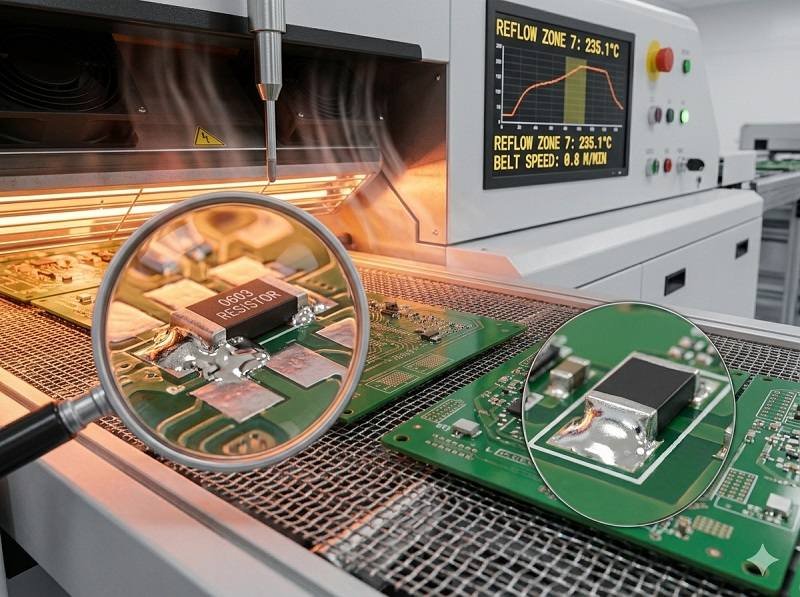
Cómo funciona la soldadura reflow
El proceso de soldadura por reflujo comienza una vez aplicada la pasta de soldadura a la placa de circuito impreso mediante una plantilla. A continuación, los componentes se colocan sobre la pasta en su posición correcta.
La placa ensamblada pasa por un horno de reflujo, donde se somete a un perfil de temperatura cuidadosamente controlado. A medida que aumenta la temperatura, la pasta de soldadura se funde y fluye alrededor de los conductores y las almohadillas de los componentes.
Tras alcanzar la temperatura máxima, la placa se enfría gradualmente. La soldadura fundida se solidifica, formando uniones fuertes y fiables que garantizan conexiones eléctricas adecuadas.
Este paso es un puente fundamental entre Fabricación de PCB y montaje final de PCB.
Perfil de temperatura de soldadura por reflujo
Un perfil de reflujo es una curva controlada de calentamiento y enfriamiento que garantiza una soldadura adecuada sin dañar los componentes. Suele constar de cuatro etapas.
La etapa de precalentamiento eleva gradualmente la temperatura para evitar el choque térmico y activar el fundente.
La etapa de remojo estabiliza la temperatura y permite que el fundente limpie las superficies.
La etapa de reflujo alcanza el punto de fusión de la soldadura, permitiendo que fluya y forme juntas.
La fase de enfriamiento solidifica la soldadura y garantiza la resistencia de la unión.
La optimización de este perfil de temperatura es esencial para obtener resultados de alta calidad en el montaje SMT.
Tipos de soldadura reflow
Existen diferentes tipos de métodos de soldadura por reflujo utilizados en el montaje de placas de circuito impreso.
La soldadura por reflujo por convección es la más habitual, ya que utiliza aire caliente para distribuir uniformemente la temperatura por la placa de circuito impreso.
La soldadura por reflujo de infrarrojos (IR) utiliza la radiación infrarroja para calentar los componentes, aunque se utiliza menos debido a los riesgos de calentamiento desigual.
La soldadura por reflujo en fase vapor utiliza un líquido especial para transferir el calor de forma eficaz y evitar el sobrecalentamiento, por lo que resulta adecuada para componentes sensibles.
Papel de la soldadura reflow en el ensamblaje SMT
La soldadura por reflujo es esencial en Montaje SMT porque garantiza una soldadura precisa y uniforme de los componentes de montaje superficial.
Admite líneas de producción automatizadas, lo que permite un montaje de PCB de alta velocidad y repetible. Esto es especialmente importante para las placas complejas y de alta densidad utilizadas en la electrónica moderna.
Combinando la aplicación de pasta de soldadura, la colocación de componentes y la soldadura por reflujo, los fabricantes pueden conseguir una producción fiable y escalable.
Soldadura por reflujo en el montaje llave en mano de placas de circuito impreso
En Montaje de PCB llave en mano, la soldadura por reflujo se gestiona como parte de una solución de fabricación completa. El proveedor de servicios controla la selección de la pasta de soldadura, el diseño de la plantilla, la colocación de los componentes y los parámetros de reflujo.
Este enfoque integrado garantiza la compatibilidad en todos los procesos de fabricación y montaje de placas de circuito impreso, reduciendo los defectos y mejorando la calidad general del producto.
Defectos comunes en la soldadura por reflujo
A pesar de sus ventajas, la soldadura por reflujo puede producir defectos si no se controla adecuadamente.
Entre los problemas más comunes se encuentran la formación de puentes de soldadura, la formación de tombstones, las juntas frías y los huecos. Estos defectos suelen deberse a un volumen incorrecto de pasta de soldadura, a perfiles de temperatura inadecuados o a una mala colocación de los componentes.
Para detectar y corregir estos problemas se utilizan métodos de inspección habituales, como la inspección óptica automatizada (IOA) y el análisis por rayos X.
Prácticas recomendadas para la soldadura por reflujo
Para lograr resultados óptimos, deben seguirse varias prácticas recomendadas.
Utilice pasta de soldar de alta calidad y garantice unas condiciones de almacenamiento adecuadas.
Diseñe esténciles de PCB precisos para controlar la deposición de pasta.
Optimice el perfil de temperatura de reflujo en función del diseño de la placa de circuito impreso y las especificaciones de los componentes.
Mantenga y calibre los hornos de reflujo con regularidad para garantizar un rendimiento constante.
Trabaje con proveedores experimentados en montaje de PCB para garantizar el control de procesos y la garantía de calidad.
Conclusión
La soldadura por reflujo es un proceso fundamental en el ensamblaje de placas de circuito impreso y en el ensamblaje SMT, que permite una fijación fiable y eficaz de los componentes electrónicos. Su precisión y escalabilidad lo hacen esencial tanto para la creación de prototipos como para la fabricación de PCB de gran volumen.
Cuando se integra en los servicios de montaje de placas de circuito impreso llave en mano, la soldadura por reflujo ayuda a garantizar una calidad constante, una reducción de los defectos y una producción eficaz de los dispositivos electrónicos modernos.
¿Necesita ayuda con la lista de materiales y la búsqueda de componentes? Solicite un presupuesto.
Ofrecemos servicios profesionales de ensamblaje de placas de circuito impreso, incluyendo SMT, DIP y soluciones completas llave en mano.
✔ NDA disponible ✔ Presupuesto rápido en 24 horas ✔ Fábrica certificada ISO ✔ Servicio integral de PCB y PCBA.
 Español
  English
  Deutsch
  Français
  Português do Brasil
  日本語
日本語  Nederlands
  Italiano
  Русский
  한국어
한국어  العربية
  Svenska
  Polski
  Türkçe
  繁體中文
繁體中文