
Proceso de eliminación del revestimiento
El proceso de eliminación del revestimiento se refiere a la eliminación controlada de Revestimiento conforme de una placa de circuito impreso para permitir su inspección, reparación, modificación o reelaboración. Es una operación crítica en Montaje de PCB y Montaje SMT, especialmente cuando hay que corregir defectos o sustituir componentes.
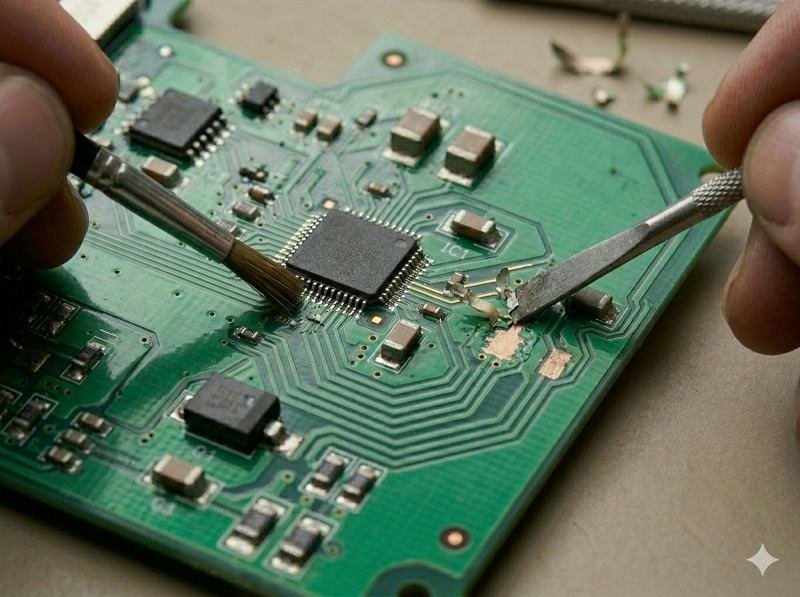
Por qué es necesario eliminar el revestimiento
En Montaje de PCB llave en mano, La eliminación del revestimiento suele ser necesaria para
- Reparación o sustitución de componentes defectuosos
- Reparación de defectos del revestimiento (burbujas, grietas, deslaminación)
- Eliminación de la contaminación atrapada bajo el revestimiento
- Aplicación de cambios de diseño o ingeniería
- Realización de inspecciones o pruebas detalladas
Sin una extracción adecuada, acceder a los circuitos de la placa de circuito impreso sería difícil y arriesgado.
Tipos de revestimientos conformados y dificultad de eliminación
Los distintos revestimientos requieren métodos de eliminación diferentes:
- Revestimientos acrílicos → más fácil de quitar
- Recubrimientos de silicona → flexible, dificultad moderada
- Recubrimientos de uretano → más resistente a los productos químicos
- Revestimientos epoxídicos → muy duro, difícil de eliminar
- Revestimientos de parileno → requieren técnicas especializadas
Comprender el tipo de revestimiento es esencial para Montaje de PCB antes de iniciar la retirada.
Métodos habituales de eliminación de revestimientos
Eliminación de disolventes
- Utiliza disolventes químicos para disolver el revestimiento
- Más eficaz para revestimientos acrílicos
- Sencillo y muy utilizado en Montaje SMT repasar
Eliminación mecánica
- Implica raspado, cepillado o microabrasión
- Adecuado para la eliminación localizada
- Requiere precisión para evitar daños en la placa de circuito impreso
Decapado químico
- Utiliza productos químicos más fuertes para revestimientos resistentes (uretano, epoxi)
- Eficaz, pero debe controlarse cuidadosamente
- Requiere medidas de seguridad adecuadas
Eliminación térmica
- Aplica calor para ablandar el revestimiento
- Facilita la extracción mecánica
- Debe evitar el sobrecalentamiento de los componentes sensibles
Eliminación con plasma o láser (avanzada)
- Se utiliza para placas de alta precisión o complejas
- Ideal para la eliminación selectiva en Montaje de PCB llave en mano
Etapas del proceso de eliminación del revestimiento
- Identificar el tipo de revestimiento
- Seleccione el método de eliminación adecuado
- Proteja los componentes circundantes (enmascarando si es necesario)
- Eliminar el revestimiento de la zona deseada
- Limpiar a fondo los residuos
- Inspeccionar la placa de circuito impreso en busca de daños o restos de revestimiento
Cada paso debe controlarse cuidadosamente para mantener la integridad de la placa.
Desafíos en la eliminación de revestimientos
- Riesgo de dañar componentes o trazas de PCB
- Los residuos que quedan afectan al repintado
- Requiere mucho tiempo para revestimientos duros
- Seguridad en el uso de productos químicos
Estos retos ponen de relieve la importancia de un control adecuado del proceso en Montaje de PCB.
Buenas prácticas
- Utilizar revestimientos que faciliten la reelaboración siempre que sea posible.
- Limitar la retirada sólo a las zonas necesarias
- Utilizar herramientas adecuadas y técnicos formados
- Siga las directrices de seguridad y medio ambiente
- Garantizar una limpieza completa antes del repintado
Conclusión
El proceso de eliminación del revestimiento es una parte esencial del retrabajo en Montaje de PCB, Montaje SMT, y Montaje de PCB llave en mano. Seleccionando el método correcto y siguiendo procedimientos controlados, los fabricantes pueden eliminar de forma segura Revestimiento conforme, reparar y restablecer la funcionalidad de las placas de circuito impreso sin comprometer la fiabilidad.
Obtenga un presupuesto de revestimiento de conformación
¿Trabaja en electrónica de automoción, industrial o de exteriores? Podemos ayudarle con el revestimiento de conformación.
Envíenos sus requisitos y obtenga una respuesta rápida de nuestro equipo de ingenieros.
✔ Respuesta en 24 horas ✔ Soporte de ingeniería ✔ Producción en serie y a pequeña escala
Shenzhen Tengxinjie Electronics Co.
 Español
  English
  Deutsch
  Français
  Português do Brasil
  日本語
日本語  Nederlands
  Italiano
  Русский
  한국어
한국어  العربية
  Svenska
  Polski
  Türkçe
  繁體中文
繁體中文