
Wave Soldering vs Reflow Soldering in PCB Assembly
Wave soldering and reflow soldering are two widely used soldering methods in PCB-Montage. Both processes are essential in PCB-Herstellung und SMT-Bestückung, but they are designed for different types of components and production requirements.
Understanding the differences between these two methods helps manufacturers choose the right process for efficient and reliable Schlüsselfertige PCB-Montage.
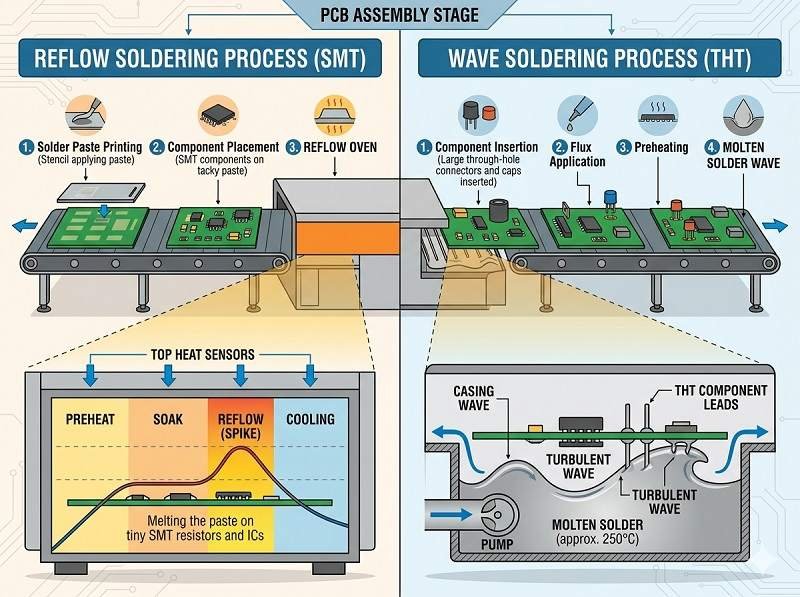
What is Reflow Soldering
Reflow soldering is primarily used for surface-mount components in SMT-Bestückung.
In this process, solder paste is first applied to PCB pads using a stencil. Components are then placed on the board, and the entire assembly is passed through a reflow oven. The heat melts the solder paste, forming strong electrical and mechanical connections.
Key Features of Reflow Soldering
- Ideal for surface-mount devices (SMDs)
- High precision for fine-pitch and small components
- Fully automated and suitable for high-density PCBs
- Üblich in modernen PCB-Montage Zeilen
What is Wave Soldering
Wave soldering is mainly used for through-hole components.
In this process, the PCB passes over a موجة (wave) of molten solder. The solder adheres to exposed metal areas, creating connections between component leads and the PCB.
Key Features of Wave Soldering
- Suitable for through-hole components
- Efficient for soldering multiple joints at once
- Commonly used after SMT-Bestückung for mixed-technology boards
- Reliable for strong mechanical connections
Wave Soldering vs Reflow Soldering: Key Differences
Component Type
Reflow soldering is used for surface-mount components in SMT-Bestückung.
Wave soldering is used for through-hole components.
Process Method
Reflow uses controlled heating in an oven to melt solder paste.
Wave soldering uses a موجة of molten solder to form joints.
Automation and Precision
Reflow soldering offers higher precision and is ideal for fine-pitch designs.
Wave soldering is less precise but highly efficient for bulk soldering.
Application in PCB Assembly
Reflow soldering dominates modern PCB-Herstellung due to the widespread use of SMT components.
Wave soldering is still important for connectors, transformers, and other through-hole parts.
When to Use Reflow Soldering
Reflow soldering is best when:
- The design uses surface-mount components
- High-density layouts are required
- Precision and consistency are critical
- Large-scale SMT-Bestückung is involved
When to Use Wave Soldering
Wave soldering is suitable when:
- The PCB includes through-hole components
- Strong mechanical connections are needed
- Mixed-technology boards are used
- Production efficiency is important
Role in Turnkey PCB Assembly
Unter Schlüsselfertige PCB-Montage, both methods are often used together.
Reflow soldering handles SMT components.
Wave soldering is used for through-hole components after SMT processes are completed.
This combination ensures efficient and reliable assembly for complex PCB designs.
Advantages and Limitations
Reflow Soldering Advantages
High accuracy and repeatability
Suitable for miniaturized electronics
Compatible with automated SMT-Bestückung
Reflow Soldering Limitations
Not suitable for most through-hole components
Requires precise process control
Wave Soldering Advantages
Efficient for through-hole soldering
Strong and reliable joints
Suitable for batch production
Wave Soldering Limitations
Less suitable for fine-pitch components
Risk of solder bridging if not properly controlled
Schlussfolgerung
Wave soldering and reflow soldering are both essential in modern electronics manufacturing. Reflow soldering is the standard for SMT-Bestückung, offering high precision and efficiency, while wave soldering remains important for through-hole components.
Unter PCB-Montage, PCB-Herstellung, und Schlüsselfertige PCB-Montage, selecting the right soldering method—or combining both—ensures optimal performance, reliability, and production efficiency.
Von der Entwurfsprüfung bis zur Lieferung - wir unterstützen jeden Schritt. Fordern Sie Ihr Angebot für die Leiterplattenbestückung an.
Wir bieten professionelle PCB-Bestückungsdienstleistungen, einschließlich SMT, DIP und schlüsselfertige Lösungen.
✔ NDA verfügbar ✔ Schnelles Angebot innerhalb von 24 Stunden ✔ ISO-zertifizierte Fabrik ✔ PCB & PCBA Service aus einer Hand
 Deutsch
  English
  Français
  Português do Brasil
  Español
  日本語
日本語  Nederlands
  Italiano
  Русский
  한국어
한국어  العربية
  Svenska
  Polski
  Türkçe
  繁體中文
繁體中文