
Mixed PCB Assembly
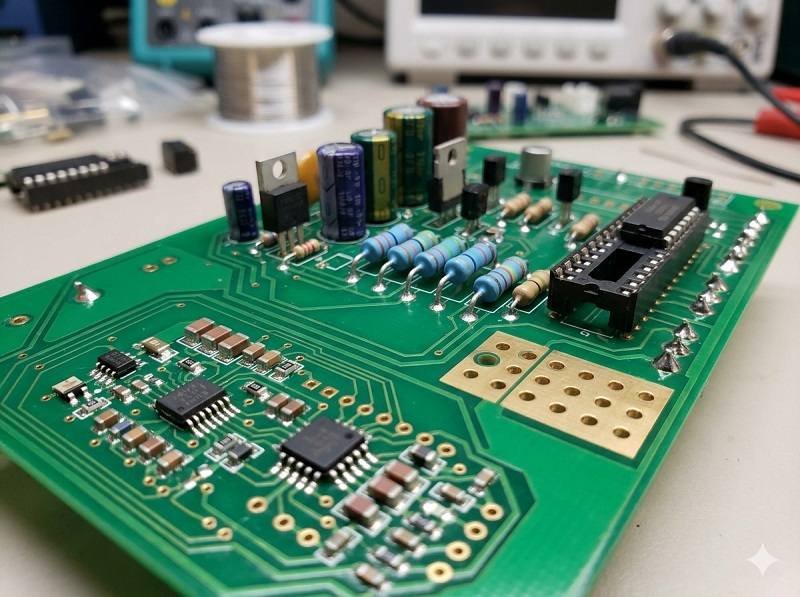
Mixed PCB Assembly is a manufacturing approach that combines both تجميع SMT (Surface Mount Technology) and through-hole technology (THT) on the same printed circuit board. In modern تجميع ثنائي الفينيل متعدد الكلور, this hybrid method is widely used to achieve the best balance between compact design, production efficiency, and mechanical strength.
Instead of relying on a single assembly method, mixed PCB Assembly integrates the advantages of SMT Assembly—such as high-speed automation and miniaturization—with the durability and reliability of through-hole components.
Why Use Mixed PCB Assembly?
In real-world electronic designs, not all components are suitable for SMT Assembly. While small and lightweight components work well with surface mounting, larger or high-power components often require stronger mechanical support.
Mixed PCB Assembly is used when:
- The design includes both SMD (surface mount devices) and through-hole components
- High mechanical strength is required (e.g., connectors, transformers)
- The product must withstand vibration or harsh environments
- Electrical performance and structural reliability are both critical
This makes mixed PCB Assembly a practical solution for complex and high-performance electronics.
Mixed PCB Assembly Process
The mixed PCB Assembly process typically follows a carefully planned sequence to ensure quality and efficiency:
SMT Assembly First
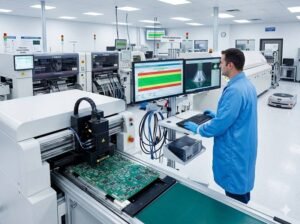
In most cases, SMT Assembly is performed first. Solder paste is applied, components are placed using pick-and-place machines, and the board goes through reflow soldering.
Through-Hole Component Insertion
After SMT Assembly, through-hole components are inserted into pre-drilled holes. This can be done manually or using automated insertion equipment.
Wave Soldering or Selective Soldering
Through-hole components are soldered using wave soldering or selective soldering techniques, depending on the design and production requirements.
Inspection and Testing
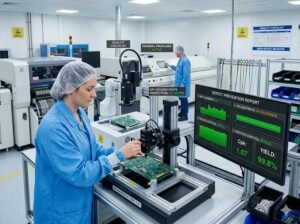
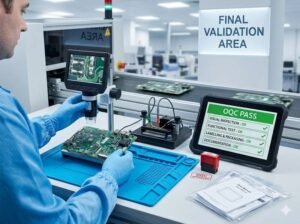
The final PCB Assembly undergoes inspection processes such as AOI, X-ray inspection, and functional testing to ensure all components are correctly installed and the board operates as intended.
Advantages of Mixed PCB Assembly
Mixed PCB Assembly offers several important benefits:
Design Flexibility
Engineers can choose the most suitable mounting method for each component, optimizing both performance and reliability.
Improved Mechanical Strength
Through-hole components provide strong anchoring, especially for connectors and heavy parts.
High Efficiency
SMT Assembly ensures fast and automated placement of smaller components, improving overall production efficiency.
Enhanced Reliability
Combining both technologies results in a more robust and durable product, especially in demanding environments.
Challenges of Mixed PCB Assembly
While mixed PCB Assembly is highly effective, it also introduces some complexities:
- More complicated manufacturing process compared to pure SMT Assembly
- Requires careful process planning and sequencing
- Higher production cost due to multiple assembly steps
- Increased inspection requirements
Manufacturers must have strong expertise in both PCB Assembly and SMT Assembly to successfully manage mixed technology projects.
Mixed PCB Assembly vs Pure SMT Assembly
Mixed PCB Assembly:
- Combines SMT Assembly and through-hole assembly
- Offers better mechanical strength
- Suitable for complex and high-reliability designs
- Slightly higher cost and complexity
SMT Assembly Only:
- Uses only surface-mounted components
- Faster and more cost-effective for large volumes
- Ideal for compact consumer electronics
- Limited mechanical strength for large components
Applications of Mixed PCB Assembly
Mixed PCB Assembly is commonly used in industries where both performance and durability are essential:
- Automotive electronics and control systems
- Industrial automation equipment
- Power supplies and energy systems
- الأجهزة الطبية
- إلكترونيات الطيران والفضاء والدفاع
These applications often require a combination of compact circuitry and robust physical connections.
Role in Modern PCB Assembly
As electronic products become more advanced, mixed PCB Assembly has become increasingly important. It allows manufacturers to leverage the speed of SMT Assembly while maintaining the strength of through-hole components.
Many modern PCB Assembly projects are no longer purely SMT-based but instead rely on mixed technology to meet demanding technical requirements.
الخاتمة
Mixed PCB Assembly is a hybrid approach that combines SMT Assembly and through-hole technology to create high-performance, reliable, and durable electronic products. By integrating the strengths of both methods, it offers the flexibility needed for complex designs and demanding applications.
For companies seeking optimized performance and reliability, mixed PCB Assembly is often the best solution within modern PCB Assembly processes.
هل تحتاج إلى مساعدة فيما يتعلق بتسعير تجميع ثنائي الفينيل متعدد الكلور والمهلة الزمنية؟ اطلب عرض الأسعار اليوم.
نحن نوفر خدمات تجميع ثنائي الفينيل متعدد الكلور الاحترافية بما في ذلك SMT وDIP وحلول تسليم المفتاح الكاملة.
✔ إتاحة اتفاقية عدم الإفشاء ✔ عرض أسعار سريع في غضون 24 ساعة ✔ مصنع معتمد من ISO ✔ خدمة PCB و PCBA الشاملة
 العربية
  English
  Deutsch
  Français
  Português do Brasil
  Español
  日本語
日本語  Nederlands
  Italiano
  Русский
  한국어
한국어  Svenska
  Polski
  Türkçe
  繁體中文
繁體中文