
Acrylic vs silicone Conformal Coating
When comparing acrylic and silicone Conformal Coating in PCB Assembly and SMT Assembly, there is no single “better” option. Each material is designed for different environments and performance needs. Choosing the right coating depends on your application, cost considerations, and reliability requirements.
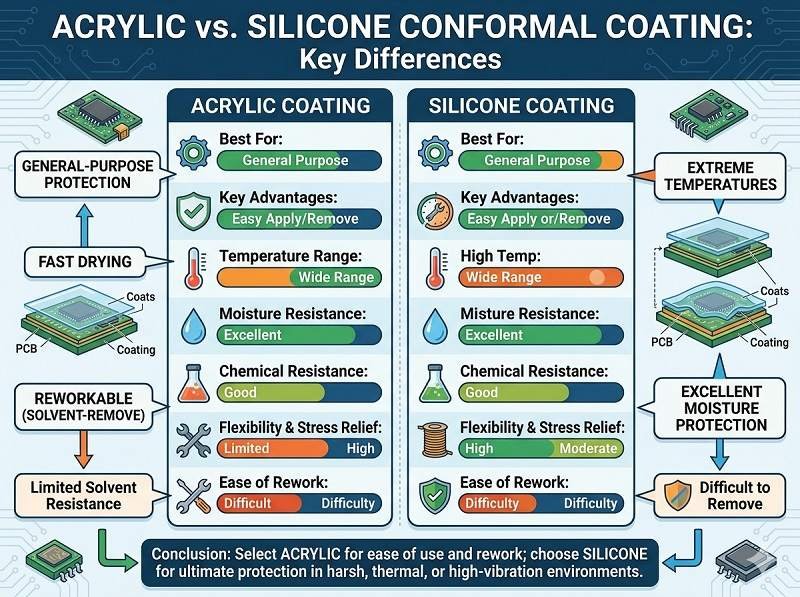
Key differences at a glance
Temperature resistance
Acrylic coatings typically perform up to around 120–125°C, while silicone coatings can withstand a much wider range, from very low temperatures up to 200°C or higher.
Flexibility
Acrylic is relatively rigid and may crack under mechanical stress or thermal expansion. Silicone, on the other hand, is highly flexible and performs well under vibration and temperature cycling.
Moisture performance
Acrylic provides good protection in moderate humidity conditions. Silicone offers superior resistance in high-humidity or outdoor environments.
Chemical resistance
Acrylic coatings have limited resistance to harsh chemicals, while silicone performs better in environments exposed to oils, solvents, and contaminants.
Rework and repair
Acrylic Conformal Coating is easy to remove, making it ideal for rework during PCB Assembly. Silicone is more difficult to remove and usually requires specialized processes.
Cost
Acrylic is more cost-effective and suitable for large-scale SMT Assembly, while silicone is more expensive but offers higher performance.
Advantages of acrylic Conformal Coating
Acrylic coatings are widely used because they are easy to apply, fast drying, and economical. They are ideal for high-volume PCB Assembly where production efficiency is important. Their reworkability also makes them suitable for products that may require repair or modification after manufacturing.
Advantages of silicone Conformal Coating
Silicone coatings are preferred in demanding environments due to their excellent thermal stability and flexibility. They can withstand extreme temperatures, vibration, and moisture, making them suitable for automotive, aerospace, and industrial SMT Assembly applications.
When to choose acrylic vs silicone
Choose acrylic Conformal Coating if your product operates in a controlled environment, requires low cost, and may need rework or repair. It is a practical solution for consumer electronics and general-purpose applications.
Choose silicone Conformal Coating if your product is exposed to high temperatures, moisture, or mechanical stress. It is the better option for harsh environments where long-term reliability is critical.
Final conclusion
Acrylic and silicone Conformal Coating each have their own strengths. Acrylic is best for cost efficiency and ease of use in standard PCB Assembly, while silicone is better suited for high-performance applications in challenging conditions. The best choice ultimately depends on your specific design and operating environment.
Get a Conformal Coating Quote
Ensure long-term reliability for your PCBs with our coating solutions. Start here.
Send us your requirements and get a fast response from our engineering team.
✔ 24-hour response ✔ Engineering support ✔ Small & Mass Production
Shenzhen Tengxinjie Electronics Co., Ltd.

 English
  Deutsch
  Français
  Português do Brasil
  Español
  日本語
日本語  Nederlands
  Italiano
  Русский
  한국어
한국어  العربية
  Svenska
  Polski
  Türkçe
  繁體中文
繁體中文