
Test coating quality
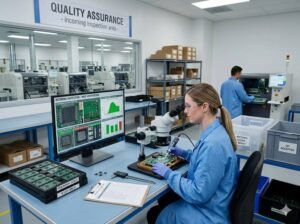
Testing coating quality is a critical step in ensuring the reliability of Conformal Coating in PCB Assembly and SMT Assembly. Proper inspection and testing help verify that the coating provides effective protection against moisture, dust, chemicals, and environmental stress.
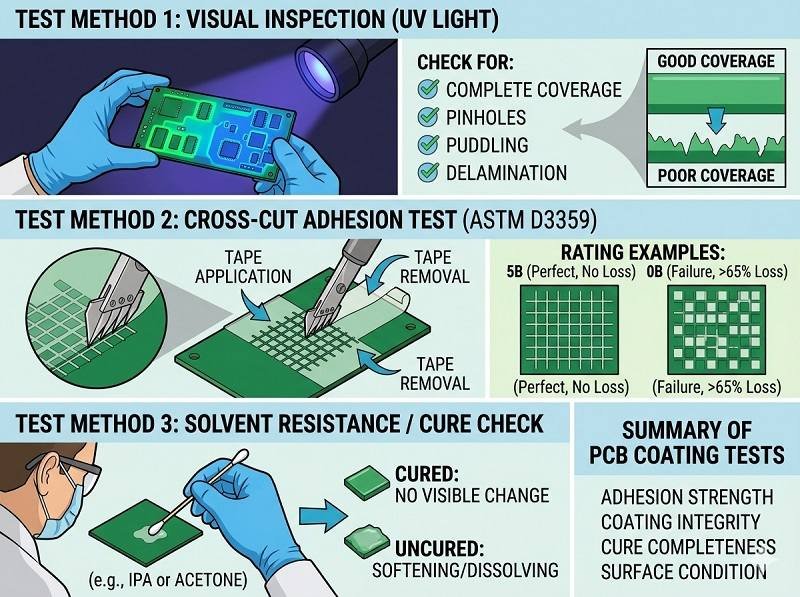
Visual inspection
Visual inspection is the most basic and widely used method.
What to check:
- Uniform coating coverage
- Absence of bubbles, cracks, or pinholes
- No contamination or foreign particles
- Proper masking boundaries
Under normal or magnified light, inspectors can quickly identify obvious defects in Conformal Coating.
UV inspection
Many Conformal Coating materials contain UV tracers.
Process:
- Expose PCB to UV light
- Coating fluoresces, making coverage visible
Benefits:
- Detects missed areas or thin coating
- Improves inspection accuracy in SMT Assembly
Thickness measurement
Coating thickness is essential for performance.
Methods:
- Wet film thickness gauge (before curing)
- Dry film thickness measurement (after curing)
- Micrometer or ultrasonic measurement
Proper thickness ensures optimal protection without affecting component function in PCB Assembly.
Adhesion testing
Adhesion testing checks how well the coating bonds to the PCB.
Common methods:
- Cross-hatch (tape) test
- Scratch test
Good adhesion ensures long-term durability of Conformal Coating.
Electrical testing
Electrical performance must not be compromised.
Tests include:
- Insulation resistance testing
- Dielectric withstand (Hi-Pot) testing
These confirm that the coating enhances insulation in SMT Assembly.
Environmental and reliability testing
For high-reliability applications, environmental tests are required.
Examples:
- Temperature cycling
- Humidity testing
- Salt spray (corrosion) testing
These tests simulate real-world conditions to validate Conformal Coating performance.
Automated optical inspection (AOI)
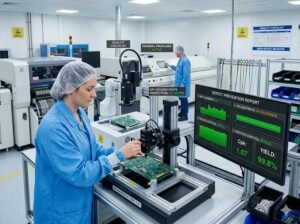
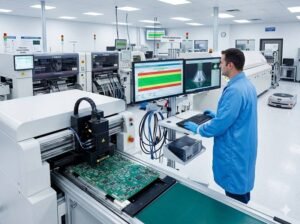
In advanced PCB Assembly, AOI systems are used to detect coating defects.
Advantages:
- High-speed inspection
- Consistent and repeatable results
- Suitable for mass production
Common coating defects detected
- Uneven thickness
- Bubbles and voids
- Delamination
- Incomplete coverage
- Contamination
Early detection prevents failures in final products.
Final conclusion
Testing coating quality is essential in PCB Assembly and SMT Assembly to ensure the effectiveness of Conformal Coating. By combining visual inspection, UV inspection, thickness measurement, adhesion testing, and environmental testing, manufacturers can guarantee high reliability and long-term protection of electronic devices.
Get a Conformal Coating Quote
Get expert advice and pricing for your conformal coating needs today.
Send us your requirements and get a fast response from our engineering team.
✔ 24-hour response ✔ Engineering support ✔ Small & Mass Production
Shenzhen Tengxinjie Electronics Co., Ltd.
 English
  Deutsch
  Français
  Português do Brasil
  Español
  日本語
日本語  Nederlands
  Italiano
  Русский
  한국어
한국어  العربية
  Svenska
  Polski
  Türkçe
  繁體中文
繁體中文