
Silicone vs polyurethane Coating
When selecting a Conformal Coating for electronics, silicone and polyurethane (urethane) are two high-performance options widely used in PCB Assembly and SMT Assembly. Both provide strong environmental protection, but they differ significantly in flexibility, chemical resistance, and application scenarios.
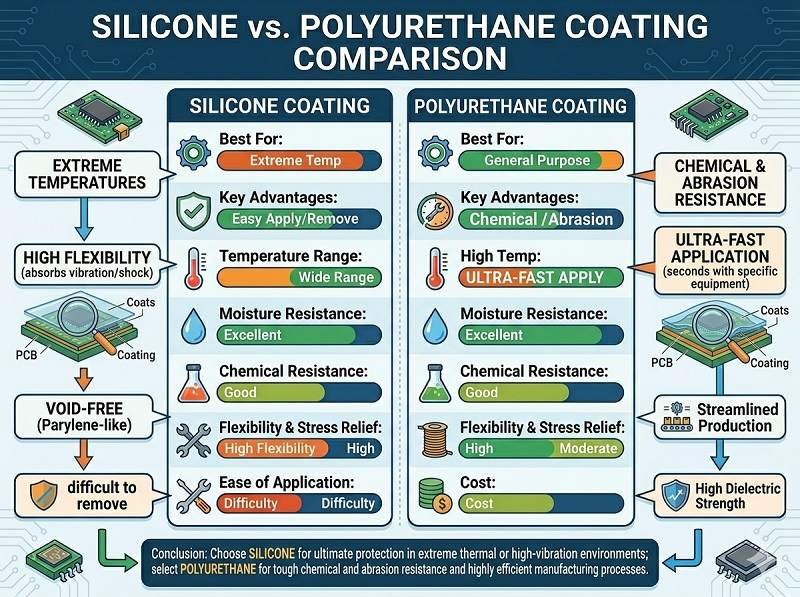
Key differences between silicone and polyurethane
Temperature resistance
Silicone Conformal Coating offers excellent thermal stability, typically operating from -55°C up to 200°C or higher. Polyurethane coatings have a narrower range and may degrade under prolonged high temperatures.
Flexibility
Silicone is highly flexible and elastic, making it ideal for applications with vibration, thermal expansion, or mechanical stress. Polyurethane is more rigid, providing structural strength but less flexibility.
Chemical resistance
Polyurethane Conformal Coating provides superior resistance to chemicals, solvents, fuels, and oils. Silicone offers moderate chemical resistance but is not as strong in aggressive chemical environments.
Moisture protection
Both coatings offer good moisture resistance, but silicone performs better in high-humidity and condensation-prone environments due to its hydrophobic nature.
Abrasion and mechanical durability
Polyurethane forms a tough, wear-resistant layer that protects against abrasion and physical damage. Silicone is softer and less resistant to mechanical wear.
Rework and removal
Silicone coatings are difficult but still manageable to remove with specialized tools. Polyurethane is generally harder to remove, making rework more challenging in PCB Assembly.
Cost
Silicone coatings are typically more expensive due to their high-performance properties. Polyurethane is usually mid-range in cost but offers strong value for chemically harsh environments.
Advantages of silicone Conformal Coating
Silicone coatings are best known for their flexibility and temperature resistance. They are widely used in SMT Assembly for applications exposed to thermal cycling, vibration, or outdoor conditions. Their ability to maintain performance under extreme conditions makes them ideal for automotive, aerospace, and LED lighting applications.
Advantages of polyurethane Conformal Coating
Polyurethane coatings excel in chemical resistance and mechanical durability. In PCB Assembly, they are commonly used in industrial environments where exposure to solvents, fuels, or corrosive substances is a concern. Their tough surface also helps protect against abrasion and handling damage.
When to choose silicone vs polyurethane
Choose silicone Conformal Coating if your application involves high temperatures, rapid temperature changes, or mechanical stress. It is the better option for flexible protection and long-term reliability in harsh environmental conditions.
Choose polyurethane Conformal Coating if your product is exposed to chemicals, oils, or abrasive conditions. It is ideal for industrial electronics where durability and chemical resistance are the top priorities.
Final conclusion
Silicone and polyurethane Conformal Coating both offer strong protection in PCB Assembly and SMT Assembly, but they serve different purposes. Silicone is superior for flexibility and temperature resistance, while polyurethane is better for chemical protection and mechanical durability. The best choice depends on your operating environment and performance requirements.
Get a Conformal Coating Quote
From prototype to mass production, we provide conformal coating services. Get your quote now.
Send us your requirements and get a fast response from our engineering team.
✔ 24-hour response ✔ Engineering support ✔ Small & Mass Production
Shenzhen Tengxinjie Electronics Co., Ltd.

 English
  Deutsch
  Français
  Português do Brasil
  Español
  日本語
日本語  Nederlands
  Italiano
  Русский
  한국어
한국어  العربية
  Svenska
  Polski
  Türkçe
  繁體中文
繁體中文