
Nano Coating for PCB
Nano coating for PCB is an advanced type of Conformal Coating that uses nanotechnology to create an ultra-thin protective layer on the surface of electronic assemblies. It is designed to provide high-level protection while maintaining minimal thickness, making it ideal for modern miniaturized designs in PCB Assembly and SMT Assembly.
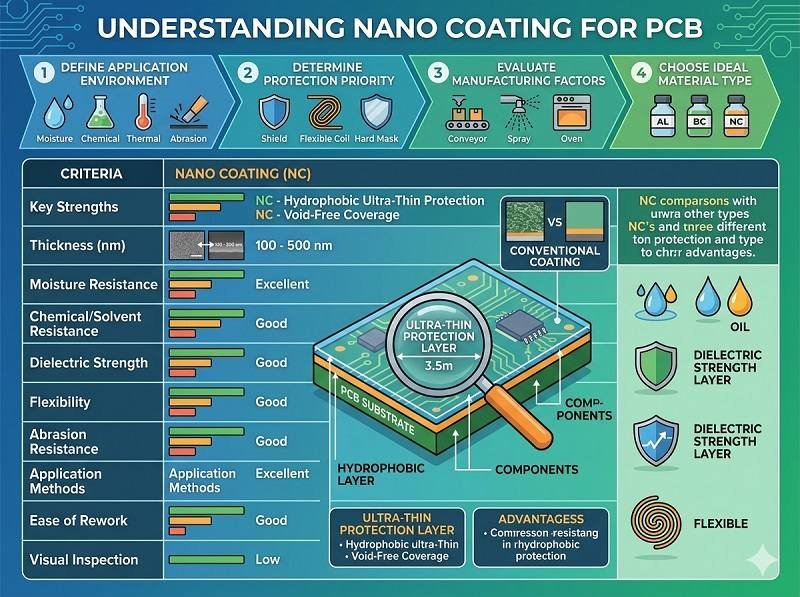
What is nano coating
Nano Conformal Coating is typically applied as a very thin film—often in the nanometer to micrometer range—compared to traditional coatings that are much thicker. Despite its thinness, it forms a highly effective barrier against environmental factors such as moisture, dust, and contaminants.
These coatings are often based on advanced materials like fluoropolymers or plasma-deposited films, which bond at a molecular level to the PCB surface.
Key features of nano coating
Ultra-thin layer
Nano Conformal Coating is significantly thinner than traditional coatings, allowing it to protect circuits without adding bulk or affecting component spacing in high-density SMT Assembly.
Hydrophobic properties
Many nano coatings are water-repellent, preventing moisture from adhering to the PCB surface and reducing the risk of corrosion.
High transparency
The coating is usually transparent and does not interfere with inspection, testing, or optical components.
Minimal impact on weight and size
Because of its extremely thin structure, nano coating is ideal for compact and lightweight electronic devices.
Advantages in PCB Assembly and SMT Assembly
Nano Conformal Coating offers several benefits:
- Excellent protection against humidity and contamination
- Maintains electrical performance without altering design tolerances
- Suitable for compact, high-density PCB designs
- Allows easier rework compared to thicker coatings (in some cases)
Limitations to consider
Lower mechanical protection
Due to its thinness, nano coating provides less physical and abrasion resistance compared to thicker coatings like epoxy or polyurethane.
Limited chemical resistance
Some nano coatings may not perform as well in highly aggressive chemical environments.
Higher cost and specialized processes
Application methods such as plasma deposition or vapor-phase coating can increase manufacturing complexity and cost in PCB Assembly.
Typical applications
Nano Conformal Coating is commonly used in:
- Consumer electronics (smartphones, wearables)
- Medical devices
- IoT and compact electronic modules
- High-density SMT Assembly products
These applications benefit from protection without compromising size or performance.
Conclusion
Nano coating is an innovative form of Conformal Coating that provides effective environmental protection with an ultra-thin layer. In PCB Assembly and SMT Assembly, it is especially valuable for compact and high-performance electronics where space, weight, and precision are critical. While it may not replace traditional coatings in all cases, it offers a modern solution for next-generation electronic protection.
Get a Conformal Coating Quote
Have special coating requirements? Send us your PCB files for evaluation.
Send us your requirements and get a fast response from our engineering team.
✔ 24-hour response ✔ Engineering support ✔ Small & Mass Production
Shenzhen Tengxinjie Electronics Co., Ltd.




 English
  Deutsch
  Français
  Português do Brasil
  Español
  日本語
日本語  Nederlands
  Italiano
  Русский
  한국어
한국어  العربية
  Svenska
  Polski
  Türkçe
  繁體中文
繁體中文