
Introduction
In the world of Printed Circuit Board Assembly (PCBA), soldering is one of the most critical processes that determines both the reliability and performance of electronic products. Among the various soldering techniques, wave soldering and selective soldering stand out as two widely used methods for through-hole components. While both aim to achieve strong and reliable joints, they differ significantly in process, application, and suitability.
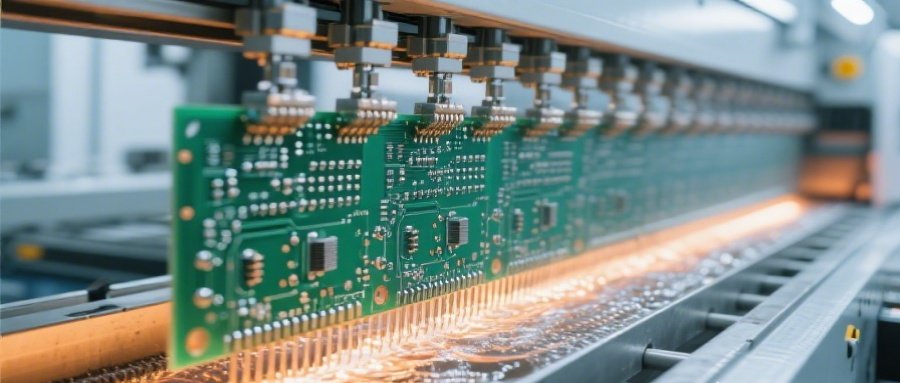
Wave Soldering
- Process: The PCB passes over a continuous “wave” of molten solder. Flux is applied beforehand to clean and prepare the surfaces, and the solder wave simultaneously bonds all exposed through-hole pins.
- Advantages:
- High throughput, ideal for mass production.
- Cost-effective for boards with many through-hole components.
- Reliable joints when properly controlled.
- Limitations:
- Exposes the entire underside of the board to heat.
- Less suitable for mixed assemblies with sensitive SMT components.
- Limited flexibility—every pin in contact with the wave is soldered.
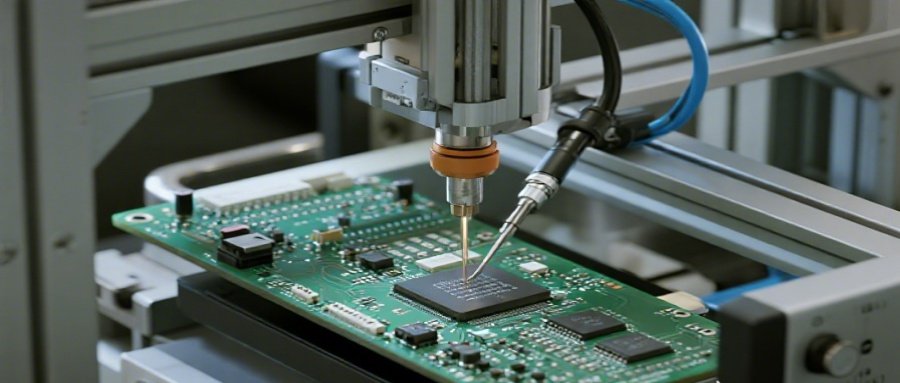
Selective Soldering
- Process: Uses precision nozzles or mini-waves to solder only designated areas of the PCB. This allows targeted soldering without affecting surrounding components.
- Advantages:
- Protects heat-sensitive SMT components.
- High flexibility—only specific joints are soldered.
- Suitable for complex boards with mixed technologies.
- Limitations:
- Slower cycle time compared to wave soldering.
- Higher equipment and setup costs.
- Requires careful programming and process control.
Comparison Table
| Aspect | Wave Soldering | Selective Soldering |
|---|---|---|
| Process | Whole-board immersion | Localized soldering |
| Speed | Very high | Moderate |
| Best for | High-volume, simple THT boards | Complex, mixed SMT + THT boards |
| Heat impact | High, affects all components | Low, targeted |
| Cost efficiency | Excellent for mass production | Better for specialized assemblies |
| Flexibility | Limited | High |
Applications
- Wave soldering: Consumer electronics, power supplies, and products with predominantly through-hole components.
- Selective soldering: Automotive electronics, medical devices, and industrial boards where reliability and mixed assembly are critical.
Conclusion
Choosing between wave soldering and selective soldering depends on production volume, board complexity, and component sensitivity. Wave soldering remains the go-to solution for high-volume, cost-sensitive production, while selective soldering offers precision and flexibility for advanced designs. In modern PCBA, many manufacturers employ both techniques strategically to balance efficiency and reliability.
 English
  Deutsch
  Français
  Português do Brasil
  Español
  日本語
日本語  Nederlands
  Italiano
  Русский
  한국어
한국어  العربية
  Svenska
  Polski
  Türkçe
  繁體中文
繁體中文