
Processo de retrabalho de revestimento conformacional
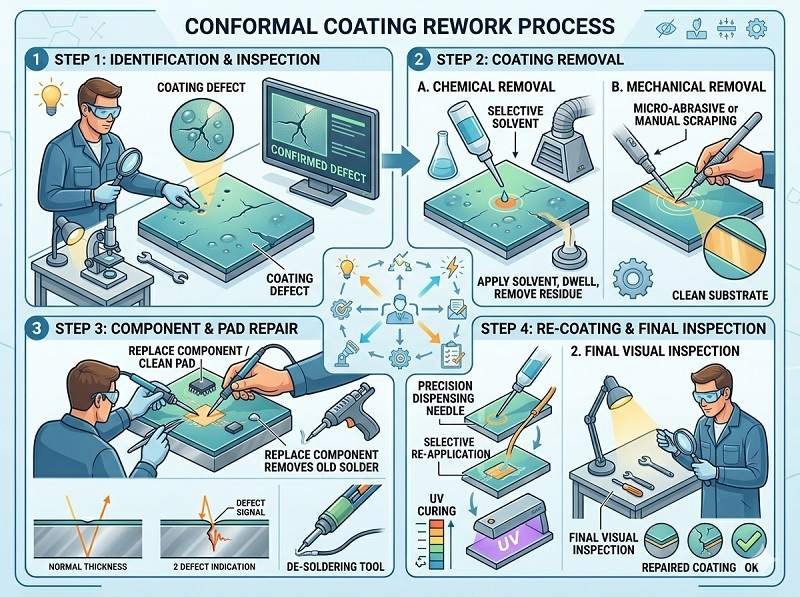
O processo de retrabalho do revestimento isolante refere-se à remoção controlada, ao reparo e à reaplicação de Revestimento conformacional em uma placa de circuito impresso quando são necessários defeitos, alterações no projeto ou substituições de componentes. É uma etapa importante na Montagem de PCB e Montagem SMT, garantindo que as placas possam ser corrigidas sem comprometer a confiabilidade.
Por que o retrabalho é necessário
Pode ser necessário retrabalho em Montagem de PCB pronta para uso por vários motivos:
- Defeitos no revestimento (bolhas, vazios, espessura irregular)
- Contaminação presa sob o revestimento
- Mascaramento ou revestimento incorreto dos conectores
- Reparo ou substituição de componentes
- Alterações de engenharia ou atualizações de projeto
Sem o retrabalho adequado, esses problemas podem levar à falha funcional ou à redução da vida útil.
Etapas do retrabalho de revestimento isolante
Identificação do revestimento
Primeiro, identifique o tipo de Revestimento conformacional (acrílico, silicone, uretano, epóxi ou parileno), pois cada um requer um método de remoção diferente.
Remoção do revestimento
As técnicas comuns de remoção incluem:
- Remoção de solventes → dissolve revestimentos acrílicos
- Remoção mecânica → raspagem ou microabrasão
- Métodos térmicos → amolecimento do revestimento com calor
- Decapagem química → usado para revestimentos mais resistentes, como epóxi
O método deve ser escolhido com cuidado para evitar danos aos componentes ou traços durante Montagem de PCB reparo.
Limpeza da placa de circuito impresso
Após a remoção:
- Limpe os resíduos usando solventes apropriados
- Verifique se a superfície está livre de contaminantes
- Seque a placa completamente antes de continuar o processamento
A limpeza adequada é fundamental antes de aplicar novamente o revestimento em Montagem SMT.
Reparo ou substituição
Executar as ações necessárias, como:
- Substituição de componentes defeituosos
- Fixação de juntas de solda
- Modificação de áreas de circuito
Essa etapa segue os procedimentos de reparo padrão em Montagem de PCB pronta para uso.
Reaplicação do revestimento
Quando os reparos forem concluídos:
- Reaplicar Revestimento conformacional usando pincel, spray ou revestimento seletivo
- Garantir o mascaramento adequado das áreas sem revestimento
- Manter a espessura e a cobertura corretas
Cura e inspeção final
Finalmente:
- Cure o revestimento (secagem ao ar, calor ou UV, dependendo do material)
- Inspecionar usando métodos UV ou AOI
- Verificar a cobertura, a adesão e a espessura
Desafios no retrabalho
- Risco de danificar componentes sensíveis
- Dificuldade de remover determinados revestimentos (por exemplo, epóxi ou parileno)
- Manutenção da qualidade consistente do revestimento após o retrabalho
- Custos de tempo e mão de obra
Devido a esses desafios, o retrabalho deve ser minimizado por meio do controle adequado do processo em Montagem de PCB.
Práticas recomendadas
- Use revestimentos que facilitem o retrabalho (por exemplo, acrílico) quando possível
- Projeto para acessibilidade no layout de PCB
- Aplique o mascaramento adequado durante o revestimento inicial
- Treinar técnicos em técnicas de remoção seguras
Conclusão
O processo de retrabalho do revestimento isolante é essencial para corrigir defeitos e permitir reparos em Montagem de PCB, Montagem SMT, e Montagem de PCB pronta para uso. Ao remover, reparar e reaplicar cuidadosamente o revestimento, os fabricantes podem manter a qualidade do produto e, ao mesmo tempo, reduzir o desperdício e os custos.
Obter uma cotação de revestimento isolante
Reduza os riscos de falhas em PCBs com revestimento isolante profissional. Solicite uma cotação agora.
Envie-nos seus requisitos e receba uma resposta rápida de nossa equipe de engenharia.
Resposta 24 horas ✔ Suporte de engenharia ✔ Produção pequena e em massa
Shenzhen Tengxinjie Electronics Co., Ltd.



 Português do Brasil
  English
  Deutsch
  Français
  Español
  日本語
日本語  Nederlands
  Italiano
  Русский
  한국어
한국어  العربية
  Svenska
  Polski
  Türkçe
  繁體中文
繁體中文