
PCB Assembly (PCBA)
PCB Assembly (PCBA) is the process of mounting and soldering electronic components onto a printed circuit board (PCB) to create a fully functional electronic circuit. A bare PCB only provides the mechanical support and electrical pathways, but it cannot operate on its own. Through PCB Assembly, components such as resistors, capacitors, diodes, integrated circuits, and connectors are added to transform the board into a working electronic product.
Montaż PCB is a core part of modern electronics manufacturing and plays a vital role in industries such as consumer electronics, automotive systems, telecommunications, aerospace, and medical equipment. With the rapid development of smart devices and IoT technologies, the demand for high-quality PCB Assembly and advanced SMT Assembly solutions continues to grow.
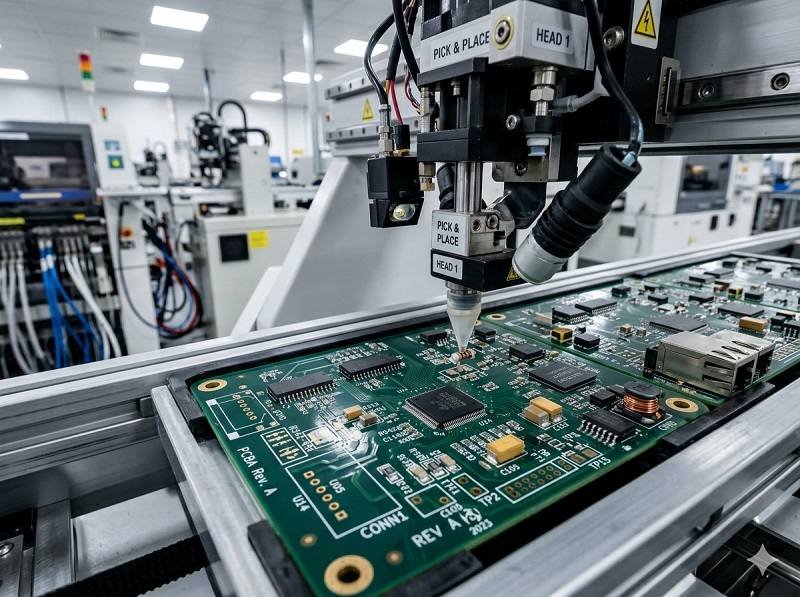
What is Included in PCB Assembly?
PCB Assembly is not just a single step but a complete manufacturing workflow that includes material preparation, component placement, soldering, inspection, and testing. The complexity of PCB Assembly depends on the design, component density, and performance requirements of the final product.
The process ensures that all components are accurately placed and electrically connected according to the PCB design files, such as Gerber files and Bill of Materials (BOM).
Key Steps in the PCB Assembly Process
Drukowanie pasty lutowniczej
The first step in PCB Assembly is applying solder paste onto the PCB pads using a stainless steel stencil. The solder paste contains a mixture of metal alloy particles and flux, which helps create reliable solder joints during the heating process.
SMT Assembly (Surface Mount Technology)
Montaż SMT is the most widely used method in PCB Assembly today. In this stage, automated pick-and-place machines position surface mount components directly onto the PCB pads. SMT Assembly supports high-speed production, high accuracy, and compact circuit designs, making it ideal for modern electronic products.
Lutowanie rozpływowe
After SMT Assembly, the PCB is passed through a reflow oven where the temperature is precisely controlled. The solder paste melts and forms strong electrical and mechanical connections between the components and the board.
Through-Hole Assembly (THT)
Some components, such as connectors or large capacitors, require through-hole assembly for additional mechanical strength. These components are inserted into drilled holes and soldered using wave soldering or manual soldering techniques.
Inspekcja i kontrola jakości
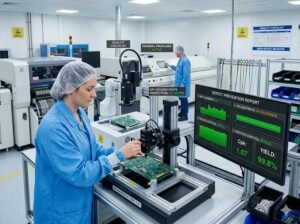
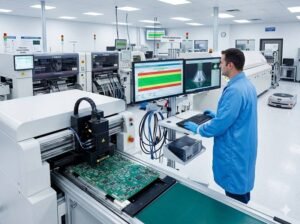
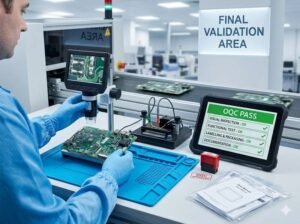
To ensure product reliability, PCB Assembly includes multiple inspection stages. These may involve Automated Optical Inspection (AOI), X-ray inspection for hidden solder joints, and In-Circuit Testing (ICT). Functional testing is also performed to verify that the assembled board operates as intended.
PCB Assembly vs SMT Assembly
Many people confuse PCB Assembly with SMT Assembly, but they are different concepts:
- Montaż PCB refers to the entire process of assembling all types of components onto a PCB.
- Montaż SMT is a specific technique within PCB Assembly that focuses on placing surface-mounted components.
In modern electronics manufacturing, SMT Assembly accounts for the majority of PCB Assembly work due to its efficiency and ability to support high-density designs. However, a combination of SMT Assembly and through-hole technology is often used for optimal performance and durability.
Advantages of PCB Assembly
PCB Assembly offers numerous advantages that make it essential for electronic product development:
High Efficiency and Automation
Automated SMT Assembly lines significantly reduce production time and labor costs, enabling fast turnaround for both prototypes and mass production.
Compact and Lightweight Design
SMT Assembly allows components to be placed on both sides of the PCB, resulting in smaller and lighter electronic devices.
Improved Reliability
Modern PCB Assembly processes ensure consistent solder quality and strong connections, improving product lifespan and performance.
Cost-Effective Production
For large-scale manufacturing, PCB Assembly reduces overall costs through automation, material optimization, and reduced manual intervention.
Skalowalność
PCB Assembly services can support everything from small prototype batches to high-volume production runs, making them suitable for startups and large enterprises alike.
Applications of PCB Assembly
PCB Assembly is widely used across multiple industries and applications:
- Consumer electronics such as smartphones, laptops, and smart home devices
- Automotive electronics including engine control units and EV systems
- Industrial automation and robotics
- Medical devices such as monitoring and diagnostic equipment
- Telecommunications infrastructure and networking devices
As technology advances, PCB Assembly continues to evolve to meet the increasing demands for higher performance, miniaturization, and energy efficiency.
How to Choose a Reliable PCB Assembly Manufacturer
Selecting the right PCB Assembly partner is crucial for ensuring product quality and project success. Here are some important factors to consider:
- Expertise in both PCB Assembly and SMT Assembly processes
- Advanced equipment such as high-speed placement machines and inspection systems
- Strict quality standards and certifications (e.g., IPC-A-610)
- Strong supply chain management and component sourcing capabilities
- Ability to provide quick turnaround for prototypes and stable delivery for mass production
A professional PCB Assembly manufacturer not only ensures high-quality production but also helps optimize design, reduce costs, and improve time-to-market.
Future Trends in PCB Assembly
The PCB Assembly industry is continuously evolving with new technologies and trends:
- Increasing use of automation and smart factories
- Adoption of AI-based inspection systems
- Growth of high-density interconnect (HDI) and miniaturized components
- Demand for environmentally friendly and lead-free processes
- Expansion of IoT and wearable device applications
SMT Assembly will remain a key technology driving innovation in PCB Assembly, especially as electronic devices become smaller and more complex.
Wnioski
PCB Assembly (PCBA) is a vital process that transforms a bare PCB into a fully functional electronic product. By integrating advanced techniques such as SMT Assembly, modern PCB Assembly achieves high precision, efficiency, and scalability. Whether for prototyping or large-scale production, high-quality PCB Assembly is essential for ensuring reliable performance in today’s electronic devices.
Pracujesz nad projektami motoryzacyjnymi, przemysłowymi, IoT lub elektroniki użytkowej?
Zapewniamy profesjonalne usługi montażu PCB, w tym SMT, DIP i pełne rozwiązania "pod klucz".
✔ Dostępna NDA ✔ Szybka wycena w ciągu 24 godzin ✔ Fabryka z certyfikatem ISO ✔ Kompleksowy serwis PCB i PCBA
 Polski
  English
  Deutsch
  Français
  Português do Brasil
  Español
  日本語
日本語  Nederlands
  Italiano
  Русский
  한국어
한국어  العربية
  Svenska
  Türkçe
  繁體中文
繁體中文