
Is Lead-Free Soldering
Lead-free soldering is a process used in Montaż PCB where solder materials do not contain lead (Pb). Instead of traditional tin-lead alloys, lead-free solder uses alternative metal compositions that comply with environmental regulations such as the Dyrektywa RoHS.
This process is widely adopted in modern Produkcja obwodów drukowanych oraz Montaż SMT to ensure safer and more environmentally friendly electronics production.
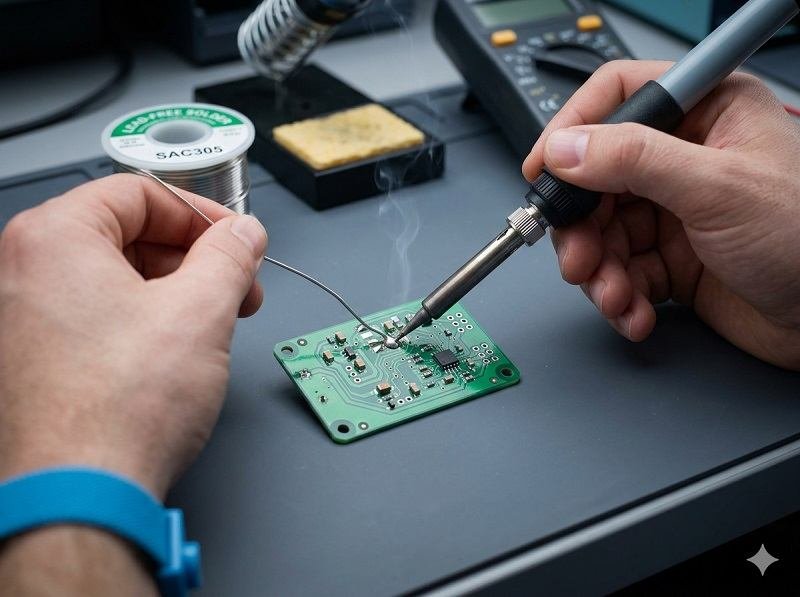
Common Lead-Free Solder Alloys
In lead-free soldering, several alloy combinations are used to replace traditional SnPb (tin-lead) solder.
The most common is SAC alloy (tin-silver-copper), such as SAC305 (96.5% Sn, 3.0% Ag, 0.5% Cu).
Other variations may include tin-copper (SnCu) or tin-bismuth (SnBi), depending on application requirements.
These materials are designed to provide reliable electrical and mechanical connections in Montaż PCB.
Why Lead-Free Soldering Is Important
Lead-free soldering is primarily driven by environmental and health concerns.
The Dyrektywa RoHS restricts the use of hazardous substances like lead in electronic products. By adopting lead-free soldering, manufacturers ensure compliance with global regulations and reduce environmental impact.
It is now a standard requirement in most international markets, especially in Europe.
How Lead-Free Soldering Affects SMT Assembly
Lead-free soldering introduces several changes to Montaż SMT procesy.
One major difference is the higher melting temperature. Lead-free solder typically melts around 217–221°C, compared to about 183°C for traditional leaded solder.
This requires higher reflow temperatures, which can increase thermal stress on components and PCBs.
Process control becomes more critical to ensure proper wetting and strong solder joints.
Advantages of Lead-Free Soldering
Lead-free soldering offers several benefits.
It complies with environmental regulations and improves product safety.
It reduces toxic waste and supports sustainable Produkcja obwodów drukowanych.
It enables access to global markets that require RoHS compliance.
Challenges of Lead-Free Soldering
Despite its advantages, lead-free soldering presents some challenges.
Higher process temperatures can affect sensitive components.
Lead-free solder may have slightly different wetting characteristics, making process optimization important.
Material costs, especially for silver-containing alloys, can be higher.
Manufacturers must carefully control reflow profiles and material selection in Montaż SMT.
Applications in PCB Assembly
Lead-free soldering is used across a wide range of industries.
It is standard in consumer electronics, automotive systems, industrial equipment, and telecommunications.
W Montaż płytek drukowanych pod klucz, all materials and processes are typically selected to ensure full compliance with lead-free and RoHS requirements.
Best Practices for Lead-Free Soldering
Aby osiągnąć wiarygodne wyniki, producenci powinni przestrzegać najlepszych praktyk.
Use high-quality lead-free solder paste.
Optimize reflow temperature profiles for specific components.
Ensure proper PCB surface finishes such as ENIG or lead-free HASL.
Maintain strict quality control and inspection processes.
Partner with experienced providers in Montaż PCB oraz Montaż SMT.
Wnioski
Lead-free soldering is a critical process in modern electronics manufacturing, enabling environmentally friendly and regulation-compliant Montaż PCB. By replacing traditional lead-based materials with safer alternatives, manufacturers can meet global standards while maintaining high reliability.
With proper process control and material selection, lead-free soldering ensures consistent performance in Produkcja obwodów drukowanych, Montaż SMT, oraz Montaż płytek drukowanych pod klucz.
Uzyskaj profesjonalną wycenę montażu PCB dostosowaną do Twoich potrzeb. Zacznij tutaj.
Zapewniamy profesjonalne usługi montażu PCB, w tym SMT, DIP i pełne rozwiązania "pod klucz".
✔ Dostępna NDA ✔ Szybka wycena w ciągu 24 godzin ✔ Fabryka z certyfikatem ISO ✔ Kompleksowy serwis PCB i PCBA
 Polski
  English
  Deutsch
  Français
  Português do Brasil
  Español
  日本語
日本語  Nederlands
  Italiano
  Русский
  한국어
한국어  العربية
  Svenska
  Türkçe
  繁體中文
繁體中文