
DIP coating PCB
Dip coating is a widely used method for applying Conforme coating to printed circuit boards during PCB-assemblage en SMT-assemblage. In this process, the entire PCB is immersed (or “dipped”) into a liquid coating material and then withdrawn, leaving a uniform protective layer on all exposed surfaces.
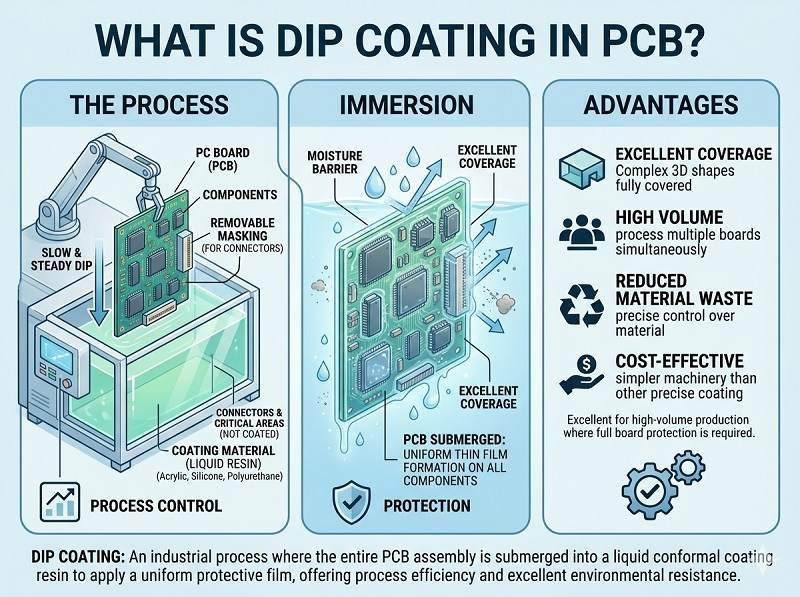
This technique is especially effective for achieving full coverage, including hard-to-reach areas beneath components.
How dip coating works
During dip coating, a fully assembled PCB is lowered into a tank containing liquid Conforme coating material. After a controlled immersion time, the board is slowly withdrawn at a consistent speed. As it is removed, excess coating drains off, and the remaining film cures to form a protective layer.
The final coating thickness depends on factors such as withdrawal speed, viscosity of the coating material, and environmental conditions.
Advantages of dip coating
Complete coverage
Dip coating ensures that all surfaces of the PCB, including complex geometries and densely populated areas typical in SMT-assemblage, are thoroughly coated.
Consistency
Because the entire board is immersed, dip coating provides highly uniform results across multiple boards in PCB-assemblage production.
Efficiency for batch processing
This method is ideal for high-volume manufacturing where many boards can be coated in sequence.
Good penetration
It allows coating material to reach tight spaces under components where spray methods might struggle.
Limitations to consider
Masking requirements
Areas such as connectors, switches, and test points must be masked before dipping to prevent unwanted coating.
Material waste
Compared to selective coating methods, dip coating may result in higher material usage.
Thickness control
It can be more challenging to precisely control coating thickness compared to automated spray or selective coating.
Not suitable for all designs
Very delicate components or assemblies with trapped air pockets may not be ideal for dip coating.
Applications in PCB-assemblage en SMT-assemblage
Dip coating is commonly used in applications where full environmental protection is required, such as industrial electronics, power supplies, and automotive modules. It is particularly beneficial when uniform and thorough Conforme coating coverage is critical.
Conclusie
Dip coating is a reliable and efficient method for applying Conforme coating in PCB-assemblage en SMT-assemblage. By immersing the entire board, it ensures complete and consistent protection against moisture, contaminants, and environmental stress, making it a preferred choice for many high-reliability applications.
Vraag een offerte aan voor conforme coating
Working on automotive, industrial, or outdoor electronics? We can help with conformal coating.
Send us your requirements and get a fast response from our engineering team.
✔ 24-hour response ✔ Engineering support ✔ Small & Mass Production
Shenzhen Tengxinjie Electronics Co, Ltd.
 Nederlands
  English
  Deutsch
  Français
  Português do Brasil
  Español
  日本語
日本語  Italiano
  Русский
  한국어
한국어  العربية
  Svenska
  Polski
  Türkçe
  繁體中文
繁體中文