
Vereiste cleanroom voor coating
Cleanroom-vereisten voor Conforme coating verwijzen naar de omgevingscontroles die nodig zijn om verontreiniging tijdens het coatingproces te voorkomen. In PCB-assemblage, Prototype PCB-assemblage, en SMT-assemblage, Het handhaven van een schone en gecontroleerde omgeving is essentieel om coatingkwaliteit, hechting en betrouwbaarheid op lange termijn te garanderen.
In tegenstelling tot halfgeleiderfabricage vereist conformal coating niet altijd ultrahoge cleanroomniveaus, maar een gecontroleerde schone omgeving is nog steeds van cruciaal belang om defecten zoals stofinsluiting, gaatjes, bellen en slechte oppervlakteafwerking te voorkomen.
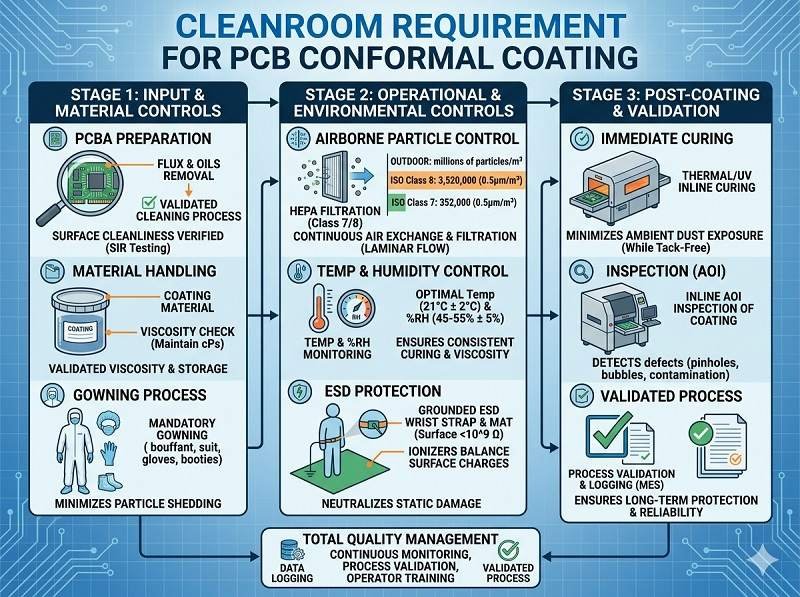
Typische cleanroomniveaus
Voor de meeste PCB-assemblage coatingprocessen worden gewoonlijk de volgende normen gebruikt:
- ISO klasse 7-8 cleanroom (Klasse 10.000-100.000) voor toepassingen met een hoge betrouwbaarheid
- Gecontroleerde productieruimtes met filtratie voor algemeen industrieel gebruik
In Prototype PCB-assemblage, Een volledige cleanroom is misschien niet nodig, maar een schone, stofvrije werkruimte is nog steeds vereist.
Belangrijkste milieuvereisten
Luchtzuiverheid en filtratie
HEPA-filters (High Efficiency Particulate Air) worden gebruikt om deeltjes in de lucht te verwijderen. Een schone luchtstroom vermindert het risico dat stof zich afzet op natte Conforme coating oppervlakken.
Temperatuurregeling
Stabiele temperatuur (meestal 20-25°C) zorgt voor een consistente coatingviscositeit en uithardingsgedrag in SMT-assemblage processen.
Vochtigheidsregeling
De relatieve vochtigheid wordt gewoonlijk op 40-60% om statische opbouw te voorkomen en vochtgerelateerde defecten te vermijden tijdens PCB-assemblage.
Beheer van luchtstromen
Een laminaire of gecontroleerde luchtstroom helpt om deeltjes weg te leiden van gecoate oppervlakken. Positieve druk omgevingen voorkomen dat externe verontreinigingen het coatinggebied binnendringen.
Waarom cleanroomcontrole belangrijk is
- Voorkomt dat stof en deeltjes de coating vervuilen
- Zorgt voor een gladde en uniforme coatingafwerking
- Verbetert de hechting en elektrische isolatie
- Vermindert defecten en herbewerking in SMT-assemblage
- Verbetert de betrouwbaarheid van producten, vooral in zware omgevingen
Cleanroom vs. gecontroleerde omgeving
Niet alle coatingprocessen vereisen een volledige cleanroom. Veel fabrikanten gebruiken een gecontroleerde coatingzone in plaats daarvan:
- Afgesloten coatinggebied
- Luchtfiltersystemen
- Antistatische vloeren en oppervlakken
- Beperkte toegang om vervuiling te minimaliseren
Deze benadering brengt kosten en prestaties in evenwicht, vooral in standaard PCB-assemblage operaties.
Aanvullende vereisten voor coatinggebieden
ESD-besturing
Cleanroomomgevingen moeten ook ESD-beschermingsmaatregelen bevatten om elektrostatische schade te voorkomen tijdens Conforme coating.
Reinheid van materiaal en apparatuur
Alle gereedschappen, armaturen en coatingapparatuur moeten regelmatig worden gereinigd om te voorkomen dat er verontreinigingen in komen.
Discipline van de operator
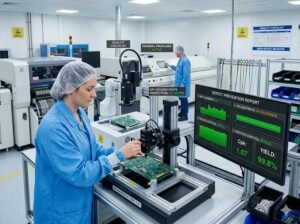
Het personeel moet schone kleding en handschoenen dragen en strikte hanteringsprocedures volgen, vooral bij Prototype PCB-assemblage waar handmatige processen gebruikelijk zijn.
Inspectie en controle
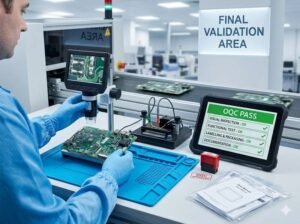
Regelmatige controle van deeltjesniveaus, vochtigheid en temperatuur zorgt ervoor dat de omgeving binnen aanvaardbare grenzen blijft.
Beste praktijken
- Gebruik HEPA-gefilterde luchtsystemen
- Stabiele temperatuur en luchtvochtigheid handhaven
- Isoleer coatinggebieden van processen die stof genereren
- Strikte schoonmaak- en onderhoudsschema's implementeren
- Personeel trainen op cleanroomprotocollen
Concluderend Conforme coating vereist niet altijd een volledige cleanroom voor halfgeleiders, een gecontroleerde, schone omgeving is essentieel in PCB-assemblage, SMT-assemblage, en Prototype PCB-assemblage. Een goede omgevingscontrole minimaliseert vervuiling, vermindert defecten en garandeert coatingprestaties van hoge kwaliteit.
Vraag een offerte aan voor conforme coating
Klaar om uw conformal coating project te starten? Vul onderstaand formulier in om te beginnen.
Stuur ons je vereisten en krijg snel antwoord van ons engineeringteam.
✔ 24-uurs respons ✔ Engineering-ondersteuning ✔ Kleine & massaproductie
Shenzhen Tengxinjie Electronics Co, Ltd.
 Nederlands
  English
  Deutsch
  Français
  Português do Brasil
  Español
  日本語
日本語  Italiano
  Русский
  한국어
한국어  العربية
  Svenska
  Polski
  Türkçe
  繁體中文
繁體中文