
Batch coatingproces
De batch coatingproces in Conforme coating verwijst naar het aanbrengen van een coating op meerdere printplaten tegelijk in gegroepeerde cycli in plaats van continu. Deze methode wordt veel gebruikt in PCB-assemblage, Prototype PCB-assemblage, en kleine tot middelgrote schaal SMT-assemblage, waar flexibiliteit en kostenbeheersing belangrijk zijn.
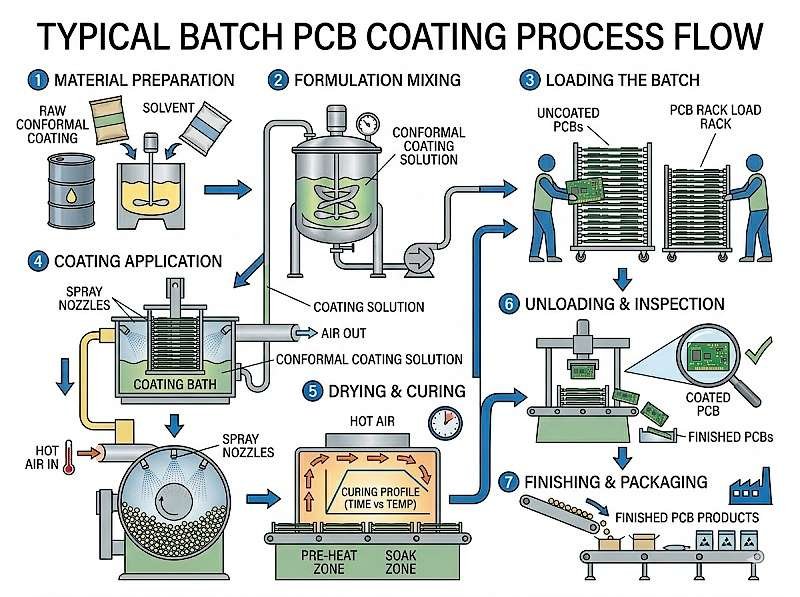
Hoe batchcoating werkt
In een batchproces wordt een groep geassembleerde printplaten voorbereid, gemaskeerd en samen gecoat met methodes zoals dompelen, spuiten of borstelen. Na het coaten gaan alle printplaten in de batch door een gedeelde droog- of uithardingscyclus. Na afloop wordt de volgende batch verwerkt.
Gebruikelijke methoden voor batchcoating
Dompelcoating
PCB's worden ondergedompeld in een tank met Conforme coating materiaal en dan teruggetrokken met een gecontroleerde snelheid. Dit zorgt voor een volledige dekking, maar vereist een goede maskering in PCB-assemblage.
Handmatig coaten of spuiten
Operators of halfautomatische spuitsystemen brengen de coating aan op meerdere platen die in rekken of klemmen zijn geplaatst. Dit is gebruikelijk in Prototype PCB-assemblage vanwege de flexibiliteit.
Kwastcoating
Vooral gebruikt voor nabewerking of kleine series, waar precisie nodig is maar het productievolume laag is.
Belangrijkste kenmerken van batch coating
Gegroepeerde verwerking
Meerdere platen worden samen gecoat en uitgehard, wat de efficiëntie verbetert in vergelijking met de verwerking van één plaat.
Flexibele opstelling
Ideaal voor verschillende PCB-ontwerpen of orders in kleine aantallen, vooral in Prototype PCB-assemblage.
Lagere uitrustingskosten
Vergeleken met volledig geautomatiseerde inline systemen die worden gebruikt in snelle SMT-assemblage, batchprocessen vereisen minder investeringen.
Voordelen van batch coating
- Rendabel voor kleine en middelgrote productieruns
- Gemakkelijk schakelen tussen verschillende producten
- Geschikt voor complexe of onregelmatige PCB-ontwerpen
- Vereenvoudigde procesbesturing voor prototyping
Beperkingen van batchcoating
Lagere consistentie
Vergeleken met geautomatiseerd inline coaten in SMT-assemblage, Bij batchprocessen kan er meer variatie zijn in dikte en dekking.
Arbeidsintensief
Handmatig hanteren verhoogt de arbeidskosten en het risico op menselijke fouten in PCB-assemblage.
Langzamere doorvoer
De verwerking gebeurt in cycli in plaats van continu, wat de productiesnelheid kan beperken.
Risico op defecten
Onjuiste behandeling, ongelijkmatig dompelen of inconsistent spuiten kan leiden tot bellen, druppels of een ongelijkmatige coating.
Batch vs inline coaten
- Batchcoating: Flexibel, lagere kosten, ideaal voor Prototype PCB-assemblage en kleine volumes
- Inline coating: Geautomatiseerd, hoge consistentie, het beste voor grootschalige SMT-assemblage
Beste werkwijzen voor batchcoating
- Gebruik consistente opspanningen om printplaten op hun plaats te houden
- Regelsnelheid bij dompelcoating
- Behoud een stabiele coatingviscositeit en -temperatuur
- Zorg voor goede reiniging en afplakken voor het coaten
- Standaardiseer uithardingsomstandigheden voor elke batch
Concluderend batch coatingproces is een praktische en kosteneffectieve benadering voor het toepassen van Conforme coating in PCB-assemblage, Vooral voor prototyping en middelgrote productieseries. Hoewel het misschien niet de snelheid en precisie van inline systemen evenaart, biedt het flexibiliteit en aanpasbaarheid voor een breed scala aan toepassingen.
Vraag een offerte aan voor conforme coating
Conformal coating nodig voor toepassingen in ruwe omgevingen? Dien hieronder uw aanvraag in.
Stuur ons je vereisten en krijg snel antwoord van ons engineeringteam.
✔ 24-uurs respons ✔ Engineering-ondersteuning ✔ Kleine & massaproductie
Shenzhen Tengxinjie Electronics Co, Ltd.
 Nederlands
  English
  Deutsch
  Français
  Português do Brasil
  Español
  日本語
日本語  Italiano
  Русский
  한국어
한국어  العربية
  Svenska
  Polski
  Türkçe
  繁體中文
繁體中文