
What PCB assembly quality means
PCB assembly quality refers to the overall reliability, consistency, and performance of a finished circuit board after all components have been mounted and soldered. In professional electronics manufacturing, high quality means the board meets electrical, mechanical, and functional requirements without defects.
In PCB 어셈블리, quality is not controlled by a single step. It is achieved through a complete system that includes component control, process management, inspection, and testing at every stage.
Quality starts with component control
The foundation of PCB assembly quality is component quality. Even the best manufacturing process cannot compensate for poor or counterfeit components.
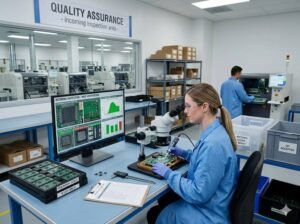
Before production begins, all materials are checked through incoming inspection. This ensures components used in SMT 어셈블리 meet required specifications and are sourced from reliable suppliers.
Key checks include:
- Component authenticity verification
- Packaging and labeling inspection
- Electrical parameter verification
- Moisture sensitivity control
This step significantly reduces the risk of defects later in PCB Assembly.
Design review and DFM analysis
Before production starts, engineers perform Design for Manufacturability (DFM) analysis. This step ensures the PCB design is suitable for mass production and reduces potential assembly issues.
DFM checks typically include:
- Component spacing and footprint compatibility
- Solder mask and pad design
- Thermal balance considerations
- SMT Assembly feasibility
By identifying design risks early, manufacturers can prevent issues such as solder bridging, misalignment, or reflow defects.
SMT assembly process control
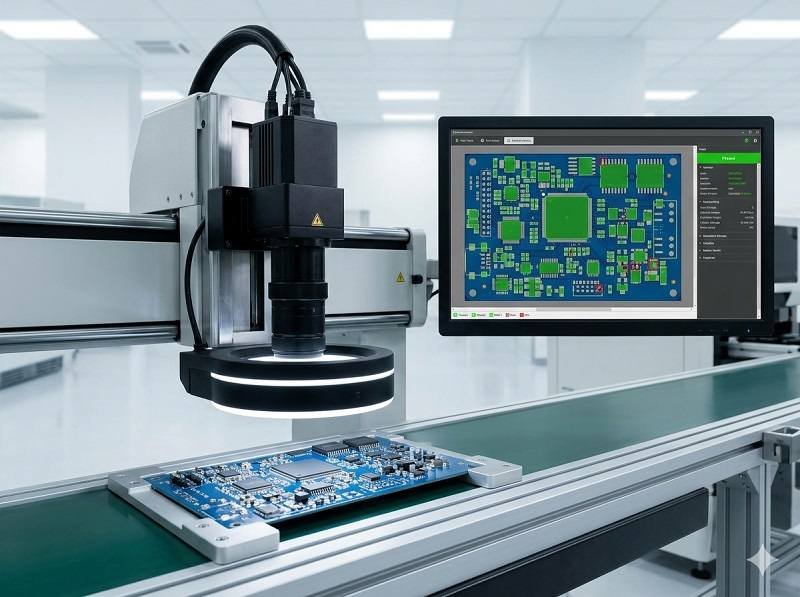
SMT Assembly is one of the most critical stages in PCB manufacturing. It involves high-speed placement of components and precise soldering using reflow ovens.
To ensure quality, manufacturers strictly control:
- Solder paste printing accuracy
- Pick-and-place machine calibration
- Reflow temperature profiling
- Line setup verification
Even small deviations in SMT Assembly can lead to defects, so process stability is essential.
자동화된 검사 시스템
Modern PCB Assembly relies heavily on automated inspection to detect defects early and accurately.
Common inspection systems include:
- AOI (Automated Optical Inspection) for surface defects
- SPI (Solder Paste Inspection) for printing quality
- X-ray inspection for hidden joints like BGA
These systems ensure that defects are identified immediately instead of passing to the next stage.
Manual inspection and engineering review
Although automation is important, manual inspection is still used for complex or critical boards.
Experienced engineers review:
- Component placement accuracy
- Solder joint quality
- Mechanical alignment
- Visual defects not captured by machines
This combination of human expertise and automation strengthens overall PCB Assembly quality control.
In-circuit and functional testing
After SMT Assembly is completed, boards go through electrical testing to verify functionality.
Two key methods are used:
- ICT (In-Circuit Test) to check component-level performance
- Functional testing to simulate real operating conditions
These tests ensure the final product works correctly before shipment and meets customer requirements.
Process standardization and control systems
Consistency is key to high-quality PCB Assembly. Manufacturers use standardized processes and strict documentation to ensure every board is produced under the same conditions.
This includes:
- Standard operating procedures (SOPs)
- Controlled production parameters
- Equipment calibration schedules
- Operator training programs
These systems reduce variation and improve long-term reliability.
Material storage and handling control
Improper handling of components can directly affect SMT Assembly quality. Sensitive components must be stored under controlled temperature and humidity conditions.
Manufacturers implement:
- Moisture control systems (dry cabinets)
- ESD (Electrostatic Discharge) protection
- FIFO material management
- Controlled warehouse environments
This ensures components remain stable before and during production.
Traceability and quality tracking
Traceability allows manufacturers to track every step of PCB Assembly from components to final product delivery.
If a problem occurs, engineers can quickly identify:
- Which batch of components was used
- Which production line was involved
- Which process step caused the issue
This reduces investigation time and improves corrective actions.
Continuous improvement system
Quality is not a one-time achievement. Professional SMT Assembly providers use continuous improvement systems to optimize production.
They analyze:
- Defect reports
- Yield rates
- Process data
- Customer feedback
Based on this data, they refine processes to reduce future defects and improve stability.
결론
PCB assembly quality is achieved through a complete system that includes component control, engineering review, SMT Assembly process management, inspection, testing, and traceability.
By combining advanced equipment with strict quality control procedures, manufacturers can ensure stable performance, high reliability, and consistent production results. For customers, choosing a PCB Assembly partner with strong quality systems is essential for long-term product success.
필요에 맞는 전문 PCB 어셈블리 견적을 받아보세요. 여기에서 시작하세요.
당사는 SMT, DIP 및 전체 턴키 솔루션을 포함한 전문 PCB 조립 서비스를 제공합니다.
NDA 가능 ✔ 24시간 이내 빠른 견적 ✔ ISO 인증 공장 ✔ 원스톱 PCB 및 PCBA 서비스
 한국어
한국어  English
  Deutsch
  Français
  Português do Brasil
  Español
  日本語
日本語  Nederlands
  Italiano
  Русский
  العربية
  Svenska
  Polski
  Türkçe
  繁體中文
繁體中文