
Lead time for components
Component lead time is a critical factor in PCB 어셈블리, SMT 어셈블리, 및 턴키 PCB 어셈블리 projects. It directly affects production scheduling, delivery timelines, and overall project efficiency.
The lead time refers to the period from placing an order for electronic components to receiving them ready for use in PCB 제조.
Typical component lead times
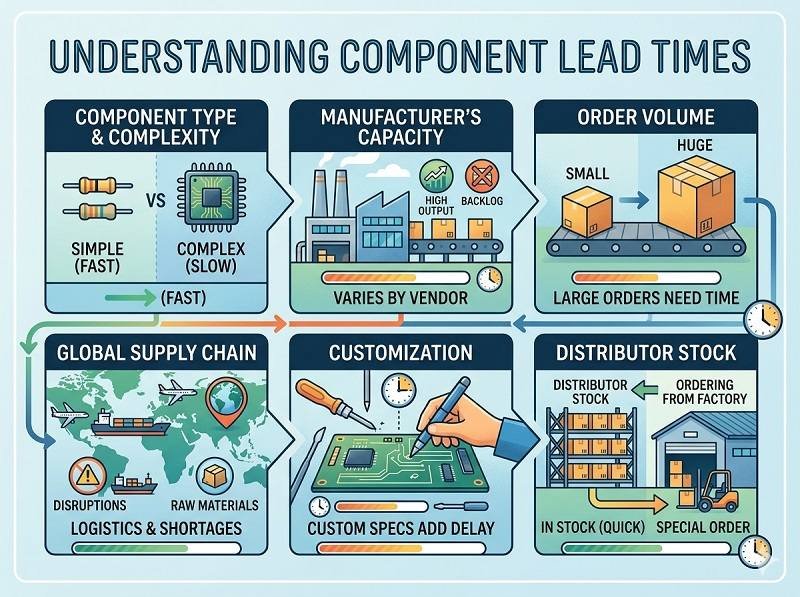
Component lead times can vary widely depending on the type, availability, and sourcing channel. In general:
- In-stock components (authorized distributors): 1–7 days
- Standard components (regular supply): 1–4 weeks
- Factory lead time (out of stock): 4–12 weeks
- Long lead-time or specialized components: 12–30+ weeks
For 턴키 PCB 어셈블리, sourcing time is often the longest phase, especially when dealing with complex BOMs.
Factors that affect component lead time
Several key factors influence how quickly components can be sourced:
Component Availability
If parts are readily available from authorized distributors, lead times are short. Shortages can significantly extend timelines.
Component Type
Common resistors and capacitors are usually fast to source, while ICs, MCUs, and specialized chips often have longer lead times.
Global Supply Chain Conditions
Market demand, raw material shortages, and logistics disruptions can impact availability across the PCB 제조 industry.
주문 수량
Large-volume orders may require factory scheduling, increasing lead time compared to prototype quantities.
Supplier Location
Local or regional suppliers can deliver faster than overseas manufacturers, especially for urgent SMT 어셈블리 needs.
Lead time in turnkey PCB assembly
In 턴키 PCB 어셈블리, the manufacturer manages the entire supply chain, including component procurement.
The overall timeline typically includes:
- BOM verification and sourcing: 1–5 days
- Component procurement: varies (as above)
- Incoming inspection (IQC): 1–3 days
- Production scheduling for PCB 어셈블리
Because sourcing is integrated, any delay in components directly affects the start of SMT 어셈블리.
How to reduce component lead time
To ensure faster delivery and smoother production, several strategies can be applied:
Use Standard, Widely Available Components
Designing with common parts reduces sourcing risks.
Provide Alternative Components
Allowing substitutions helps avoid delays when primary parts are out of stock.
Work with Turnkey PCB Assembly Providers
They have established supply chains and can source components more efficiently.
Plan Ahead
Forecasting demand and placing orders early is essential for large-scale PCB 제조.
Avoid Obsolete Components
End-of-life (EOL) parts often have unpredictable availability and long delays.
Handling urgent projects
For urgent PCB 어셈블리 projects, manufacturers may:
- Source from multiple authorized distributors simultaneously
- Use in-stock alternatives
- Prioritize critical components first
- Offer expedited procurement and SMT 어셈블리 scheduling
This can significantly shorten overall lead time, especially for prototype builds.
What happens if components are delayed?
If certain components are delayed:
- Partial kitting may be used to prepare available parts
- Production may be rescheduled
- Alternative components may be recommended
- Customers are notified with updated timelines
Effective communication is key to managing expectations in 턴키 PCB 어셈블리.
결론
Component lead time can range from a few days to several months depending on availability, component type, and market conditions.
In PCB 어셈블리, SMT 어셈블리, 및 턴키 PCB 어셈블리, managing component lead time is essential for ensuring on-time delivery and efficient production.
Working with an experienced PCB 제조 partner helps minimize delays through optimized sourcing strategies, strong supplier networks, and proactive planning.
지금 바로 PCB 파일을 제출하고 빠른 견적을 받아보세요. 지금 요청하세요.
당사는 SMT, DIP 및 전체 턴키 솔루션을 포함한 전문 PCB 조립 서비스를 제공합니다.
NDA 가능 ✔ 24시간 이내 빠른 견적 ✔ ISO 인증 공장 ✔ 원스톱 PCB 및 PCBA 서비스

 한국어
한국어  English
  Deutsch
  Français
  Português do Brasil
  Español
  日本語
日本語  Nederlands
  Italiano
  Русский
  العربية
  Svenska
  Polski
  Türkçe
  繁體中文
繁體中文