
Turnkey vs consigned assembly
When working with a PCB 어셈블리 partner, you will often encounter two common service models: 턴키 PCB 어셈블리 and consigned assembly. Understanding the difference between these two options is essential for choosing the most efficient, cost-effective, and reliable approach for your project.
Both models are widely used in SMT 어셈블리 그리고 PCB 제조, but they differ significantly in responsibility, supply chain management, and risk distribution.
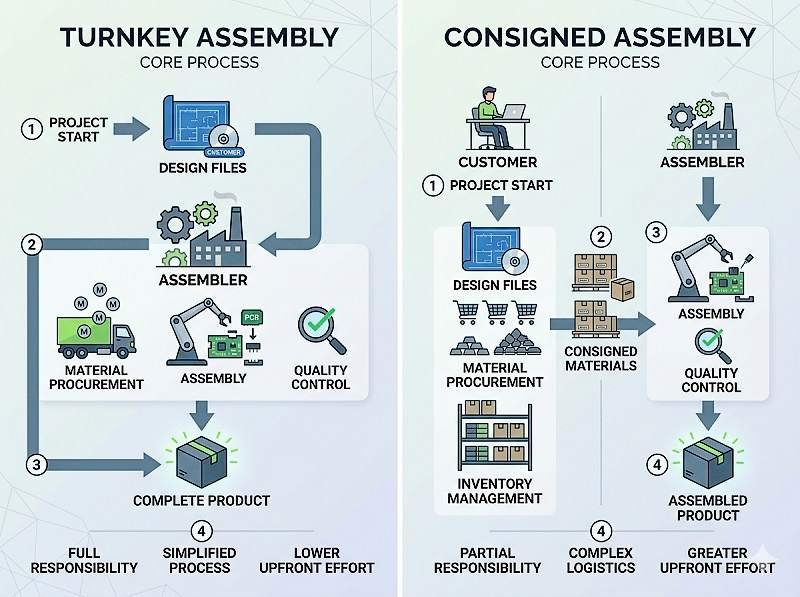
What is Turnkey PCB Assembly?
턴키 PCB 어셈블리 is a full-service solution where the manufacturer handles the entire process, including:
- PCB 제조 (fabrication of bare boards)
- Component sourcing (procurement of all electronic parts)
- SMT 어셈블리 and through-hole assembly
- Testing, inspection, and final delivery
In this model, the customer only needs to provide design files such as Gerber files and BOM (Bill of Materials). Everything else is managed by the supplier.
Key Advantages of Turnkey PCB Assembly
Simplified Process
You work with a single vendor, reducing communication complexity and coordination efforts.
Stronger Supply Chain Control
Manufacturers use verified suppliers, ensuring component quality and authenticity.
Faster Lead Time
Integrated sourcing and production streamline the entire PCB 어셈블리 workflow.
Lower Risk
The manufacturer takes responsibility for sourcing, quality, and logistics.
What is Consigned Assembly?
Consigned assembly (also called customer-supplied assembly) means the customer provides some or all of the components, while the manufacturer focuses on SMT 어셈블리 and board assembly.
There are two common types:
- Full Consignment – customer supplies all components
- Partial Consignment – customer supplies some components, manufacturer sources the rest
Key Advantages of Consigned Assembly
비용 관리
Customers can leverage their own supply channels or inventory.
Supplier Flexibility
You can choose specific brands or components.
Inventory Utilization
Ideal if you already have components in stock.
Key Differences Between Turnkey and Consigned Assembly
Responsibility
- Turnkey: Manufacturer handles everything
- Consigned: Customer manages component sourcing
Supply Chain Management
- Turnkey: Fully controlled by manufacturer
- Consigned: Shared or customer-controlled
Risk Distribution
- Turnkey: Lower risk for customer
- Consigned: Higher responsibility on customer
Production Efficiency
- Turnkey: Typically faster and smoother
- Consigned: May face delays if components are missing or incorrect
품질 관리
- Turnkey: Better consistency due to controlled sourcing
- Consigned: Depends on quality of supplied components
Which Option is Better?
The choice depends on your project needs:
Choose Turnkey PCB Assembly if:
- You want a hassle-free, one-stop solution
- You lack a reliable component sourcing network
- You need fast turnaround and consistent quality
- You prefer reduced risk in PCB 제조
Choose Consigned Assembly if:
- You already have components in stock
- You have strong sourcing capabilities
- You need strict control over specific parts
- You want to reduce upfront component costs
Hybrid Model: The Best of Both Worlds
Many companies choose a hybrid approach in 턴키 PCB 어셈블리, combining both models:
- Critical or expensive components are customer-supplied
- Standard parts are sourced by the manufacturer
This balances cost control with supply chain reliability and is widely used in modern SMT 어셈블리 프로젝트.
결론
The difference between 턴키 PCB 어셈블리 and consigned assembly lies in who manages component sourcing and supply chain responsibilities. Turnkey offers convenience, efficiency, and lower risk, while consigned assembly provides flexibility and cost control.
Choosing the right model for your PCB 어셈블리 그리고 PCB 제조 project depends on your resources, timeline, and level of supply chain expertise. In many cases, a hybrid solution can deliver the best overall results.
PCB 어셈블리 비용을 알고 싶으신가요? 지금 자세한 견적을 요청하세요.
당사는 SMT, DIP 및 전체 턴키 솔루션을 포함한 전문 PCB 조립 서비스를 제공합니다.
NDA 가능 ✔ 24시간 이내 빠른 견적 ✔ ISO 인증 공장 ✔ 원스톱 PCB 및 PCBA 서비스

 한국어
한국어  English
  Deutsch
  Français
  Português do Brasil
  Español
  日本語
日本語  Nederlands
  Italiano
  Русский
  العربية
  Svenska
  Polski
  Türkçe
  繁體中文
繁體中文