
Customs Clearance Process
그리고 customs clearance process is the official procedure required for importing or exporting goods across international borders. In the PCB 어셈블리 그리고 SMT 어셈블리 industry, customs clearance is an important part of global logistics because electronic products, components, and finished PCBAs are frequently shipped between countries.
Customs clearance ensures that shipments comply with local laws, taxes, duties, safety regulations, and import/export requirements before they can enter or leave a country.
Why Customs Clearance is Important in PCB Assembly
International PCB Assembly shipments often include:
- Bare PCBs
- SMT Assembly products
- 전자 부품
- Finished electronic devices
- Prototype hardware
Without proper customs clearance:
- Shipments may be delayed
- Additional fees may occur
- Goods can be held or rejected by customs authorities
👉 Efficient customs handling is essential for smooth international PCB Assembly delivery.
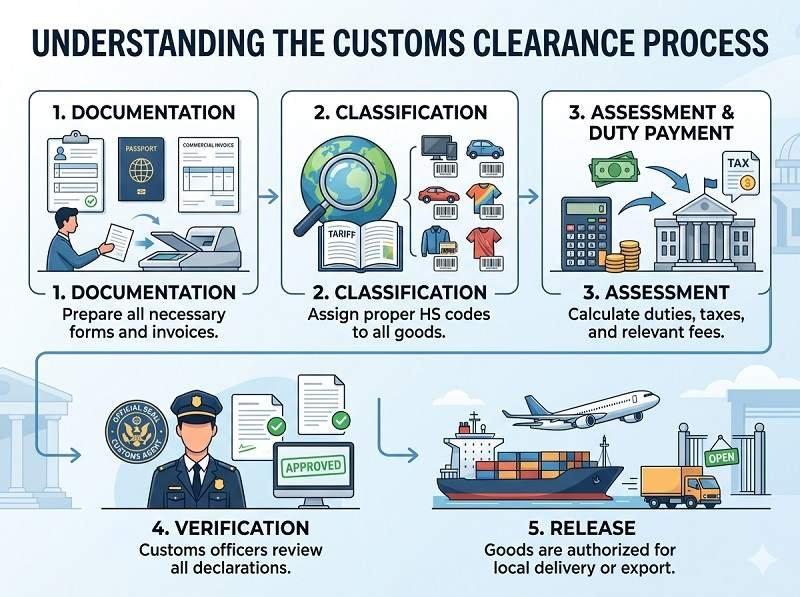
Overview of the Customs Clearance Process
The customs clearance process generally includes:
- Shipping documentation preparation
- Customs declaration submission
- Duties and tax assessment
- Customs inspection (if required)
- Approval and release of goods
- Final delivery
Each step must be completed accurately to avoid delays.
Shipping Documentation Preparation
Before shipment, the exporter prepares necessary documents, such as:
- Commercial invoice
- Packing list
- Air waybill or bill of lading
- HS code classification
- Certificate of origin (if required)
For PCB Assembly shipments, accurate product descriptions are extremely important.
Customs Declaration
The shipment information is submitted electronically or manually to customs authorities.
This includes:
- Product type
- Quantity
- Declared value
- Country of origin
- Importer/exporter information
Incorrect declarations can cause customs delays or penalties.
HS Codes for PCB Assembly Products
Customs authorities use HS (Harmonized System) codes to classify goods.
PCB Assembly products may use different HS codes depending on:
- Bare PCB
- Populated PCBA
- Finished electronic equipment
- 전자 부품
👉 Correct HS code classification helps avoid customs problems and incorrect tax charges.
Duties and Taxes Assessment
Customs calculates applicable charges, such as:
- Import duties
- VAT/GST
- Handling fees
- Anti-dumping duties (in some countries)
The amount depends on:
- Product category
- Shipment value
- Destination country
- Trade agreements
Customs Inspection
Some shipments may be selected for inspection.
Customs officers may verify:
- Product description
- Quantity and value
- Compliance documentation
- Safety regulations
PCB Assembly products containing batteries or wireless modules may receive additional scrutiny.
Customs Release
Once customs approves the shipment:
- Duties/taxes are paid
- Goods are released
- The courier or freight company continues delivery
👉 This completes the customs clearance process.
DDP vs DAP in Customs Clearance
DDP (Delivered Duty Paid)
The PCB Assembly supplier handles:
- Customs clearance
- Duties and taxes
- Import procedures
DAP (Delivered at Place)
The buyer handles:
- Import duties
- VAT
- Customs clearance after arrival
👉 Many PCB 어셈블리 customers prefer DDP because it simplifies international shipping.
Common Customs Challenges in PCB Assembly
Incorrect Product Description
Vague terms like “electronics” can cause delays.
Better examples:
- PCB Assembly module
- SMT control board
- Industrial PCBA
Incorrect HS Code
Wrong classification may lead to:
- Higher taxes
- Shipment holds
- Customs penalties
Undervalued Shipments
Declaring unrealistically low values may trigger inspections.
Missing Documentation
Incomplete invoices or packing lists often delay customs clearance.
How to Speed Up Customs Clearance
To reduce delays:
- Use accurate commercial invoices
- Provide correct HS codes
- Clearly describe PCB Assembly products
- Choose experienced logistics partners
- Use DDP shipping when possible
Customs Clearance for Prototype vs Mass Production
프로토타입 PCB 어셈블리
- Usually shipped by express couriers (DHL/FedEx/UPS)
- Faster customs processing
Mass Production Orders
- Often shipped by air cargo or sea freight
- More detailed customs procedures may apply
Role of Freight Forwarders and Couriers
Professional logistics providers help manage:
- Customs declarations
- Import/export documentation
- Tax payments
- Clearance coordination
This is especially useful for international SMT 어셈블리 프로젝트.
Why Proper Customs Clearance Matters
Efficient customs handling helps:
- Avoid shipping delays
- Reduce storage fees
- Improve delivery reliability
- Ensure legal compliance
- Protect supply chain stability
결론
The customs clearance process is a critical part of international PCB 어셈블리 그리고 SMT 어셈블리 logistics. It involves preparing shipping documents, declaring goods, paying duties and taxes, and obtaining customs approval before products can enter a country.
With accurate documentation and professional logistics support, PCB Assembly manufacturers and customers can ensure fast, compliant, and efficient international delivery.
파일을 업로드하고 자세한 견적을 받아보세요. 시작하려면 아래를 클릭하세요.
당사는 SMT, DIP 및 전체 턴키 솔루션을 포함한 전문 PCB 조립 서비스를 제공합니다.
NDA 가능 ✔ 24시간 이내 빠른 견적 ✔ ISO 인증 공장 ✔ 원스톱 PCB 및 PCBA 서비스
 한국어
한국어  English
  Deutsch
  Français
  Português do Brasil
  Español
  日本語
日本語  Nederlands
  Italiano
  Русский
  العربية
  Svenska
  Polski
  Türkçe
  繁體中文
繁體中文