
Export Gerber Files from Altium Designer
Exporting Gerber files from Altium Designer is a key step in preparing your design for Produzione di PCB e Assemblaggio di PCB. These files ensure your board layout is correctly translated into fabrication data for Assemblaggio SMT e Assemblaggio di PCB chiavi in mano.
Below is a step-by-step guide to exporting Gerber files properly.
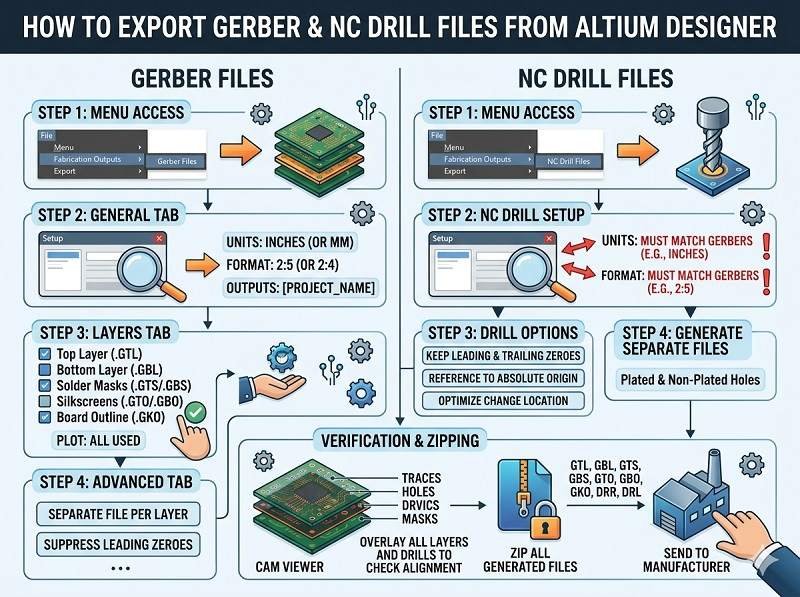
Step 1: Open Your PCB Project
Start by opening your completed PCB layout file (.PcbDoc) in Altium Designer.
Before exporting, make sure your design is finalized and has passed all design rule checks (DRC). This helps prevent errors during PCB Manufacturing.
Step 2: Open the Gerber Export Tool
Go to the top menu:
File → Fabrication Outputs → Gerber Files
This will open the Gerber setup window where you can configure export settings.
Step 3: Configure General Settings
In the “General” tab:
- Set Units (millimeters or inches, mm is recommended)
- Scegliere Format (e.g., 2:5 or 2:6 precision)
- Select RS-274X format (industry standard)
- Enable Embedded apertures
These settings ensure compatibility with most Produzione di PCB processi.
Step 4: Select Layers to Export
Switch to the “Layers” tab and select all required layers.
Typical layers include:
- Top Layer (Top Copper)
- Bottom Layer (Bottom Copper)
- Internal Layers (for multilayer PCBs)
- Top Solder Mask
- Bottom Solder Mask
- Top Silkscreen (Overlay)
- Bottom Silkscreen
- Board Outline (Mechanical Layer)
Selecting the correct layers is critical for accurate Assemblaggio di PCB and fabrication.
Step 5: Configure Apertures and Advanced Settings
In the “Apertures” tab:
- Utilizzo Embedded apertures (RS-274X)
In advanced settings:
- Enable Plot Layers in correct order
- Mirror settings only if required (usually off for standard exports)
Step 6: Generate Gerber Files
Click OK to generate the Gerber files.
Altium will output a set of files, each representing a PCB layer. These files will be saved in your project’s output folder.
Step 7: Export NC Drill Files
Gerber files alone are not enough—you also need drill data.
Go to:
File → Fabrication Outputs → NC Drill Files
Configure:
- Units (same as Gerber)
- Format (match Gerber precision)
Export the drill file, which defines hole locations and sizes for Produzione di PCB.
Step 8: Verify Gerber Files
Before sending files for Assemblaggio di PCB, always verify them using a Gerber viewer (Altium has a built-in viewer or you can use third-party tools).
Check for:
- Missing layers
- Alignment issues
- Correct board outline
- Proper pad and mask openings
This step helps avoid costly errors in Assemblaggio SMT e produzione.
Step 9: Prepare for Turnkey PCB Assembly
Per Assemblaggio di PCB chiavi in mano, you will need to provide:
- File Gerber
- File di foratura NC
- Distinta base (Bill of Materials)
- Pick and place (centroid) file
- Disegni di montaggio
A complete file package ensures smooth coordination between PCB Manufacturing and assembly.
Common Mistakes to Avoid
- Exporting in outdated Gerber formats (always use RS-274X)
- Forgetting solder mask or silkscreen layers
- Mismatched units between Gerber and drill files
- Missing board outline
- Not verifying files before submission
Avoiding these mistakes ensures a smoother manufacturing process.
Conclusione
Exporting Gerber files from Altium Designer is a straightforward but critical step in PCB production. By correctly configuring settings, selecting the right layers, and verifying outputs, you can ensure high-quality results in Produzione di PCB, Assemblaggio SMT, e Assemblaggio di PCB chiavi in mano.
A well-prepared Gerber package minimizes errors, reduces delays, and helps deliver reliable electronic products.
Ottenete una consulenza esperta e prezzi accurati in un solo passaggio. Richiedete oggi stesso il vostro preventivo.
Forniamo servizi professionali di assemblaggio di PCB, tra cui SMT, DIP e soluzioni complete chiavi in mano.
✔ NDA disponibile ✔ Preventivo veloce entro 24 ore ✔ Fabbrica certificata ISO ✔ Servizio unico per PCB e PCBA




 Italiano
  English
  Deutsch
  Français
  Português do Brasil
  Español
  日本語
日本語  Nederlands
  Русский
  한국어
한국어  العربية
  Svenska
  Polski
  Türkçe
  繁體中文
繁體中文