
Réapplication du revêtement
Oui, Revêtement conforme peut être réappliqué sur une carte de circuit imprimé, et c'est une pratique courante dans le secteur de la construction. Assemblage du circuit imprimé et Assemblage SMT lorsque des réparations, des retouches ou des défauts de revêtement se produisent. Toutefois, la réussite de la réapplication dépend de la bonne préparation de la surface et de la compatibilité avec le revêtement d'origine.
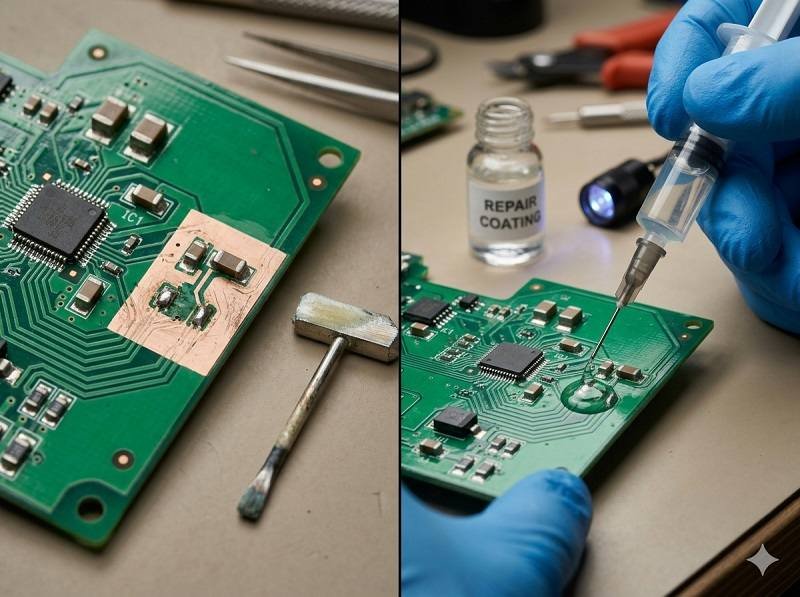
Quand une nouvelle application est nécessaire
L'application d'un nouveau revêtement est fréquente dans les cas suivants Assemblage de circuits imprimés clés en main dans les conditions suivantes :
- Après réparation ou remplacement de composants
- Lorsque le revêtement d'origine est endommagé (fissures, décollement, rayures)
- S'il y a des défauts de revêtement tels que des bulles ou une couverture inégale
- à la suite de changements ou de modifications techniques
Exigence clé avant de présenter une nouvelle demande
L'étape la plus critique est préparation de la surface:
- Retirer les éléments endommagés ou anciens Revêtement conforme dans la zone affectée
- Nettoyer la surface pour éliminer les résidus, la poussière et les contaminants.
- S'assurer que la carte de circuit imprimé est complètement sèche
Sans un nettoyage adéquat, le nouveau revêtement risque de ne pas bien adhérer, ce qui entraînera des défaillances ultérieures.
Considérations sur la compatibilité
- Idéalement, il faut réappliquer le même type de revêtement (acrylique, silicone, uréthane, etc.)
- Certains revêtements adhèrent bien à eux-mêmes (par exemple, les acryliques).
- D'autres peuvent nécessiter un enlèvement complet avant le recouvrement (par exemple, époxy ou parylène).
En Assemblage SMT, L'utilisation de matériaux compatibles garantit une forte adhérence et une protection uniforme.
Méthodes de réapplication
Les méthodes les plus courantes sont les suivantes :
- Revêtement au pinceau → convient aux petites surfaces de réparation
- Revêtement par pulvérisation → assure une couverture plus uniforme
- Revêtement sélectif → automatisé et précis pour les environnements de production
La méthode doit correspondre au processus original utilisé dans les Assemblage du circuit imprimé aussi proche que possible.
Durcissement après réapplication
Après l'application du nouveau revêtement :
- Permettre un durcissement approprié (séchage à l'air, à la chaleur ou aux UV selon le matériau)
- Respecter les spécifications du fabricant en ce qui concerne la durée et la température.
- Éviter toute manipulation avant le durcissement complet
Un durcissement adéquat garantit la durabilité et la performance.
Inspection après recouvrement
Une fois le produit durci, inspecter le circuit imprimé :
- Utiliser l'inspection UV pour vérifier la couverture
- Vérifier qu'il n'y a pas de bulles, de lacunes ou de surcouche.
- Vérifier l'épaisseur et l'adhérence
L'inspection est essentielle pour Assemblage de circuits imprimés clés en main de maintenir des normes de qualité.
Limites et risques
- Mauvaise adhérence si la surface n'est pas correctement nettoyée
- Incompatibilité entre les anciens et les nouveaux revêtements
- Epaisseur irrégulière si le recouvrement n'est pas contrôlé
- Difficultés liées à la multiplicité des cycles de reprise
Pour minimiser les risques, la réapplication doit être soumise à des contrôles de processus stricts.
Conclusion
Oui, Revêtement conforme peut être réappliqué efficacement, à condition que la surface soit correctement préparée et que des matériaux compatibles soient utilisés. Dans le cas d'une Assemblage du circuit imprimé, Assemblage SMT, et Assemblage de circuits imprimés clés en main, Le revêtement soigneux permet de restaurer la protection, de prolonger la durée de vie du produit et de maintenir une grande fiabilité.
Obtenir un devis pour un revêtement conforme
Vous souhaitez optimiser le coût du revêtement sans compromettre la qualité ? Contactez-nous dès maintenant.
Envoyez-nous vos exigences et obtenez une réponse rapide de notre équipe d'ingénieurs.
✔ Réponse dans les 24 heures ✔ Soutien technique ✔ Production en petite et grande série
Shenzhen Tengxinjie Electronics Co. Ltd.
 Français
  English
  Deutsch
  Português do Brasil
  Español
  日本語
日本語  Nederlands
  Italiano
  Русский
  한국어
한국어  العربية
  Svenska
  Polski
  Türkçe
  繁體中文
繁體中文