
Is Selective Soldering Used For
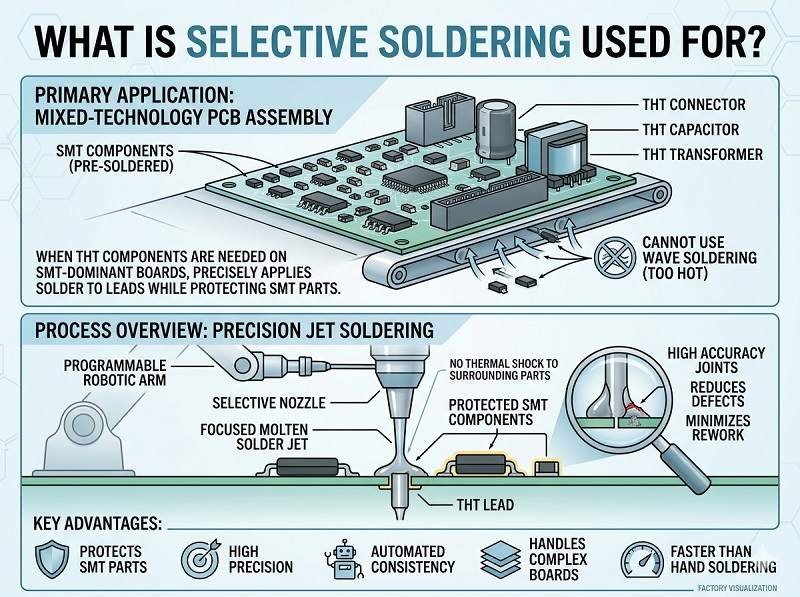
Selective soldering is a specialized soldering process used in Montaje de PCB to solder specific through-hole components on a board without affecting surrounding areas. It is commonly applied in mixed-technology boards where both surface-mount and through-hole components are present.
This method is widely used in Montaje SMT environments and advanced Montaje de PCB llave en mano projects where precision and control are required.
Why Selective Soldering Is Needed
En moderno Fabricación de PCB, most components are placed using SMT processes. However, certain components—such as connectors, transformers, and large capacitors—still require through-hole mounting.
Traditional wave soldering can expose the entire board to molten solder, which may damage sensitive SMT components. Selective soldering solves this problem by targeting only specific areas.
Main Uses of Selective Soldering
Selective soldering is used in several key scenarios.
Mixed Technology PCBs
When a PCB contains both SMT and through-hole components, selective soldering is used after reflow to solder only the through-hole parts.
Protecting Sensitive Components
It prevents heat or solder exposure to sensitive SMT components already mounted on the board.
Complex PCB Designs
For high-density or complex layouts, selective soldering provides better control than wave soldering.
Low to Medium Volume Production
It is suitable for flexible production environments where different PCB designs are processed in Montaje de PCB llave en mano.
Cómo funciona la soldadura selectiva
The process typically involves several controlled steps.
Flux is applied only to the target soldering areas.
The PCB is preheated to prepare for soldering.
A mini solder wave or soldering nozzle selectively applies molten solder to specific joints.
Each joint is soldered individually or in small groups with high precision.
This controlled approach ensures high-quality results in Montaje de PCB.
Ventajas de la soldadura selectiva
Selective soldering offers several benefits.
High precision with minimal impact on surrounding components.
Reduced risk of solder bridging and defects.
Better thermal control compared to wave soldering.
Ideal for complex and high-reliability Montaje SMT proyectos.
Improved flexibility in Montaje de PCB llave en mano.
Limitations of Selective Soldering
Despite its advantages, there are some limitations.
Slower than wave soldering for large volumes.
Higher equipment and programming costs.
Requires careful process setup and optimization.
Soldadura selectiva frente a soldadura por ola
Selective soldering targets specific areas, while wave soldering processes the entire board.
Selective soldering is more precise and suitable for mixed assemblies.
Wave soldering is faster and better for high-volume through-hole production.
Role in SMT Assembly
En Montaje SMT, selective soldering is typically used after reflow soldering.
Once SMT components are soldered, selective soldering is applied to complete the through-hole connections without disturbing existing joints.
Role in Turnkey PCB Assembly
En Montaje de PCB llave en mano, selective soldering is an essential step for handling complex boards.
It ensures that both SMT and through-hole components are assembled efficiently while maintaining high quality and reliability.
Conclusión
Selective soldering is a critical process in modern electronics manufacturing, especially for mixed-technology PCBs. It provides precise, controlled soldering of through-hole components without affecting sensitive SMT parts.
En Montaje de PCB, Montaje SMT, y Montaje de PCB llave en mano, selective soldering plays a key role in achieving high-quality results for complex and high-reliability products.
Obtenga asesoramiento experto y precios precisos en un solo paso. Solicite su presupuesto hoy mismo.
Ofrecemos servicios profesionales de ensamblaje de placas de circuito impreso, incluyendo SMT, DIP y soluciones completas llave en mano.
✔ NDA disponible ✔ Presupuesto rápido en 24 horas ✔ Fábrica certificada ISO ✔ Servicio integral de PCB y PCBA.
 Español
  English
  Deutsch
  Français
  Português do Brasil
  日本語
日本語  Nederlands
  Italiano
  Русский
  한국어
한국어  العربية
  Svenska
  Polski
  Türkçe
  繁體中文
繁體中文