
Handle defective boards
Handling defective boards is a critical part of maintaining quality and reliability in Montaje de PCB, Montaje SMT, y Montaje de PCB llave en mano. A professional Fabricación de PCB partner follows a structured and transparent process to identify, isolate, analyze, and resolve defects while preventing recurrence.
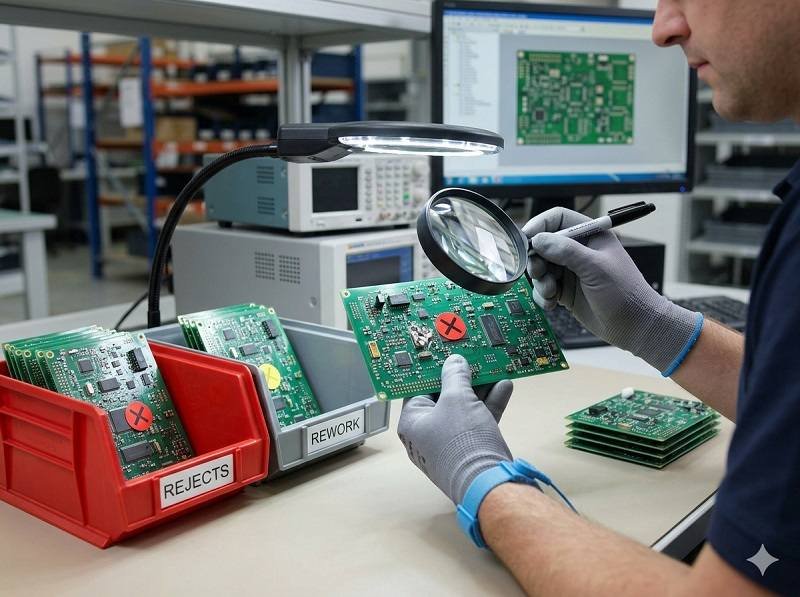
Immediate identification and isolation
Once a defect is detected—whether during AOI, X-ray, ICT, or functional testing—the affected boards are immediately:
- Marked and labeled as non-conforming
- Removed from the production line
- Segregated in a controlled area
This prevents defective units from moving forward in the Montaje SMT or shipping process.
Defect classification
Not all defects are the same. Each issue is categorized to determine the appropriate action.
Common classifications include:
- Soldering defects (bridging, cold joints, insufficient solder)
- Component issues (wrong part, polarity error, damage)
- Process defects (misalignment, tombstoning)
- Design-related issues (DFM/DFT problems)
Accurate classification helps streamline the recovery process in Montaje de PCB.
Root Cause Analysis (RCA)
Before any correction is made, engineers perform a detailed Root Cause Analysis.
This involves:
- Reviewing production data and machine logs
- Analyzing inspection and test results
- Checking component batches and supplier records
- Evaluating process parameters (e.g., reflow profile)
RCA ensures that the real cause—not just the symptom—is addressed within the Fabricación de PCB workflow.
Rework and repair process
If the defective board is recoverable, controlled rework procedures are applied.
Typical rework actions include:
- Removing and replacing faulty components
- Re-soldering defective joints
- Cleaning and restoring PCB surfaces
All rework follows IPC standards (such as IPC-7711/7721) to ensure that repaired boards meet the same quality requirements as original Montaje SMT outputs.
Retesting after rework
After repair, boards must pass the same inspection and testing procedures again:
- AOI or visual inspection
- ICT or flying probe testing
- Functional testing (FCT)
Only boards that fully pass all tests are approved to continue in the Montaje de PCB llave en mano proceso.
Scrap management (if non-repairable)
If a board cannot be repaired or does not meet quality standards after rework:
- It is officially classified as scrap
- Removed from production records
- Properly disposed of according to environmental regulations
This ensures that no substandard products enter the final delivery stage of Montaje de PCB.
Corrective and preventive actions (CAPA)
To prevent recurrence, corrective and preventive actions are implemented.
These may include:
- Adjusting SMT machine parameters
- Updating solder paste or stencil design
- Improving operator training
- Changing or requalifying component suppliers
CAPA is a key part of continuous improvement in Fabricación de PCB.
Documentation and traceability
Every defective case is documented for traceability and quality analysis.
Records typically include:
- Defect type and location
- Affected batch or lot number
- Root cause findings
- Rework actions taken
- Final disposition (repaired or scrapped)
This data supports long-term quality improvement in Montaje SMT y Montaje de PCB.
Customer communication
Transparency is essential, especially in Montaje de PCB llave en mano.
Customers are typically informed about:
- Major defects and their impact
- Corrective actions taken
- Delivery timeline adjustments (if any)
Detailed reports can also be provided upon request.
Continuous quality improvement
Handling defective boards is not just about fixing issues—it is about improving the entire process.
Manufacturers continuously:
- Monitor defect trends
- Optimize production processes
- Upgrade equipment and inspection systems
- Refine quality standards
This reduces future defect rates and enhances overall Fabricación de PCB rendimiento.
Conclusión
Defective boards are handled through a structured process that includes identification, isolation, root cause analysis, controlled rework, and preventive action.
En el ámbito profesional Montaje de PCB, Montaje SMT, y Montaje de PCB llave en mano, this approach ensures that only fully qualified products are delivered while continuously improving quality and reliability.
Cargue sus archivos y reciba un presupuesto detallado. Haga clic abajo para empezar.
Ofrecemos servicios profesionales de ensamblaje de placas de circuito impreso, incluyendo SMT, DIP y soluciones completas llave en mano.
✔ NDA disponible ✔ Presupuesto rápido en 24 horas ✔ Fábrica certificada ISO ✔ Servicio integral de PCB y PCBA.
 Español
  English
  Deutsch
  Français
  Português do Brasil
  日本語
日本語  Nederlands
  Italiano
  Русский
  한국어
한국어  العربية
  Svenska
  Polski
  Türkçe
  繁體中文
繁體中文