
Proceso de reelaboración de revestimientos conformados
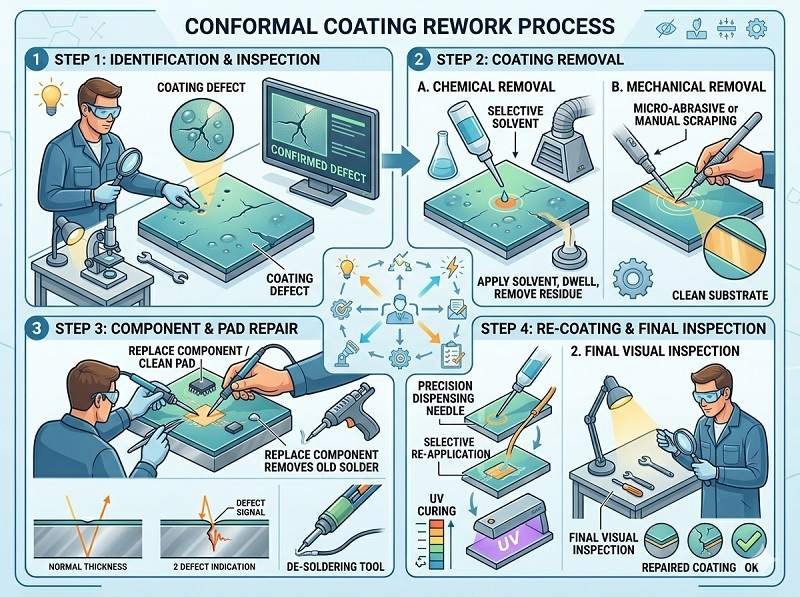
El proceso de reelaboración del revestimiento de conformación se refiere a la eliminación, reparación y reaplicación controlada de Revestimiento conforme en una placa de circuito impreso cuando se requieren defectos, cambios de diseño o sustituciones de componentes. Es un paso importante en Montaje de PCB y Montaje SMT, garantizando que las placas puedan corregirse sin comprometer la fiabilidad.
Por qué es necesario volver a trabajar
Puede ser necesario realizar trabajos de reparación en Montaje de PCB llave en mano por varias razones:
- Defectos del revestimiento (burbujas, huecos, grosor desigual)
- Contaminación atrapada bajo el revestimiento
- Enmascaramiento o recubrimiento incorrecto de los conectores
- Reparación o sustitución de componentes
- Cambios de ingeniería o actualizaciones de diseño
Sin una reparación adecuada, estos problemas podrían provocar fallos funcionales o reducir la vida útil.
Pasos de la reelaboración del revestimiento de conformación
Identificación del revestimiento
En primer lugar, identifique el tipo de Revestimiento conforme utilizados (acrílico, silicona, uretano, epoxi o parileno), ya que cada uno requiere un método de retirada diferente.
Eliminación del revestimiento
Las técnicas comunes de eliminación incluyen:
- Eliminación de disolventes → disuelve los revestimientos acrílicos
- Eliminación mecánica → raspado o microabrasión
- Métodos térmicos → reblandecimiento del revestimiento con calor
- Decapado químico → Se utiliza para revestimientos más resistentes como el epoxi.
El método debe elegirse cuidadosamente para evitar dañar componentes o trazas durante Montaje de PCB reparación.
Limpieza de la placa de circuito impreso
Después de quitarlo:
- Limpiar los residuos con disolventes adecuados
- Asegurarse de que la superficie está libre de contaminantes
- Secar completamente el tablero antes de seguir procesándolo
Una limpieza adecuada es fundamental antes de volver a recubrir en Montaje SMT.
Reparación o sustitución
Realizar las acciones necesarias, tales como:
- Sustitución de componentes defectuosos
- Fijación de soldaduras
- Modificación de las zonas del circuito
Este paso sigue los procedimientos de reparación estándar en Montaje de PCB llave en mano.
Reaplicación del revestimiento
Una vez terminadas las reparaciones:
- Vuelva a aplicar Revestimiento conforme mediante pincel, pulverización o recubrimiento selectivo
- Garantizar el enmascaramiento adecuado de las zonas sin revestimiento
- Mantener el grosor y la cobertura correctos
Curado e inspección final
Por fin:
- Curar el revestimiento (secado al aire, calor o UV según el material).
- Inspección mediante métodos UV o AOI
- Verificar la cobertura, la adherencia y el grosor
Retos de la reelaboración
- Riesgo de dañar componentes sensibles
- Dificultad para eliminar determinados revestimientos (por ejemplo, epoxi o parileno).
- Mantenimiento de una calidad de revestimiento constante tras el repaso
- Costes de tiempo y mano de obra
Debido a estos retos, la repetición de trabajos debe reducirse al mínimo mediante un control adecuado del proceso en Montaje de PCB.
Buenas prácticas
- Siempre que sea posible, utilice revestimientos que faciliten la reparación (por ejemplo, acrílicos).
- Diseño para la accesibilidad en la disposición de PCB
- Aplique el enmascaramiento adecuado durante el recubrimiento inicial
- Formar a los técnicos en técnicas de retirada seguras
Conclusión
El proceso de reelaboración del revestimiento de conformación es esencial para corregir defectos y permitir reparaciones en Montaje de PCB, Montaje SMT, y Montaje de PCB llave en mano. Al retirar, reparar y volver a aplicar cuidadosamente el revestimiento, los fabricantes pueden mantener la calidad del producto al tiempo que reducen los residuos y los costes.
Obtenga un presupuesto de revestimiento de conformación
Reduzca los riesgos de fallo de las placas de circuito impreso con un revestimiento de conformación profesional. Solicite un presupuesto ahora.
Envíenos sus requisitos y obtenga una respuesta rápida de nuestro equipo de ingenieros.
✔ Respuesta en 24 horas ✔ Soporte de ingeniería ✔ Producción en serie y a pequeña escala
Shenzhen Tengxinjie Electronics Co.
 Español
  English
  Deutsch
  Français
  Português do Brasil
  日本語
日本語  Nederlands
  Italiano
  Русский
  한국어
한국어  العربية
  Svenska
  Polski
  Türkçe
  繁體中文
繁體中文