
Ist Wellenlöten
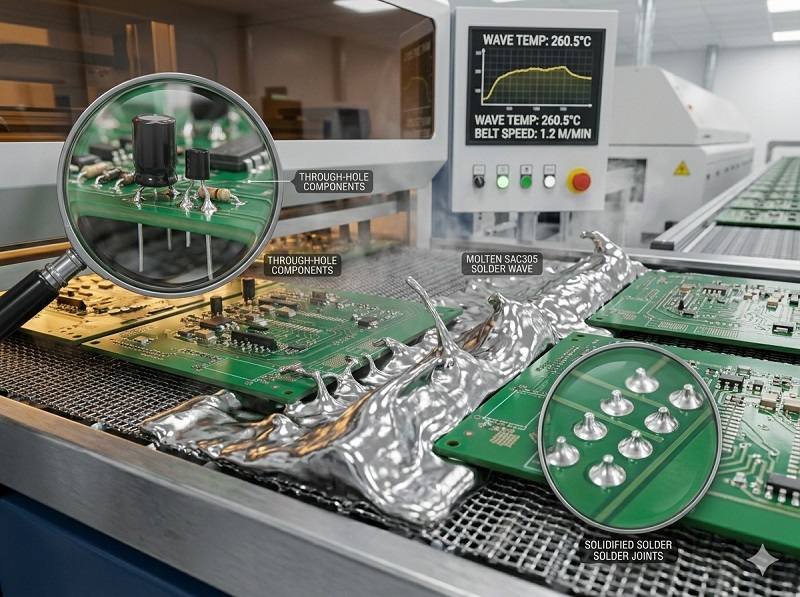
Wellenlöten ist ein Massenlötverfahren, das bei PCB-Montage zum Anbringen elektronischer Bauteile - vor allem durchkontaktierter Bauteile - auf einer Leiterplatte. Bei diesem Verfahren wird die Unterseite der Leiterplatte über eine Welle aus geschmolzenem Lot geführt, die starke und zuverlässige Verbindungen zwischen den Bauteilanschlüssen und den Leiterplattenpads herstellt.
Das Wellenlöten ist in der traditionellen Elektronikfertigung weit verbreitet und wird oft kombiniert mit SMT-Bestückung in Leiterplatten mit gemischter Technologie, die sowohl oberflächenmontierte als auch durchkontaktierte Komponenten enthalten.
Wie das Wellenlöten funktioniert
Der Wellenlötprozess umfasst mehrere wichtige Schritte.
Zunächst werden die Bauteile entweder manuell oder mit Hilfe von automatischen Bestückungsautomaten in die Leiterplatte eingesetzt. Dabei handelt es sich in der Regel um Bauteile mit Durchgangsbohrungen, deren Leitungen durch die Leiterplatte verlaufen.
Anschließend wird die Leiterplatte gereinigt und Flussmittel auf die Unterseite aufgetragen. Das Flussmittel entfernt die Oxidation und bereitet die Metalloberflächen für das richtige Löten vor.
Anschließend wird die Platine in einer Vorwärmphase schrittweise erhitzt, um das Flussmittel zu aktivieren und den Temperaturschock zu verringern.
Nach dem Vorheizen läuft die Leiterplatte über eine Welle aus geschmolzenem Lot. Während sich die Leiterplatte über die Welle bewegt, haftet das Lot an den freiliegenden Metallbereichen und bildet Verbindungen zwischen den Bauteilanschlüssen und den Leiterplattenpads.
Abschließend wird die Platine abgekühlt, damit das Lot fest wird und dauerhafte elektrische Verbindungen entstehen.
Arten des Wellenlötens
Bei der Leiterplattenbestückung werden verschiedene Wellenkonfigurationen verwendet.
Beim Einzelwellenlöten wird nur eine Lötwelle verwendet, was für einfachere Konstruktionen geeignet ist.
Beim Zwei-Wellen-Löten werden zwei Wellen verwendet - eine turbulente Welle, gefolgt von einer glatten laminaren Welle. Dieser Ansatz verbessert die Lötpenetration und reduziert Defekte, was ihn ideal für komplexere Leiterplatten macht.
Die Rolle des Wellenlötens bei der PCB-Bestückung
Das Wellenlöten ist für die Leiterplattenbestückung mit Durchgangslöchern unverzichtbar, da die Bauteile neben den elektrischen Verbindungen auch starke mechanische Verbindungen benötigen.
Während SMT-Bestückung in der modernen Elektronik dominiert, bleibt das Wellenlöten wichtig für Steckverbinder, Transformatoren und andere Komponenten, die nicht oberflächenmontiert werden können.
In vielen Fällen verwenden die Hersteller eine Kombination aus Reflow-Löten für SMT-Bauteile und Wellenlöten für Durchsteckbauteile, insbesondere bei gemischten PCB-Bestückungsprozessen.
Wellenlöten im PCB-Herstellungsprozess
Das Wellenlöten erfolgt in der Regel nach der SMT-Bestückung, wenn beide Technologien auf derselben Leiterplatte verwendet werden. SMT-Bauteile werden zunächst im Reflow-Verfahren platziert und gelötet, dann werden Durchsteckbauteile hinzugefügt und im Wellenverfahren gelötet.
Durch diese Integration wird sichergestellt, dass das Endprodukt sowohl eine kompakte Bauweise als auch mechanische Festigkeit aufweist.
Unter Schlüsselfertige PCB-Montage, Der Hersteller steuert sowohl die SMT-Bestückung als auch die Wellenlötprozesse, um Kompatibilität und Effizienz in der Produktion zu gewährleisten.
Vorteile des Wellenlötens
Wellenlöten bietet mehrere Vorteile.
Sie ermöglicht das gleichzeitige Löten mehrerer Lötstellen und ist daher für die Massenproduktion sehr effizient.
Es bietet starke und zuverlässige Verbindungen, insbesondere für durchkontaktierte Bauteile, die mechanisch haltbar sein müssen.
Es ist kosteneffizient für die Produktion mittlerer bis hoher Stückzahlen und gewährleistet bei entsprechender Kontrolle eine gleichbleibende Qualität.
Herausforderungen beim Wellenlöten
Trotz seiner Vorteile bringt das Wellenlöten auch Herausforderungen mit sich.
Die Designvorgaben sind wichtig, denn das Leiterplattenlayout muss die Lötwelle aufnehmen und Defekte wie Überbrückungen oder Abschattungen verhindern.
Thermische Belastungen können empfindliche Bauteile beeinträchtigen, wenn der Prozess nicht sorgfältig kontrolliert wird.
Auch Flussmittelrückstände und Reinigungsanforderungen müssen berücksichtigt werden, um die Produktqualität zu erhalten.
Bewährte Praktiken für das Wellenlöten
Um optimale Ergebnisse zu erzielen, sollten die Hersteller bewährte Verfahren anwenden.
Achten Sie auf ein ordnungsgemäßes PCB-Design mit angemessenen Abständen und Ausrichtungen der Komponenten.
Verwenden Sie die richtige Art und Menge an Flussmittel, um die Lötqualität zu verbessern.
Optimieren Sie die Vorwärmung und die Löttemperatur, um Defekte zu vermeiden.
Regelmäßige Wartung der Geräte, um eine gleichbleibende Leistung der Lötwellen zu gewährleisten.
Arbeiten Sie mit erfahrenen PCB-Bestückern zusammen, die sich sowohl mit der SMT-Bestückung als auch mit Durchsteckprozessen auskennen.
Schlussfolgerung
Das Wellenlöten ist ein wichtiger Prozess bei der Leiterplattenbestückung, insbesondere bei durchkontaktierten Bauteilen und Leiterplatten mit gemischter Technologie. Es ergänzt die SMT-Montage und spielt eine wichtige Rolle bei der Herstellung langlebiger und zuverlässiger elektronischer Produkte.
Integriert in die PCB-Fertigung und die schlüsselfertige PCB-Bestückung trägt das Wellenlöten dazu bei, eine effiziente Produktion, gleichbleibende Qualität und starke mechanische Verbindungen in einer Vielzahl von Anwendungen zu gewährleisten.
Von der Entwurfsprüfung bis zur Lieferung - wir unterstützen jeden Schritt. Fordern Sie Ihr Angebot für die Leiterplattenbestückung an.
Wir bieten professionelle PCB-Bestückungsdienstleistungen, einschließlich SMT, DIP und schlüsselfertige Lösungen.
✔ NDA verfügbar ✔ Schnelles Angebot innerhalb von 24 Stunden ✔ ISO-zertifizierte Fabrik ✔ PCB & PCBA Service aus einer Hand

 Deutsch
  English
  Français
  Português do Brasil
  Español
  日本語
日本語  Nederlands
  Italiano
  Русский
  한국어
한국어  العربية
  Svenska
  Polski
  Türkçe
  繁體中文
繁體中文