
Difference Between PCB and PCBA
In the electronics manufacturing industry, the terms PCB und PCBA are frequently used, yet they represent two distinct stages of product development. Understanding the difference between PCB and PCB Assembly (PCBA) is essential for engineers, buyers, and businesses involved in electronic design and production. Whether you are sourcing components or working with a PCB-Montage supplier, knowing how these two concepts differ can help you make better decisions, control costs, and ensure product quality.
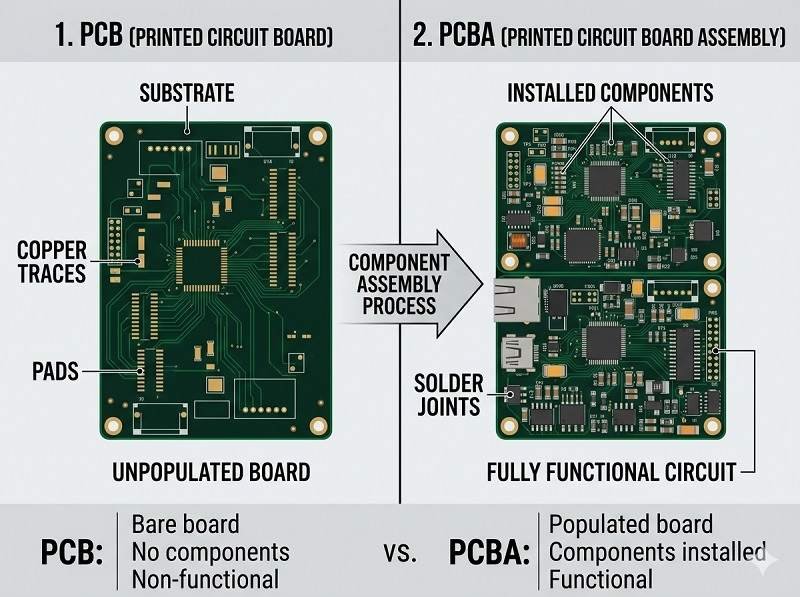
What is a PCB?
A PCB (Printed Circuit Board) is the bare board that forms the foundation of any electronic device. It is manufactured using insulating materials such as fiberglass (FR4), combined with conductive copper layers that create electrical pathways.
The PCB is designed using layout software and fabricated through processes such as etching, drilling, plating, and lamination. However, at this stage, the PCB does not include any electronic components and cannot perform any electrical function.
Key characteristics of a PCB include:
- No electronic components installed
- Provides mechanical support for components
- Contains copper traces for electrical connections
- Available in single-layer, double-layer, and multilayer designs
- Can include advanced structures like HDI (High-Density Interconnect)
In simple terms, a PCB is like the “empty platform” or infrastructure on which electronic circuits are built.
What is PCBA (PCB Assembly)?
PCBA (PCB Assembly) refers to the complete process of assembling electronic components onto the PCB, transforming it into a fully functional electronic circuit. This stage is where the real functionality of the product is created.
PCB Assembly involves multiple complex steps, including SMT-Bestückung, soldering, inspection, and testing. Once completed, the PCBA can perform the intended electronic functions and be integrated into end products.
A PCBA typically includes:
- Passive components (resistors, capacitors)
- Active components (ICs, microcontrollers)
- Connectors and mechanical parts
- Solder joints that establish electrical connections
Without PCB Assembly, a PCB remains non-functional. Therefore, PCBA represents the finished and usable form of the circuit board.
PCB Assembly Process Overview
To better understand PCBA, it is important to look at the full PCB Assembly workflow:
Lötpaste drucken
A stencil is used to apply solder paste onto the PCB pads where components will be placed.
SMT Assembly (Surface Mount Technology)
SMT Assembly is the most widely used method in modern PCB Assembly. Automated machines place components directly onto the PCB surface with high speed and precision. This process supports miniaturization and high-density designs.
Reflow-Löten
The PCB passes through a reflow oven where solder paste melts and solidifies, forming reliable electrical connections.
Through-Hole Assembly (THT)
For components requiring stronger mechanical support, leads are inserted into holes and soldered using wave soldering or manual techniques.
Inspection and Testing
Quality control processes such as AOI (Automated Optical Inspection), X-ray inspection, ICT (In-Circuit Testing), and functional testing ensure the reliability of the final PCBA.
Key Differences Between PCB and PCBA
Although PCB and PCBA are closely related, they differ significantly in several aspects:
Functionality
- PCB: Non-functional, no active circuit
- PCBA: Fully functional and operational
Components
- PCB: No components mounted
- PCBA: Includes all required electronic components
Manufacturing Stage
- PCB: Initial stage (fabrication only)
- PCBA: Final stage (assembly and testing)
Process Complexity
- PCB: Focuses on material processing and board creation
- PCBA: Involves PCB Assembly, SMT Assembly, soldering, and testing
Cost Structure
- PCB: Lower cost due to absence of components
- PCBA: Higher cost including components, labor, and testing
Application Readiness
- PCB: Cannot be used directly in products
- PCBA: Ready for integration into electronic devices
PCB vs PCBA in the Supply Chain
In a typical electronics manufacturing workflow:
- PCB design is completed using CAD tools
- PCB fabrication is carried out by a PCB manufacturer
- Components are sourced based on the BOM (Bill of Materials)
- PCB Assembly and SMT Assembly are performed
- The finished PCBA is tested and shipped for product integration
This clearly shows that PCB is just one part of the process, while PCBA represents the near-final product ready for use.
Why Understanding PCB vs PCBA Matters
For businesses and engineers, distinguishing between PCB and PCBA is critical:
Accurate Purchasing Decisions
Ordering a PCB is very different from ordering a full PCB Assembly service. Miscommunication can lead to delays and increased costs.
Better Cost Control
Understanding the difference helps break down costs between board fabrication and assembly.
Improved Product Quality
PCBA involves strict quality control processes that are not part of PCB fabrication.
Efficient Project Management
Knowing each stage helps streamline production timelines and coordination with suppliers.
Applications of PCB and PCBA
Both PCB and PCBA are essential in modern electronics, but they serve different roles:
- PCB is used as the base platform in all electronic designs
- PCBA is used in finished products such as smartphones, automotive systems, medical devices, industrial equipment, and IoT products
Without PCB Assembly and SMT Assembly, modern electronic devices would not be possible.
Schlussfolgerung
The difference between PCB and PCBA lies in functionality and manufacturing stage. A PCB is a bare board that provides structure and electrical pathways, while PCBA (PCB Assembly) is the completed board with all components assembled and ready to function.
In summary, PCB is the foundation, and PCBA is the finished product. Understanding this distinction is essential for anyone involved in electronics manufacturing, especially when working with PCB Assembly and SMT Assembly services.
Benötigen Sie ein schnelles und genaues Angebot für die Leiterplattenbestückung? Senden Sie Ihre Anfrage in Sekundenschnelle.
Wir bieten professionelle PCB-Bestückungsdienstleistungen, einschließlich SMT, DIP und schlüsselfertige Lösungen.
✔ NDA verfügbar ✔ Schnelles Angebot innerhalb von 24 Stunden ✔ ISO-zertifizierte Fabrik ✔ PCB & PCBA Service aus einer Hand
 Deutsch
  English
  Français
  Português do Brasil
  Español
  日本語
日本語  Nederlands
  Italiano
  Русский
  한국어
한국어  العربية
  Svenska
  Polski
  Türkçe
  繁體中文
繁體中文