
Nachbearbeitungsprozess für konforme Beschichtung
Der Prozess der Nachbesserung konformer Beschichtungen bezieht sich auf das kontrollierte Entfernen, Reparieren und Wiederauftragen von Konforme Beschichtung auf einer Leiterplatte, wenn Defekte, Designänderungen oder der Austausch von Komponenten erforderlich sind. Dies ist ein wichtiger Schritt bei PCB-Montage und SMT-Bestückung, Dadurch wird sichergestellt, dass die Leiterplatten ohne Beeinträchtigung der Zuverlässigkeit korrigiert werden können.
Warum Nacharbeit notwendig ist
Nacharbeit kann erforderlich sein in Schlüsselfertige PCB-Montage aus mehreren Gründen:
- Beschichtungsfehler (Blasen, Hohlräume, ungleichmäßige Dicke)
- Unter der Beschichtung eingeschlossene Verunreinigungen
- Falsches Abkleben oder Überlackieren von Steckern
- Reparatur oder Ersatz von Bauteilen
- Technische Änderungen oder Design-Updates
Ohne ordnungsgemäße Nacharbeit können diese Probleme zu Funktionsstörungen oder einer verkürzten Lebensdauer führen.
Schritte bei der Nacharbeit von konformen Beschichtungen
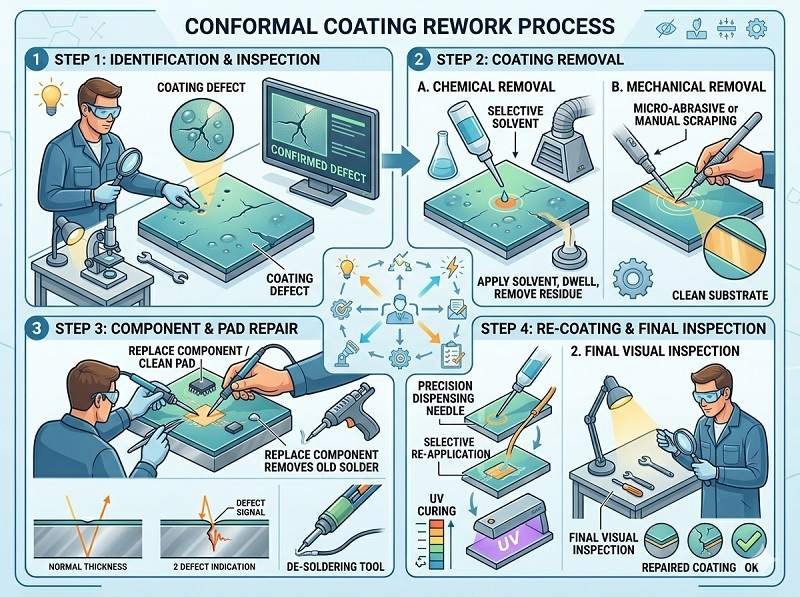
Identifizierung der Beschichtung
Bestimmen Sie zunächst die Art der Konforme Beschichtung (Acryl-, Silikon-, Urethan-, Epoxid- oder Parylenklebstoffe), da für jeden Klebstoff eine andere Entfernungsmethode erforderlich ist.
Entfernung der Beschichtung
Zu den üblichen Entfernungsmethoden gehören:
- Entfernung von Lösungsmitteln → löst Acrylbeschichtungen auf
- Mechanische Entfernung → Schaben oder Mikroabrasion
- Thermische Methoden → Erweichung der Beschichtung durch Hitze
- Chemisches Abbeizen → verwendet für härtere Beschichtungen wie Epoxid
Die Methode muss sorgfältig gewählt werden, um eine Beschädigung von Bauteilen oder Leiterbahnen während des PCB-Montage Reparatur.
Reinigung der Leiterplatte
Nach dem Entfernen:
- Rückstände mit geeigneten Lösungsmitteln reinigen
- Sicherstellen, dass die Oberfläche frei von Verunreinigungen ist
- Trocknen Sie die Platte vor der weiteren Bearbeitung vollständig.
Eine ordnungsgemäße Reinigung ist vor der erneuten Beschichtung mit SMT-Bestückung.
Reparatur oder Ersatz
Führen Sie die erforderlichen Maßnahmen durch, z. B:
- Austausch defekter Komponenten
- Befestigen von Lötstellen
- Ändern von Schaltkreisbereichen
Dieser Schritt folgt den Standardreparaturverfahren in Schlüsselfertige PCB-Montage.
Erneutes Auftragen der Beschichtung
Sobald die Reparaturen abgeschlossen sind:
- Erneut beantragen Konforme Beschichtung mit Pinsel, Spray oder selektiver Beschichtung
- Sicherstellen einer ordnungsgemäßen Maskierung der nicht beschichteten Bereiche
- Beibehaltung der richtigen Dicke und Abdeckung
Aushärtung und Endkontrolle
Endlich:
- Aushärten der Beschichtung (Lufttrocknung, Hitze oder UV, je nach Material)
- Prüfen Sie mit UV- oder AOI-Methoden
- Abdeckung, Haftung und Dicke prüfen
Herausforderungen bei der Nacharbeit
- Gefahr der Beschädigung empfindlicher Komponenten
- Schwierigkeiten bei der Entfernung bestimmter Beschichtungen (z. B. Epoxid oder Parylen)
- Aufrechterhaltung einer gleichbleibenden Beschichtungsqualität nach der Nacharbeit
- Zeit- und Arbeitskosten
Aufgrund dieser Herausforderungen sollte die Nacharbeit durch eine angemessene Prozesssteuerung in PCB-Montage.
Bewährte Praktiken
- Verwenden Sie nach Möglichkeit nacharbeitsfreundliche Beschichtungen (z. B. Acryl)
- Design für Barrierefreiheit im PCB-Layout
- Angemessene Abdeckungen bei der Erstbeschichtung
- Schulung von Technikern in sicheren Entfernungstechniken
Schlussfolgerung
Der Prozess der Nacharbeit für konforme Beschichtungen ist von entscheidender Bedeutung für die Korrektur von Fehlern und die Ermöglichung von Reparaturen in PCB-Montage, SMT-Bestückung, und Schlüsselfertige PCB-Montage. Durch sorgfältiges Entfernen, Reparieren und Wiederauftragen der Beschichtung können die Hersteller die Produktqualität erhalten und gleichzeitig Abfall und Kosten reduzieren.
Angebot für Conformal Coating einholen
Verringern Sie das Risiko von Leiterplattenausfällen mit professioneller Schutzlackierung. Fordern Sie jetzt ein Angebot an.
Senden Sie uns Ihre Anforderungen und erhalten Sie eine schnelle Antwort von unserem technischen Team.
✔ 24-Stunden-Reaktion ✔ Technische Unterstützung ✔ Klein- und Massenproduktion
Shenzhen Tengxinjie Electronics Co, Ltd.
 Deutsch
  English
  Français
  Português do Brasil
  Español
  日本語
日本語  Nederlands
  Italiano
  Русский
  한국어
한국어  العربية
  Svenska
  Polski
  Türkçe
  繁體中文
繁體中文