
Provide lifecycle management
Yes, professional PCB Assembly providers offer comprehensive component lifecycle management as part of their value-added services. Lifecycle management is essential for maintaining long-term product stability, reducing supply chain risks, and ensuring smooth transitions from Prototype PCB Assembly to full-scale SMT Assembly and PCB Manufacturing.
In today’s fast-changing electronics market, components frequently move through different lifecycle stages—from introduction to obsolescence. Without proper management, this can lead to unexpected redesigns, production delays, or increased costs.
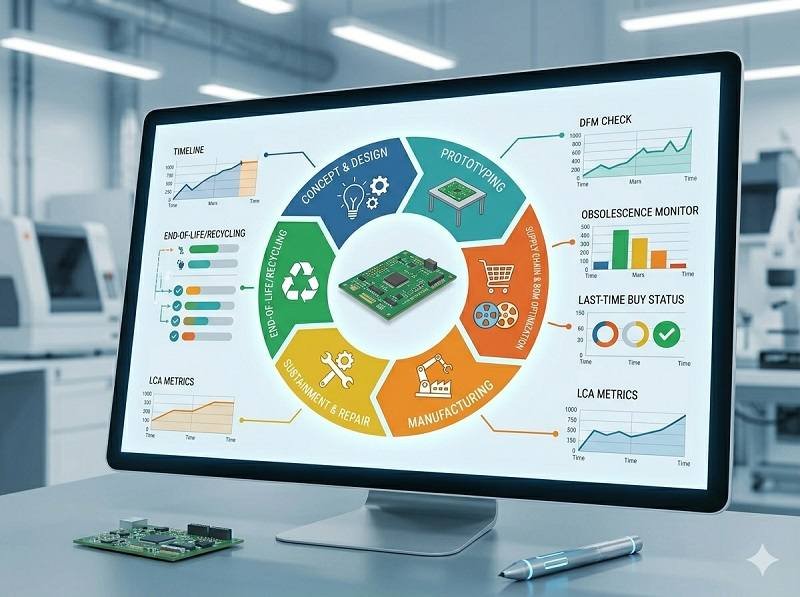
What is component lifecycle management?
Component lifecycle management is the process of monitoring and controlling the status of electronic components throughout their lifespan. It ensures that all parts used in PCB Assembly remain available, compliant, and suitable for long-term production.
Typical lifecycle stages include:
- Active – Fully supported and recommended
- NRND (Not Recommended for New Design) – Still available but nearing phase-out
- EOL (End of Life) – Production discontinued
- Obsolete – No longer available in the market
Understanding these stages is critical in both Prototype PCB Assembly and ongoing PCB Manufacturing.
Key lifecycle management services
Lifecycle monitoring and risk analysis
Manufacturers continuously monitor component databases and supplier updates to track lifecycle status. This allows early identification of risks such as:
- Components approaching EOL
- Supply shortages
- Long lead times
This proactive approach helps avoid disruptions in SMT Assembly production.
BOM lifecycle assessment
As part of BOM optimization, each component is evaluated for lifecycle risk:
- Highlighting high-risk or obsolete parts
- Recommending long-life alternatives
- Ensuring multi-source availability
This ensures that your PCB Assembly project is built on a stable and sustainable component base.
Alternative component planning
For critical components, engineers prepare approved alternatives in advance. This enables:
- Fast substitution during shortages
- Reduced redesign effort
- Continuous production in PCB Manufacturing
Alternative planning is especially valuable in high-volume SMT Assembly environments.
Last-time buy (LTB) strategy
When a component is approaching EOL, manufacturers can assist with last-time buy planning:
- Forecasting future demand
- Securing sufficient inventory
- Managing storage and usage
This ensures uninterrupted production without immediate redesign.
Lifecycle management in Prototype PCB Assembly
Lifecycle considerations are equally important in Prototype PCB Assembly, even at early stages:
- Avoid selecting near-EOL components
- Design with long-term availability in mind
- Validate alternative components early
This prevents costly redesigns when moving to mass production.
Integration with supply chain and sourcing
Lifecycle management is closely linked with global sourcing strategies:
- Access to multiple suppliers
- Real-time inventory data
- Flexible procurement options
By combining lifecycle insights with sourcing capabilities, PCB Assembly providers can quickly respond to market changes.
Benefits of lifecycle management
Implementing lifecycle management in PCB Manufacturing offers several advantages:
- Reduced risk of production interruptions
- Lower long-term costs
- Improved product reliability
- Better planning for product longevity
- Smooth transition from prototype to mass production
These benefits are critical for industries with long product lifecycles, such as industrial, automotive, and medical electronics.
Digital tools and data support
Advanced manufacturers use digital tools and databases to support lifecycle management:
- Component lifecycle databases
- Supply chain analytics platforms
- Automated alerts for status changes
These systems provide real-time insights that improve decision-making in PCB Assembly projects.
When lifecycle management is most important
Lifecycle management is particularly important when:
- Products have long market lifespans
- Certification requirements limit design changes
- Components are highly specialized
- Production volumes are high
In such cases, proactive lifecycle planning is essential for maintaining stable SMT Assembly operations.
Conclusion
Yes, lifecycle management is a key service provided by modern PCB Assembly partners. By monitoring component status, planning alternatives, and aligning sourcing strategies, manufacturers ensure long-term stability and reliability in PCB Manufacturing.
From early-stage Prototype PCB Assembly to high-volume SMT Assembly, lifecycle management helps you avoid obsolescence risks, reduce costs, and maintain a consistent supply chain—keeping your product competitive and production-ready for the long term.
Get expert advice and accurate pricing in one step. Request your quote today.
We provide professional PCB assembly services including SMT, DIP, and full turnkey solutions.
✔ NDA Available ✔ Fast Quotation Within 24 Hours ✔ ISO Certified Factory ✔ One-stop PCB & PCBA Service
 English
  Deutsch
  Français
  Português do Brasil
  Español
  日本語
日本語  Nederlands
  Italiano
  Русский
  한국어
한국어  العربية
  Svenska
  Polski
  Türkçe
  繁體中文
繁體中文