
Lead time for PCB assembly
The lead time for PCB Assembly refers to the total time required from order confirmation to finished product delivery. It includes multiple stages such as PCB Manufacturing, component sourcing, and SMT Assembly, and can vary significantly depending on project complexity, quantity, and supply chain conditions.
Understanding lead time is essential for planning production schedules, especially for time-sensitive projects.
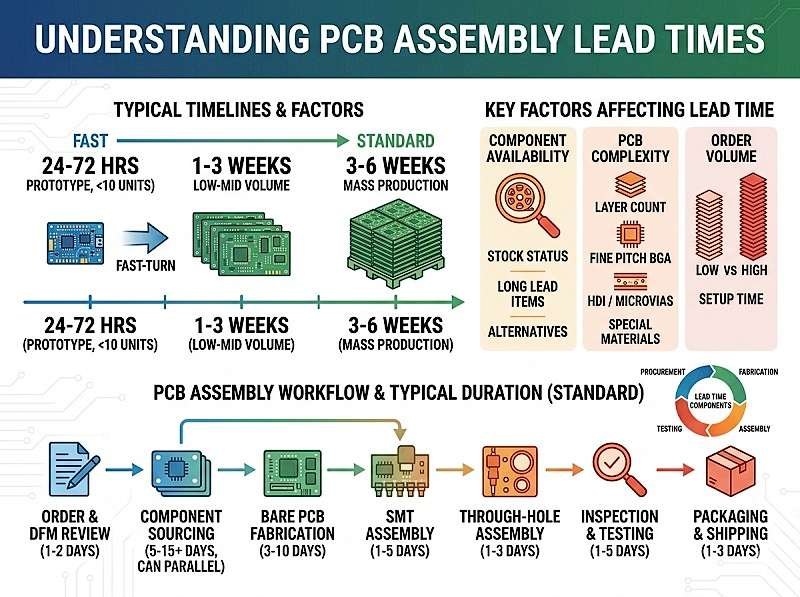
Typical PCB assembly lead time
The standard lead time for PCB Assembly usually falls into the following ranges:
- Prototype PCB Assembly: 3 to 7 days
- Small to medium batch production: 1 to 3 weeks
- Mass production: 3 to 6+ weeks
If you choose turnkey services (including PCB Manufacturing and component sourcing), the lead time may be slightly longer due to procurement time.
Breakdown of the assembly timeline
The total lead time is composed of several stages.
PCB fabrication typically takes 2 to 7 days depending on board complexity (layers, materials, surface finish). This is the first step in PCB Manufacturing.
Component sourcing can take anywhere from 1 day to several weeks. If all parts are in stock, this step is fast. However, shortages or long lead-time components can significantly delay PCB Assembly.
SMT assembly itself is relatively fast. For most projects, SMT Assembly can be completed within 1 to 3 days once materials are ready.
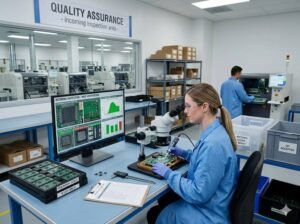
Testing and inspection (AOI, X-ray, functional testing) may add 1 to 3 days depending on requirements.
Factors that affect PCB assembly lead time
Several key factors influence how long your PCB Assembly will take.
Component availability is the biggest factor. Even if PCB Manufacturing is fast, missing components can delay the entire process.
Board complexity also matters. Multilayer boards, HDI designs, or boards requiring special materials take longer to fabricate and assemble.
Order quantity affects scheduling. Large-volume orders require more production time, while Prototype PCB Assembly is usually prioritized for speed.
Assembly type is another factor. Double-sided SMT Assembly, mixed technology (SMT + through-hole), or special processes like conformal coating will increase lead time.
Turnkey vs consigned assembly lead time
In turnkey PCB Assembly, the manufacturer handles everything, including PCB Manufacturing and component sourcing. This simplifies logistics but may increase lead time due to procurement.
In consigned assembly (customer supplies components), lead time can be shorter if all parts are ready, but it requires more coordination.
How to reduce PCB assembly lead time
There are several ways to shorten your project timeline.
Using standard components and avoiding hard-to-source parts helps prevent delays in SMT Assembly.
Providing complete and accurate files (Gerber, BOM, pick-and-place) reduces engineering review time in PCB Assembly.
Choosing quick-turn PCB Manufacturing services can significantly speed up the process.
Planning ahead and confirming component availability early is one of the most effective ways to avoid delays.
Rush and quick-turn services
Many manufacturers offer expedited services for urgent projects.
- 24–48 hour Prototype PCB Assembly (in some cases)
- Same-day or next-day PCB Manufacturing for simple boards
- Priority SMT Assembly scheduling
These services come at a higher cost but are useful for tight deadlines.
Conclusion
The lead time for PCB Assembly typically ranges from a few days for prototypes to several weeks for large-scale production. It depends on factors such as PCB Manufacturing complexity, component sourcing, and SMT Assembly requirements.
By optimizing design, ensuring component availability, and working with an experienced manufacturer, you can significantly reduce lead time and keep your project on schedule.
Looking for a reliable PCB assembly solution? Click below to request your quote now.
We provide professional PCB assembly services including SMT, DIP, and full turnkey solutions.
✔ NDA Available ✔ Fast Quotation Within 24 Hours ✔ ISO Certified Factory ✔ One-stop PCB & PCBA Service
 English
  Deutsch
  Français
  Português do Brasil
  Español
  日本語
日本語  Nederlands
  Italiano
  Русский
  한국어
한국어  العربية
  Svenska
  Polski
  Türkçe
  繁體中文
繁體中文